








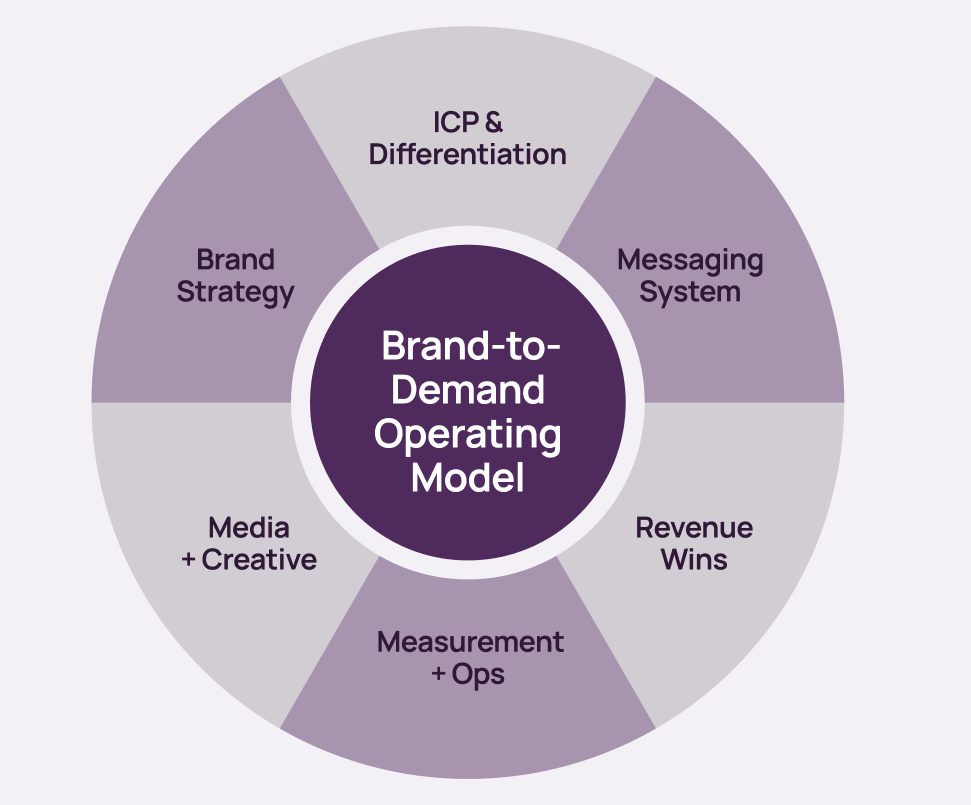
A modern brand marketing strategy does more than generate attention. It becomes a brand to demand operating model that determines who buying groups trust enough to evaluate and how quickly deals progress. The B2B leaders of 2026 integrate paid media, design, and storytelling to build authority, create demand, and turn brand perception into measurable revenue outcomes that appear in dashboards weekly and board reports quarterly. Strong brands raise pricing power, reduce perceived risk, and accelerate decision making by combining emotion with evidence. This playbook gives marketing executives a single system to align creative, media, and measurement so every investment supports pipeline growth.
Set the North Star: a brand-to-demand model tied to pipeline
Pipeline is the destination. Channels, assets, and campaigns are simply the routes that support it. Brand shapes the earliest stages of the buying journey by influencing who a buyer considers and whether they feel confident proceeding. As AI generated content becomes more common and less reliable, trust signals, consistency, and governance become essential, ensuring the promise used in ads is fully delivered in every sales conversation.
Define revenue outcomes and measurement architecture
Measurement frameworks should prove how marketing influences real commercial performance. Focus on two or three primary revenue KPIs such as pipeline created, win rate lift, and ACV expansion. Leading brand indicators such as share of search and brand lift show whether confidence is growing upstream.
According to Forrester’s 2026 B2B Marketing, Sales, and Product Predictions, 19 percent of B2B buyers who use generative AI feel less confident in the information they find, which increases the urgency of verified proof.
Example: A cybersecurity provider saw demos convert, but deals stalled due to trust concerns. By placing dated customer outcomes and independent certifications above the fold on demo pages, demo to SQL conversion improved 10 percent within one quarter. Sales teams also reported fewer credibility objections during early calls.
Formula:
Pipeline per 1,000 impressions (PPMI) = (Pipeline dollars attributed ÷ Impressions) × 1,000
Following the fundamentals in marketing principles for saas brands helps executives anchor KPIs in board level outcomes instead of surface metrics.
Owner: CMO + RevOps
Pitfall: Celebrating MQL volume instead of measurable revenue impact
Audience, entry points, and brand perception baselines
Buying groups include economic buyers, technical validators, and daily users whose trust criteria differ. Before activating spend, identify category entry points and quantify what each group currently believes versus what they need to believe to move forward.
As highlighted in The 2025 State of B2B Pipeline Growth from Pipeline360, longer cycles and tighter budgets mean alignment around revenue outcomes is no longer optional.
Example: A compliance platform discovered economic buyers believed the UI was strong but doubted risk reduction benefits. By moving analyst quotes and certification proof into the first viewport, enterprise demo requests rose 22 percent as confidence increased early.
Teams can use guidance from brand identity vs. brand image to understand what is controlled internally versus shaped by the market.
Metric:
Perception gap score = current belief percentage vs. target percentage
Pitfall: Ignoring legal and procurement stakeholders until late in evaluation
Positioning and differentiation that buyers believe
Positioning must clearly state what makes the brand uniquely valuable and why buyers should trust the claims. Every message should be supported by timely evidence.
Based on Forrester’s 2026 predictions, brands that lack verifiable proof risk destroying significant enterprise value due to AI driven misinformation and distrust.
Example: A workflow automation vendor replaced a vague “automation for everyone” message with a verifiable result: “Eliminate manual approvals in under 30 days,” backed by recent customer data. Opportunity creation increased 14 percent and sales cycles shortened because expectations were clear and credible.
Teams can stand out by applying the principles from how to get your b2b saas brand discovered which help create distinctiveness buyers instantly recognize.
Metric:
Percent of Tier 1 assets containing at least two dated customer proofs
Pitfall: Parity messaging that mirrors competitors
The 2026 B2B brand marketing strategy Steps Playbook
This nine step system gives teams a practical path to relaunch positioning, build creative systems, activate paid media, and report outcomes clearly.
Owners, artifacts, and timing
A modern relaunch should run in 12 to 16 weeks with ongoing quarterly refinements.
As explained in Performance Marketing: Unifying Brand and Demand for Pipeline Growth from Demand Gen Report, aligning brand and demand motions under one operating plan drives more consistent outcomes.
Example: A cloud governance startup conducted messaging audits in weeks 1 to 2, finalized positioning by week 5, completed a creative system in week 9, and activated media by week 10. By week 13, target account pipeline increased 18 percent because the entire journey reinforced one clear narrative.
Owner: Program Manager (RevOps)
Pitfall: Designing visual assets before validating messaging
Channel and budget guardrails for 2026
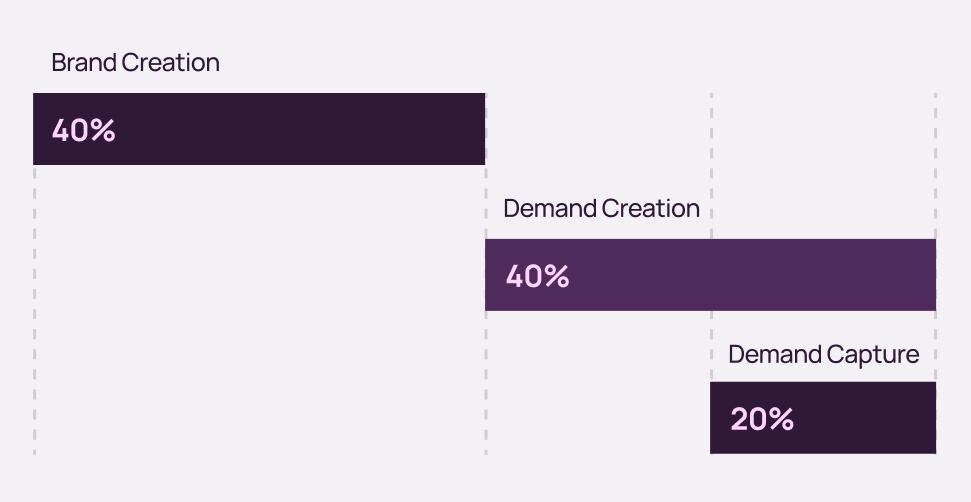
Effective budgets fund all stages of the buying journey. Start with 40 percent brand creation, 40 percent demand creation, and 20 percent capture. Adjust based on lift and pipeline gains.
New Path Digital’s 2025 paid media guidance emphasizes that privacy rules will require greater reliance on first party data and contextual signals.
Example: A data platform rebalanced from search heavy investment to include video and review syndication. Assisted pipeline increased 27 percent and search CPL improved as familiarity grew earlier in the journey.
Teams that protect upper funnel investment are applying practices reinforced in 10 necessities for your b2b marketing strategy which help leaders avoid starving tomorrow’s demand.
Metric: Share of search and pipeline contribution by channel
Pitfall: Allocating spend based solely on last click attribution
Measurement plan: MTA + MMM + lift studies
Short cycle reporting via MTA reveals which lower funnel channels accelerate purchase. MMM and controlled experiments quantify upper funnel influence and future demand creation.
According to Forrester’s B2B forecast, transparent data governance will determine which organizations can justify brand investment moving forward.
Example: A security vendor launched quarterly geo holdouts for paid video. Exposed markets achieved 11 percent higher SQL creation while unexposed markets stagnated. These results supported continued brand storytelling investment during procurement slowdowns.
Metric: Incremental pipeline and CAC payback by channel
Pitfall: Assuming correlation equals causation
Common pitfalls and QA checklist
Every update must be reflected across the full buyer experience to prevent message dilution.
Example: An accounting SaaS brand updated the website but not sales materials. Prospects entered sales calls confused. After adding proof modules to the sales deck, close rates improved 9 percent because the narrative carried through.
Owner: Brand Operations
Pitfall: Launching creative without aligning internal tools and assets
Engineer paid media to build authority and create demand
Paid media increases confidence and triggers progress. Experiments reveal which messages turn interest into action.
Targeting in a privacy first world
Build consent based audiences using CRM lists and contextual relevance for scale.
New Path Digital’s 2025 guidance predicts contextual and first party signals will outperform third party data as cookies fade.
Example: A DevOps product activated CRM based audiences and engineering publisher video placements. Influenced opportunities increased 15 percent and sales saw fewer credibility concerns due to stronger early familiarity.
Metric: Match rate and cost per incremental engaged account
Pitfall: Over dependence on lookalikes with limited signal
Channel mix and budget allocation
Invest where buyers learn, compare, and validate. Use video for story, search for verification, and review ecosystems to eliminate doubt.
Pipeline360’s research emphasizes investing in channels with proven paths to revenue contribution.
Example: A data analytics company used a three step video system representing category POV, solution clarity, and case proof. Accounts that saw all three converted to demo at a 28 percent higher rate.
Guidance from why every b2b brand needs a creative strategy supports building authority and intent together instead of treating them separately.
Metric: Assisted pipeline share and share of search trend
Pitfall: Ignoring high attention formats
Creative formats and experimentation
Creative execution is the largest performance lever in paid media. Proof is what accelerates belief.
Forrester notes that human expert voices outperform generic or AI styled messaging when confidence is at stake.
Example: A cloud technology provider replaced stock visuals with employee and customer proof clips showing measurable outcomes. Ad recall rose 31 percent and SQLs increased because the story felt real.
Metric: Ad recall, qualified CTR, and pipeline influenced by exposure
Pitfall: Static only creative that ignores mobile first consumption
Proving incrementality with lift and holdouts
Incrementality testing demonstrates what changes due to exposure, not coincidence.
Demand Gen Report shows that unifying brand and demand messaging strengthens lift performance.
Example: A logistics SaaS company conducted 20 percent holdouts to measure impact of video exposure. Exposed markets produced 12 percent more SQLs and progressed faster through early stages, making attribution clear to finance stakeholders.
Metric: Incremental lift and incremental pipeline impact
Pitfall: Treating platform reported conversions as full truth
Design and storytelling that differentiate and move deals
Storytelling must remain consistent from first touch to signed contract. Consistency multiplies trust.
Messaging pillars and brand story
Lead with the results customers experience. Support those outcomes with three or four evidence backed value pillars.
Forrester emphasizes that confidence increases when claims are paired with recent and verifiable customer results.
Example: A fintech platform created an ROI calculator aligned to proof-based messaging. SQL rates increased 21 percent as expectations became more grounded in real outcomes.
Teams ensure alignment by applying concepts in brand identity vs. brand image to keep expression consistent with market perception.
Metric: Consistency of core message across major conversion assets
Pitfall: Using internal language buyers must translate
Visual identity applied to performance
Performance design focuses on clarity, recognition, and proof visibility.
Adobe highlights that brand consistency across channels helps customers remember and choose the familiar option.
Example: A BI vendor adopted modular templates with proof elements built in. Design cycle time decreased 40 percent and more variant tests launched faster, improving outcomes.
Metric: Creative reuse rate and brand QA success
Pitfall: Low accessibility causing friction for buyers
Content engine for communities and dark social
Influence begins long before the first form fill. Content in communities and peer networks builds familiarity that attribution misses.
Pipeline360 notes that repurposing hero assets extends reach without increasing cost.
Example: An AI insights company turned a webinar into short videos, newsletters, and community posts. That long tail effort drove 19 percent of influenced pipeline that quarter.
Guidance from why every b2b brand needs a creative strategy supports scaling stories into the spaces where buyers naturally learn.
Metric: Engaged accounts influenced and assisted pipeline growth
Pitfall: Creating content that lacks evidence or specificity
Sales enablement that mirrors the brand story
Customers must encounter the same message and proof in both marketing and sales.
Demand Gen Report shows that cohesive messaging accelerates deal progress.
Example: A data quality vendor built a unified ten slide narrative deck grounded in customer outcomes and used it across all frontline conversations. Close rates improved 11 percent as buyers saw continuity instead of contradiction.
Metric: Stage to stage conversion rate and time to close
Pitfall: Sales materials lagging behind the marketing story
Prove impact and govern the system
Brand to demand systems thrive when performance is measured and maintained continuously.
Brand metrics that predict revenue
Leading indicators tell leaders whether buyers are gaining confidence before pipeline shows the result.
Forrester underscores that buyer confidence helps stabilize conversion rates in uncertain markets.
Example: A collaboration software company saw aided awareness rise 2 percent across two quarters and later recorded an 8 percent improvement in demo to SQL rate. Executives saw a clear link between familiarity and pipeline quality.
Metric: Brand health index and correlation with opportunity creation
Pitfall: Measuring impressions instead of belief shifts
Pipeline modeling and ROI
MMM reveals the value of upper funnel investment. MTA clarifies late stage impact. Finance alignment ensures shared confidence.
Pipeline360 research shows top performing organizations keep finance, marketing, and sales aligned on outcome focus.
Example: A payroll platform increased video investment by 15 percent in Q1. MMM demonstrated that exposed markets delivered 9 percent more sourced pipeline the following quarter, unlocking board level support for increasing awareness building efforts.
Metric: Incremental pipeline and CAC payback
Pitfall: Ignoring channel halo effects that influence all funnel stages
Operating cadence and governance
Cross functional governance prevents drift and ensures updates carry across every go to market touchpoint.
According to Brand strategy 101: A marketing pro explains the important elements at HubSpot, consistency and iteration together create strong brand systems.
Example: A productivity SaaS organization implemented monthly media and creative reviews and quarterly brand audits. Asset compliance exceeded 90 percent and update velocity increased as teams shared one source of truth.
Metric: Compliance and update cycle speed
Pitfall: Not documenting changes which causes version confusion
Teams maintain clarity by applying the operational principles outlined in marketing principles for saas brands which reinforce governance as a performance advantage.
Brand is responsible for revenue. A brand to demand operating model gives CEOs, CMOs, and CFOs mutual confidence by tying storytelling to measurable revenue outcomes. The B2B brands that lead in 2026 will create distinctive creative systems grounded in recent proof, activate paid media that builds authority and intent, and report progress in financial terms that protect investment. If you want to accelerate growth with confidence, schedule a working session with our creative brand strategy team to build your 90‑day brand-to-demand plan.