









Key Takeaways
|
B2B shopping is the full digital buying experience businesses use to discover, evaluate, purchase, reorder, and manage commercial relationships online. By 2028, 75% of all B2B deals will close through digital channels. That shift is already reshaping supplier selection: 85% of B2B enterprises now operate and optimize digital storefronts to compete for that volume.
A B2B shopping experience scales when qualified traffic, buyer experience, personalization, revenue operations, and retention work as one system. Teams that treat the portal as a finished project and move on leave compounding revenue on the table.
What Is B2B Shopping, and Why Does It Now Shape Growth?
The mechanics are more complex than consumer ecommerce, and the cost of getting them wrong compounds over time. B2B shopping refers to the commercial process by which businesses discover, evaluate, purchase, and reorder goods or services through digital or assisted channels.
In practice, that means account-specific pricing, multi-user access, approval workflows, and purchase flows that look nothing like consumer retail.
What changed is the strategic weight of that experience. Digital buying has become the primary competitive differentiator in supplier selection — determining which vendors make the shortlist, which orders return, and which accounts expand.
Understanding how this connects to longer-term revenue requires visibility into the full B2B sales cycle, from first discovery through renewal.
B2B Shopping Now Starts Before the Cart
70% of B2B buyers complete more than half of their vendor research independently before ever contacting a sales representative.
The buying experience begins in search results, product pages, and category content long before any transaction. Treating the cart as the beginning of the shopping journey means entering the conversation far too late.
Digital Buying Experience Has Become a Supplier Selection Factor
65% of enterprise buyers say they will actively switch suppliers if they do not receive personalized, context-aware communications. The buying experience is no longer evaluated on price and product specs alone.
Platform responsiveness, self-service clarity, and account-aware interactions are now part of how buyers decide who to trust with their procurement.
Shopping Performance Is a Revenue Problem, Not Just an Ecommerce Problem
A slow portal, broken reorder flow, or mismatched pricing creates friction that shows up in conversion rates, churn, and account contraction. That friction belongs in the same conversation as CAC, LTV, and pipeline efficiency — it is a revenue problem, not a design problem.
Which Pillars Make a B2B Shopping Experience Scale?
Scaling a B2B shopping experience has now become a systems decision. Teams that do this well align five interdependent pillars: qualified acquisition, buyer experience, personalization, revenue operations, and lifecycle marketing. Scale comes from their alignment, not their individual optimization.
| Growth Pillar | What It Changes in the Buying Journey | Key Signal to Track |
| Qualified acquisition | Determines who enters the experience and how prepared they are to buy | Traffic-to-pipeline conversion rate |
| Buyer experience | Reduces friction across complex account workflows and approval structures | Cart abandonment rate, session depth |
| Personalization | Surfaces relevant products, pricing, and content by account and role | Account-specific engagement rate |
| Revenue operations | Connects commerce data to attribution, routing, and reporting | Marketing-to-revenue attribution accuracy |
| Lifecycle marketing | Converts first orders into repeat purchases and account expansion | Reorder rate, net revenue retention |
No single pillar drives scale alone. A highly optimized portal that receives low-intent traffic will produce poor conversion. A lifecycle program running on fragmented data will misfire consistently. Integration across all five is what creates a compounding system.
Qualified Acquisition Feeds the Right Buyers Into the Journey
Bringing unqualified traffic into a B2B shopping experience inflates session counts while suppressing conversion rates. The work of acquisition is matching content, intent, and channel to the specific buyer roles that represent your best-fit accounts — volume without that match is a cost center, not a growth lever.
Buyer Experience Reduces Friction Across Complex Account Flows
B2B accounts are not single buyers. They include procurement managers, approvers, technical evaluators, and finance reviewers who interact with the portal at different stages. An experience that ignores role-level complexity creates friction that never appears in individual session data but destroys pipeline velocity at the account level.
Lifecycle and Operations Turn First Orders Into Durable Revenue
Treat the first purchase as a data event: the signals that drive reorders, surface expansion opportunities, and protect gross retention start accumulating here, before churn risk becomes visible in the numbers.
How Does Search and Demand Generation Influence B2B Shopping Performance?
B2B shopping begins when a buyer types a search query, reads a category comparison, or sees a targeted ad that matches a problem they are actively trying to solve.
Who enters the shopping experience, and how prepared they are to buy, is a direct function of acquisition strategy.
Working with a b2b ecommerce consultant helps teams identify where acquisition strategy and portal performance intersect, and where friction is being introduced before a buyer even arrives.
Search Strategy Determines Whether the Right Accounts Arrive
B2B buying intent is distributed across highly specific, low-volume queries that reflect where buyers are in their evaluation process. A search strategy built around aggregate traffic volume will capture the wrong accounts.
One built around buying intent, technical topic clusters, and ICP-aligned queries surfaces buyers who are further into their evaluation and faster to convert into qualified pipeline.
Performance Creative Helps Buyers Understand Value Faster
Creative assets in B2B shopping work as product imagery that shows operational context, copy that maps to technical buyer language, and proof points calibrated to the buying committee all accelerate the evaluation phase.
When creative and search work together, cost-per-qualified-visit drops without requiring additional traffic volume.
The goal of best b2b ecommerce website design is not visual polish. It is reducing decision friction for a buyer who arrives already 70% through their research.
Content Must Support Both Discovery and Commercial Confidence
Content that reaches buyers early in research shapes the vendor shortlist. Content that meets buyers inside the portal answers the commercial questions that hold up decisions: pricing structures, minimum order requirements, integration specifications, and approval workflows.
Both types of content are part of the shopping experience, and gaps in either create drop-off that looks like a portal problem but originates upstream.
What Makes a B2B Shopping Portal Actually Useful to Buyers?
The structural requirements of a B2B portal differ fundamentally from consumer retail. B2B accounts involve multi-user access, negotiated pricing tiers, approval hierarchies, and reorder behavior across product categories that may span thousands of SKUs.
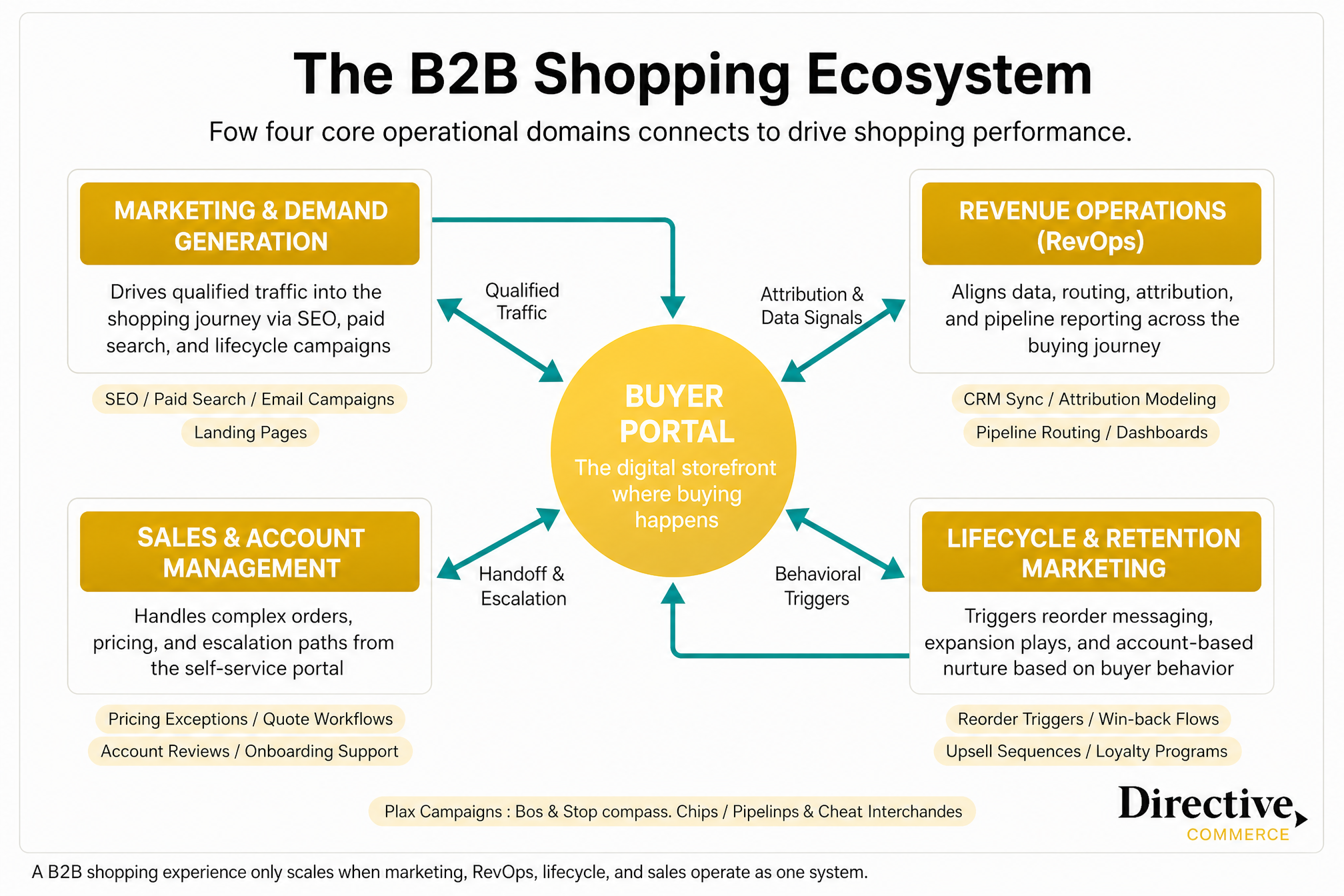
Alt Text (as written in brief): B2B shopping ecosystem linking marketing, buyer portal, revenue operations, and lifecycle programs
Buyers Need Autonomy Without Losing Control or Visibility
According to a Gartner survey published in June 2025, 61% of B2B buyers now prefer an overall rep-free buying experience. Buyers expect to research, configure, price, and reorder without requiring a sales rep for routine transactions. What they also expect is full visibility: order history, invoice access, delivery tracking, and account-level spend data available without submitting a support request.
Personalization Must Map to Account Structures and Roles
Account-based personalization in B2B is not product recommendations borrowed from consumer retail logic.
It is pricing displayed at the negotiated tier, catalog access scoped to the approved product list, and workflow routing aligned to the account’s actual approval structure.
A portal that shows a uniform experience to the procurement manager and the finance approver misses both of them in different ways.
Portals Fail When They Look Polished but Ignore Workflow Reality
The most common portal failure is a polished frontend sitting on top of a backend that cannot support the operational complexity buyers bring to it: split approvals, back-ordered inventory, contract-specific line items, and payment terms that vary by account. Buyers do not return to portals that look good but fail during the actual purchase.
In our commerce engagements, the most consistent finding is that structural fixes such as aligning portal information architecture to actual buyer evaluation stages, tightening CTA hierarchy, shortening reorder paths outperform visual redesigns in both conversion rate and pipeline quality. The problem is rarely how the portal looks.
Why Do B2B Revenue Operations Matter Inside the Shopping Experience?
Revenue operations is the connective layer between what the shopping portal records and what the business can act on. Without it, commerce data sits in silos, attribution becomes guesswork, and expansion opportunities are invisible until they have already become churn signals.
Investing in B2B revenue operations means building the infrastructure to track where value is created across the full buying cycle, not just inside the cart.
Clean Data Makes Personalization and Attribution More Trustworthy
Personalization and attribution both depend on data quality. An account that has three contact records, two pricing tiers, and an order history split across legacy systems cannot be personalized effectively or attributed accurately.
RevOps creates the single source of truth that allows marketing, commerce, and sales to operate from the same account view and make decisions based on the same underlying numbers.
Revenue Operations Connects Shopping Activity to Pipeline Value
Every reorder, product view, and abandoned cart is a signal. RevOps translates those signals into pipeline indicators such as:
- which accounts are expanding
- which are at risk
- where unresolved friction is suppressing growth
Without that translation layer, teams end up reporting shopping performance in session counts rather than revenue outcomes.
Broken Handoffs Weaken Both Experience and Growth Efficiency
When a buyer moves from self-service to assisted support, from digital to field sales, or from a new order to renewal, the handoff is a moment where data gets lost and experience continuity breaks.
Revenue operations enforces the process alignment that makes those transitions invisible to the buyer and accountable to the business.
How Do Retention and Lifecycle Programs Turn B2B Shopping Into a Compounding Engine?
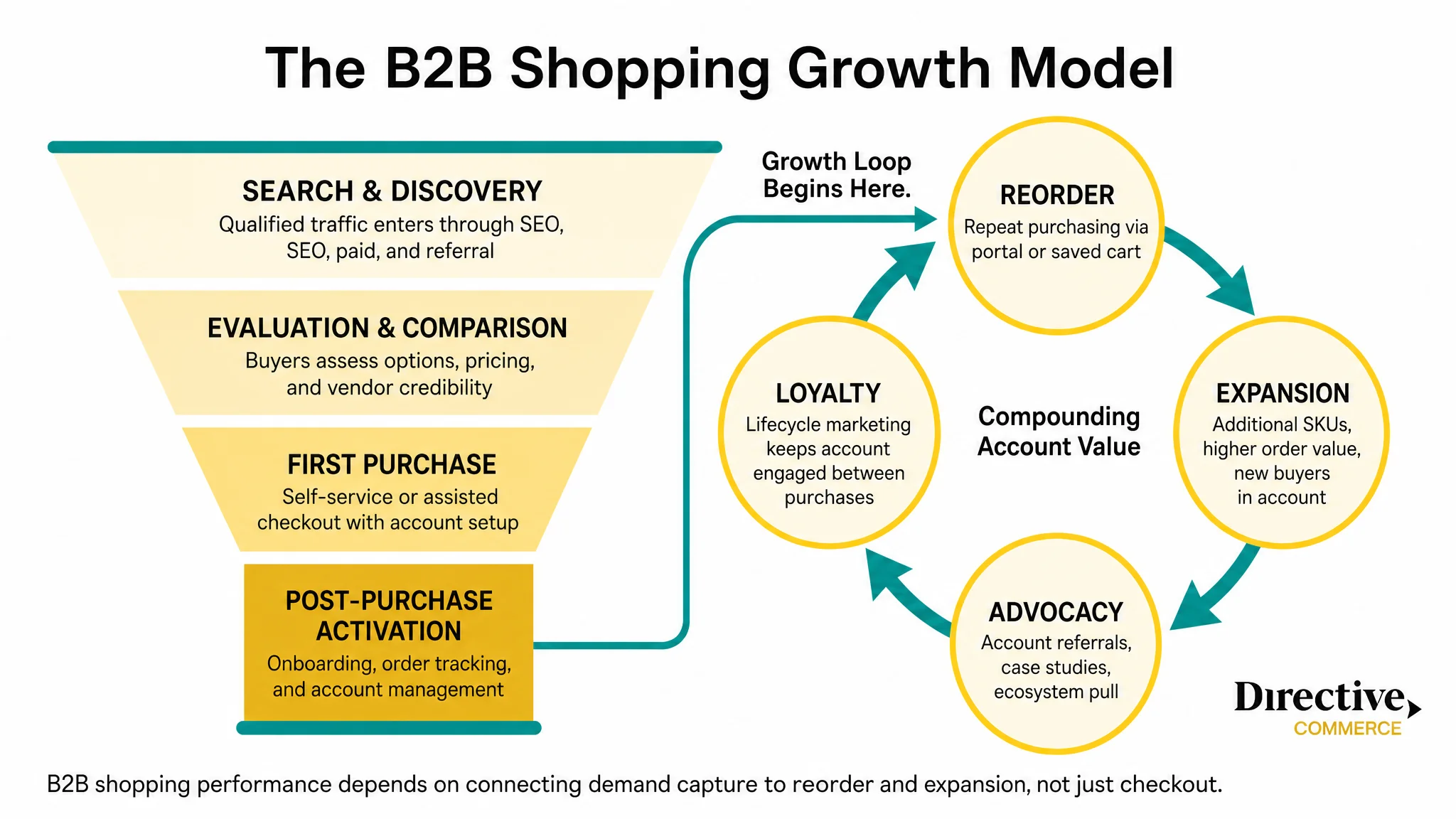
The first order is a data point. What the account does in the 90 days after tells you whether you have a customer or a one-time buyer. Accounts that reorder fast, or pull in a second category, tend to compound. The ones that go quiet rarely reverse. A retention program’s real job is to shorten that diagnostic window and act on it before the account goes cold.
Customer lifecycle marketing connects what buyers do after the first transaction to the next commercial opportunity, using behavior signals rather than calendar-based campaign cadences.
Repeat Buying Depends on Post-Purchase Clarity and Ease
A buyer who completes a first order and then struggles to locate invoice records, cannot reorder without calling support, or receives a generic email sequence has experienced friction that is invisible to the acquisition team but visible in churn data six months later. Post-purchase experience directly determines reorder rate.
Lifecycle Marketing Should Respond to Account Behavior, Not Calendar Timing
Calendar-based email cadences ignore what buyers are actually doing. A reorder sequence triggered when an account approaches 80% of its prior-period order volume is more relevant than a quarterly check-in. Behavioral triggers turn lifecycle programs into conversations that match buyer intent rather than vendor scheduling preferences.
The Best Shopping Experiences Keep Increasing Account Value After Conversion
B2B accounts that stay and expand generate the majority of revenue in high-performing businesses. Net Revenue Retention is the metric that captures this dynamic. A shopping experience designed to surface adjacent products after first purchase, support cross-team adoption, and reward reorder behavior turns customer generation into a compounding commercial asset rather than a one-time transaction.
What Mistakes Keep B2B Shopping from Scaling?
B2B shopping stalls on strategy and alignment problems — the kind that surface in platform metrics and are easy to misread as design or UX failures.
Storefront Thinking Limits Long-Term Growth
Teams that build a portal and stop there are managing a liability. Conversion holds flat, reorder rates don’t move, and buyer expectations keep shifting.
The platform stays live but the business case behind it quietly erodes. By the time it shows up in the numbers, the gap is usually 12 to 18 months wide.
Traffic Quality Problems Often Get Blamed on UX
When conversion rates are low, the first instinct is to redesign the portal. The actual problem is often that unqualified traffic is arriving. A buyer who does not fit the ICP, is at the wrong stage of their evaluation, or is searching for a product category the business does not serve well will not convert regardless of portal design quality.
It’s a pattern we’ve diagnosed in our own work. Early in building Directive’s content program, we were generating strong traffic numbers that turned out to be attracting competitors and industry peers rather than the B2B buyers we were actually targeting. It wasn’t a portal problem or a UX problem — it was an audience problem that looked like a conversion problem until we integrated sales feedback with marketing data
Great Portals Still Underperform When Teams Work in Silos
Marketing, commerce, RevOps, and lifecycle can each hit their numbers and still hand buyers a broken experience. Different account definitions mean the same company gets three different treatments depending on which team touches them first. Different success metrics mean nobody owns the gap. The fix isn’t a better platform. It’s getting those four teams to work from the same picture.
Build a Stronger B2B Shopping Engine with Directive
Directive has worked with B2B technology and commerce brands since 2013, with teams across North America, Europe, and Mexico — connecting acquisition, portal performance, and retention into systems that compound over time.
The companies that scale B2B shopping successfully do not optimize channels one at a time. They build a B2B go-to-market strategy that connects the moment a buyer first searches to the moment they reorder, expand, and stay.
If your B2B shopping experience is generating traffic but not pipeline, book an intro call to see where the leverage is.
B2B Shopping FAQs
What does B2B shopping mean?
B2B shopping refers to the digital process through which businesses discover, evaluate, purchase, reorder, and manage commercial relationships with suppliers online. Unlike consumer ecommerce, it involves account-specific pricing, multi-user access, approval workflows, and complex procurement structures that require both self-service capability and human support for high-stakes decisions.
What is a B2B shopping portal?
A B2B shopping portal is an account-specific digital environment where buyers browse a supplier’s catalog, place orders, track shipments, access invoices, and manage purchasing activity across their organization. Effective portals support role-based access, negotiated pricing tiers, reorder workflows, and real-time inventory visibility, serving both routine transactions and complex orders within a single authenticated experience.
How is B2B shopping different from B2C ecommerce?
B2C ecommerce is designed for individual, often impulse-driven decisions by a single buyer. B2B shopping involves buying committees, approval chains, contract-specific pricing, minimum order requirements, and purchase cycles that span weeks or months. The experience must support multiple user roles within a single account and integrate with ERP, CRM, and procurement systems that have no equivalent in consumer retail.
Why do B2B buyers expect self-service now?
Buyer behavior has shifted significantly. Research consistently shows that most B2B buyers prefer to complete initial discovery, product comparison, and routine reordering without sales involvement, driven by speed, autonomy, and access to better information online. The expectation for self-service does not eliminate the need for human support. It narrows when buyers expect it: for complex configurations, custom contracts, and high-stakes decisions where a rep adds genuine value.
How long does it take to improve a B2B shopping experience?
Improvements happen in phases. Quick wins in search strategy and portal UX are achievable within 30 to 60 days. RevOps data alignment and lifecycle program development typically require 60 to 90 days to instrument and calibrate. Sustained gains in reorder rate, net revenue retention, and pipeline attribution reflect 90-plus days of aligned execution across acquisition, portal experience, and retention. The timeline depends on the current state of integration across marketing, commerce, and operations.