








Key Takeaways
|
Wholesale distribution is still massive. In fact:
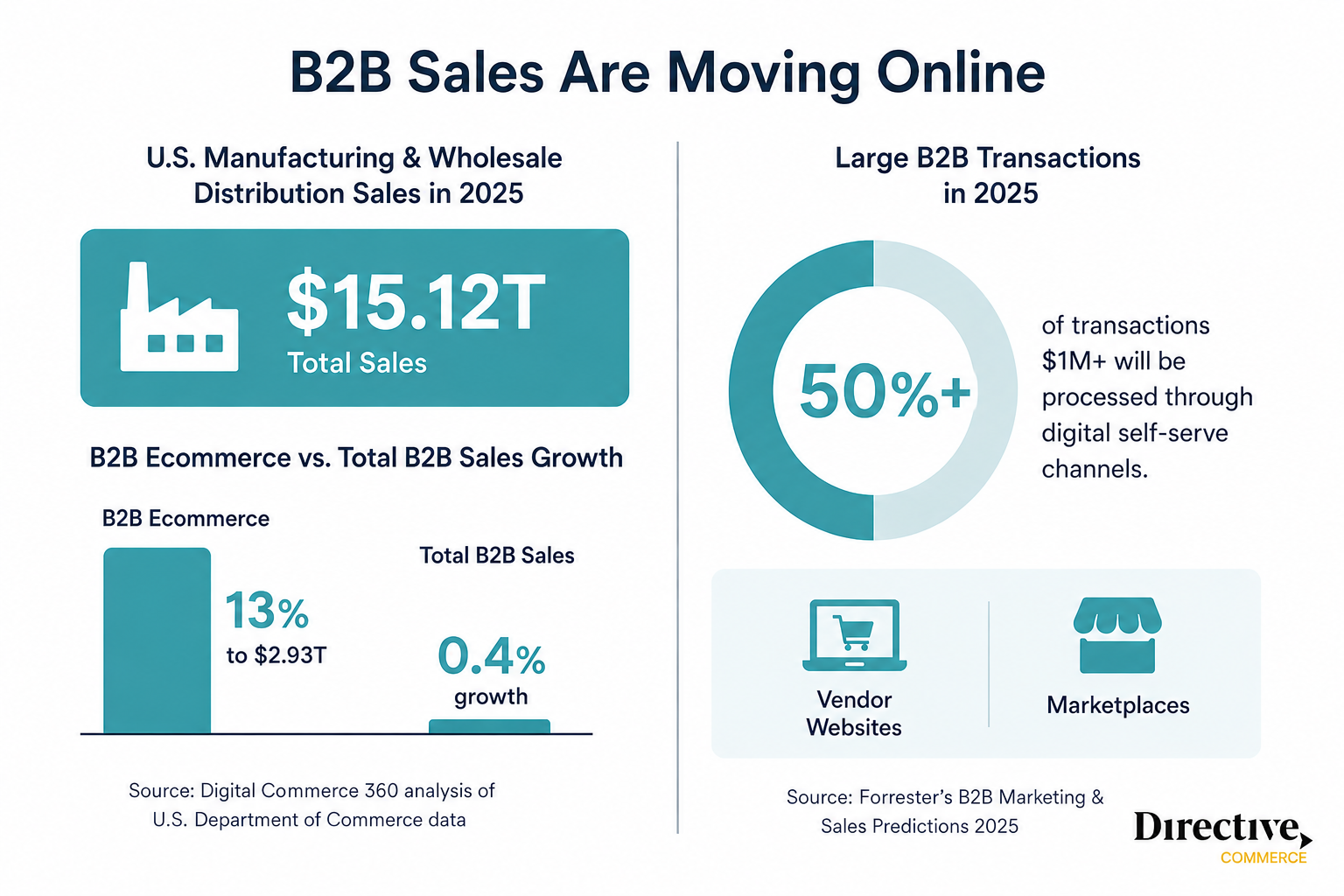
U.S. manufacturing and wholesale distribution sales reached $15.12 trillion in 2025, according to Digital Commerce 360 analysis of U.S. Department of Commerce data.
The same report found that B2B ecommerce grew 13% to $2.93 trillion, even as total B2B sales rose only 0.4%.
The shift is not only about volume. It is about how buyers want to buy.
A B2B wholesale marketplace gives buyers faster access to suppliers, clearer pricing signals, lower switching friction, and shorter procurement cycles.
That does not mean marketplaces will replace every distributor function. They are replacing the parts of the distribution that buyers find slow, opaque, or hard to compare.
Forrester’s B2B Marketing & Sales Predictions 2025 states that more than half of large B2B transactions worth $1 million or more would be processed through digital self-serve channels in 2025, including vendor websites and marketplaces.
The pressure in simple words is:
- Buyers increasingly expect marketplace-level speed, visibility, and control.
- Distributors can still win, but only when their value is clear enough to defend the extra steps in the buying process.
How Leading Teams Respond When a B2B Wholesale Marketplace Starts Pulling Buyers Away
Strong wholesale teams do not dismiss marketplaces as a niche threat. They study what buyers are choosing them for.
That distinction matters. A buyer may not want to replace a distributor relationship entirely.
They may only want faster quotes, better stock visibility, more supplier options, or less manual work for repeat orders.
Leading teams respond by looking for the first point of buyer defection. Then they decide which parts of the commercial model need to change.
A useful response starts with 4 questions:
- Where do buyers defect first? Look at pricing, availability, reorder speed, sourcing, terms, and quote response times.
- Where are buyers staying from habit, not value? Some accounts stay because switching is annoying. That is not the same as loyalty.
- Which distributor strengths still matter most? Protect technical support, credit relationships, category expertise, reliability, and local service.
- Which friction points can you remove now? Fix slow quoting, unclear pricing, limited inventory visibility, and manual reordering.
This is where B2B marketing for wholesale and distribution needs to do more than just promote products. It has to help buyers understand why staying with you reduces risk, waste, or improves outcomes.
If the answer is only “we have relationships,” that may not be enough. Buyers need to feel the value in the buying process itself.
Why Is the B2B Wholesale Marketplace Model Pulling Demand From Traditional Distribution?
Marketplaces pull demand because they make common buying jobs easier.
That does not mean every buyer is only chasing the lowest price. Many are trying to reduce the time, uncertainty, and manual work attached to sourcing. They want clearer options, faster comparison, and more control before they commit.
For wholesale leaders, the risk is not just losing a transaction. It is losing the buyer’s default starting point.
| Marketplace Advantage | What Buyers Experience | Distributor Risk |
| Pricing visibility | Faster comparison across suppliers | Less control over pricing opacity |
| Supplier access | More options without manual sourcing | Weaker hold on buyer relationships |
| Inventory transparency | Better availability checks | Less tolerance for “call for quote” workflows |
| Digital procurement | Faster ordering and reordering | Manual processes feel more expensive |
| Lower switching friction | Easier testing of new suppliers | Loyalty weakens when the value is unclear |
This is why the marketplace threat is commercial, not just technical.
A wholesale B2B platform can pull demand away by answering buyer questions faster than a sales rep, a catalog, or a phone-based process.
- Can I get it?
- Who else has it?
- What will it cost?
- How quickly can it ship?
- What are the terms?
- What happens if this supplier fails?
Those questions used to give distributors room to guide the sale. Marketplaces now answer more of them inside the buying flow.
That is where a B2B commerce marketing agency can help sharpen the buyer journey. The goal is to make your value easier to find, compare, and act on before buyers look elsewhere.
What Traditional Distribution Still Does Better Today
Traditional distribution still has real advantages. The strongest distributors do more than move products from one place to another.
They reduce risk for buyers who need judgment, reliability, and support when the order is complex. That advantage still matters, especially in categories where the wrong product, supplier, or delivery issue can create costly problems.
McKinsey’s 2024 B2B Pulse found that buyers still split their time across in-person, remote, and digital self-service interactions. They also found that:
- B2B customers use an average of 10 interaction channels during the buying journey.
- Over 50% said they are likely to switch if they don’t have a smooth experience across channels.
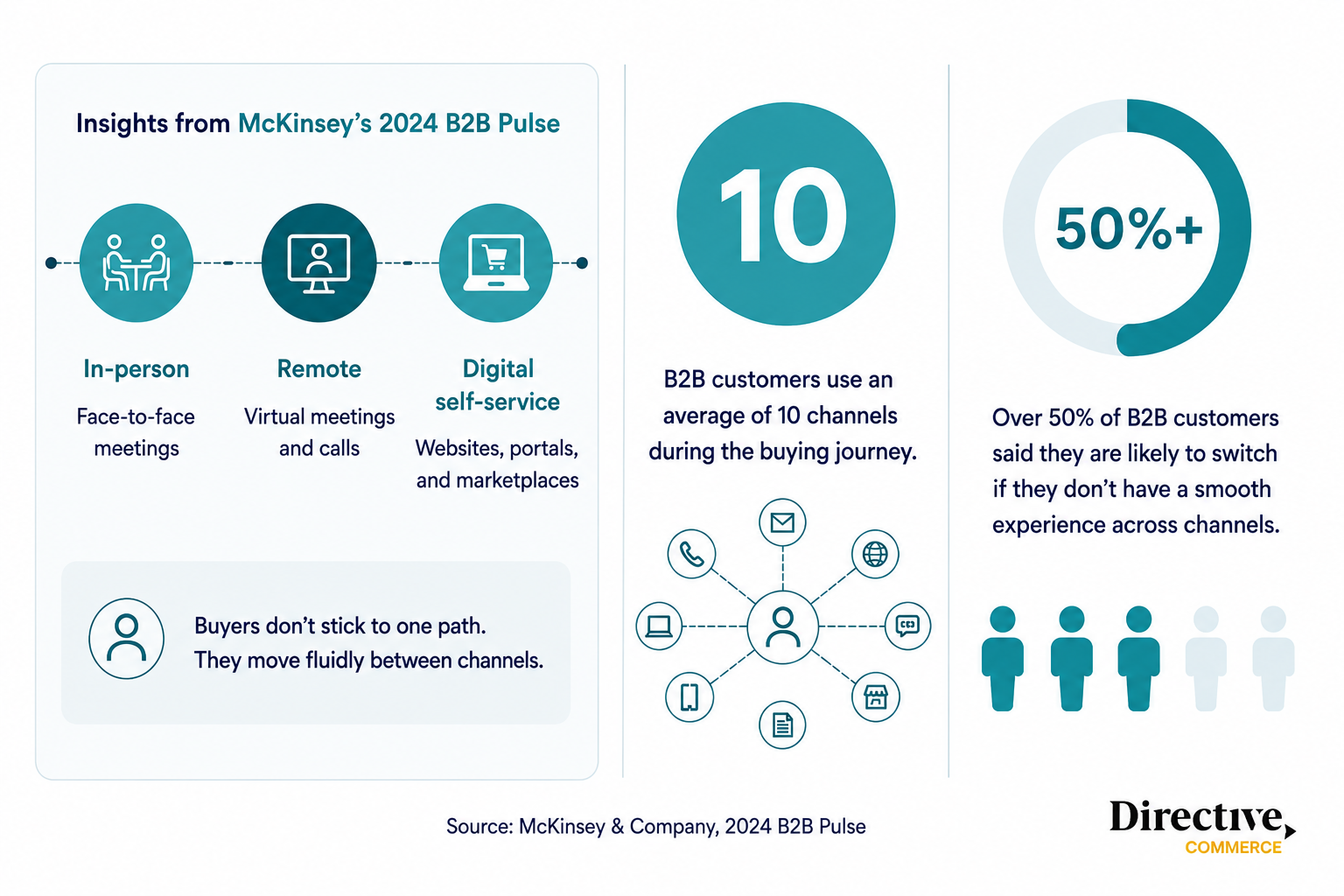
That is the important nuance. Buyers are not moving entirely to one channel. They are choosing the channel that offers the best path for the job at hand.
Distributors still win when they provide:
- Complex order guidance that requires human judgment.
- Credit relationships and payment flexibility.
- Local availability and emergency support.
- Category knowledge that reduces buyer risk.
- Service reliability in fragmented or regulated categories.
- Help navigate substitutes, shortages, or specification changes.
These advantages work best when buyers can clearly feel them.
If service is slow, expertise is hard to access, or pricing takes too long to confirm, buyers start comparing the distributor against a digital alternative. At that point, the relationship has to carry too much weight.
Why Are Some Distributor Advantages Eroding Faster Than Expected?
Distributor advantages are eroding as marketplaces continue to absorb more of the value stack.
The early marketplace pitch was often simple supplier discovery. That is no longer the full story.
Marketplaces are adding tools that reduce the need for traditional intermediaries in more parts of the buying process.
They are taking on functions such as:
- Supplier verification: Buyers can review supplier credentials, ratings, and history in one place.
- Payments and financing: More platforms support terms, payment workflows, or financing options.
- Logistics coordination: Buyers can compare delivery timing, shipping options, and fulfillment updates.
- Product discovery: Search and filters make comparison faster across many suppliers.
- Repeat ordering: Reorder workflows to reduce the need for phone calls or email threads.
- Terms and documentation: Procurement records become easier to track inside the platform.
- Supplier performance signals: Reviews and ratings create visible trust markers.
This matters because many distributor advantages were built around reducing uncertainty, like:
- Who can supply this?
- Can they deliver?
- Are the terms workable?
- Will the product match the need?
Marketplaces are now answering more of those questions directly.
Better digital buying also changes buyer patience. Once a buyer can reorder quickly, compare suppliers, and check availability without waiting, manual work starts to feel like a tax.
This is where B2B customer lifecycle marketing becomes important. Retention depends on making repeat buying easier, not just reminding buyers you exist.
Which Wholesale Categories Are Most Vulnerable to an Online Wholesale Marketplace Shift?
Marketplace risk is not uniform across all wholesale categories.
Some categories have buying conditions that make marketplace shift more likely. Others still depend on service, compliance, specification support, or tight supplier relationships.
The key is to judge the category by buyer behavior, not by tradition.
| More Vulnerable to Marketplace Shift | Less Vulnerable to Marketplace Shift |
| Fragmented supplier base | Specialized supplier relationships |
| Repeat orders | Custom or engineered orders |
| Easy product comparison | Technical specification support |
| Low switching cost | High switching risk |
| Transparent substitutes | Compliance-heavy requirements |
| Standardized logistics | Service-heavy delivery needs |
| Clear product data | Complex configuration requirements |
High-comparison categories usually move first. Buyers can compare suppliers, prices, terms, and inventory with less risk. If products are easy to specify and reorder, marketplaces have a clearer opening.
Complex service categories move more slowly. Buyers may still need technical support, installation coordination, compliance review, or local service. In those cases, the distributor’s role is harder to replace.
But slower does not mean safe. Even in complex categories, buyers may still expect better visibility, faster response times, and easier ordering. Marketplace pressure often starts at the edges, then moves deeper into the account.
Framework: How to Assess Whether Your Wholesale Business Is at Risk
You can use this framework as a quick pressure test. The goal is not to predict a full takeover of the marketplace. It is to identify where buyer expectations are outpacing your commercial model.
| Risk Factor | Why It Matters | High-Risk Signal |
| Pricing visibility | Buyers compare faster when pricing is easier to see | Buyers often request quotes only to benchmark prices |
| Supplier fragmentation | Marketplaces gain value when supplier choice is scattered | Buyers need several calls or searches to find options |
| Reorder frequency | Repeat buying rewards speed and convenience | Customers reorder the same items through manual workflows |
| Switching cost | Lower switching risk weakens loyalty | Buyers can test new suppliers without operational disruption |
| Human service dependence | Human help protects distributor value | Most orders do not need expert guidance |
| Product complexity | Simple specs are easier to compare online | Buyers can identify substitutes without support |
| Logistics sensitivity | Delivery complexity can defend distributor value | Shipping and fulfillment needs are standard |
If several high-risk signals apply, positioning becomes more important. Buyers need to understand why your model is worth choosing when a marketplace is faster.
A stronger B2B market positioning strategy helps clarify that value.
Build a Stronger Wholesale GTM Strategy With Directive
Marketplaces are changing buyer expectations across wholesale and distribution.
Buyers still value service, trust, and reliability. They also expect faster sourcing, clearer information, and easier reordering.
That puts pressure on the GTM model.
Wholesale brands need sharper positioning, stronger acquisition strategy, and better lifecycle marketing.
They also need a clearer answer to a simple buyer question: why should I keep buying from you when another option feels easier?
A stronger B2B go-to-market playbook can help connect that answer across messaging, demand capture, buyer retention, and revenue planning. The point is to make distributor value easier to see before buyers drift.
If your team needs to reassess how you acquire, retain, and defend buyers as marketplaces shift channel economics, explore Directive’s B2B marketplace agency approach.
See our work, or even better, book a demo.
B2B Wholesale Marketplace FAQs
What Is a B2B Wholesale Marketplace?
A B2B wholesale marketplace is a digital platform where business buyers can compare and purchase from multiple wholesale suppliers. It differs from a single supplier wholesale site because the buyer can evaluate several sellers, prices, terms, and inventory options in one place.
Why Are Wholesale Buyers Moving to Marketplaces?
Wholesale buyers move to marketplaces because they reduce common friction in the buying process. They can compare suppliers more quickly, view more pricing and inventory information, and complete procurement steps with less manual work.
Are Wholesale Marketplaces Bad for Distributors?
Wholesale marketplaces are a threat when distributors rely on access, habit, or manual processes to keep buyers. They can also create pressure that helps distributors improve pricing visibility, digital buying, lifecycle marketing, and account retention.
Which Wholesale Categories Are Most Likely to Shift First?
Categories with repeat buying, easy product comparison, fragmented supply, and low service dependence are more likely to shift first. Categories with technical support needs, compliance complexity, or high switching risk usually move more slowly.
What Should Traditional Distributors Do Now?
Traditional distributors should modernize the buying experience, clarify their differentiation, and protect the value buyers cannot find elsewhere. That usually means improving pricing clarity, reorder speed, customer data, service visibility, and GTM alignment.