








Key Takeaways
|
Many B2B SaaS teams don’t need more experiments. They need a clearer way to decide which experiments deserve budget, time, and sales attention.
Growth hacking B2B SaaS works when testing is tied to business outcomes, meaning:
- Following pipeline quality, CAC payback, activation, retention, and expansion.
- Not chasing random channel tricks or copying playbooks built for simpler buying cycles.
The teams that scale well usually do fewer things.
They measure those things more carefully. And they build growth around real buyer signals, not just internal activity.
How Leading Teams Hack B2B SaaS Growth
The phrase “growth hacking” still carries a lot of baggage.
It makes people think of one-off wins, short-lived tricks, and channel experiments that look good in a weekly report, but never change the business’s economics.
That is not how strong B2B SaaS teams operate.
Strong B2B SaaS teams take a different approach. They build repeatable growth loops around 4 areas:
- Positioning: Who are we for, and why should those buyers care now?
- Distribution: Where does demand already exist, and how do we meet it?
- Conversion: Where are qualified buyers slowing down or dropping off?
- Retention: Where does the product need to prove value faster?
That shift changes the question.
Instead of asking, “What can we try next?” ask, “What bottleneck is keeping revenue from moving faster?”
That question keeps experimentation connected to the model. It also prevents teams from spreading budget across paid search, paid social, review sites, content, outbound, partnerships, and product-led plays before they know where buyers actually convert.
The best teams usually start with one dominant motion. Then they support it with channels that fit that motion. For example, a sharper B2B SaaS go-to-market strategy often drives more growth than a larger media mix.
The same discipline applies to measurement:
- Cheap leads are not an efficient use of growth if they never become a qualified pipeline.
- Traffic is not useful if it only creates more sales noise.
- A landing page win matters more when it leads to higher-quality demos, faster follow-up, or better activation.
That is what growth hacking B2B SaaS looks like at scale: fewer disconnected tests, more pressure on the right constraint, and a clearer path from experiment to revenue impact.
Why Most Growth Hacking B2B SaaS Advice Breaks at Scale
A lot of growth advice sounds useful because it promises speed. For B2B SaaS, speed only helps when it points at the right constraint.
Fast testing can improve learning. But it cannot fix unclear positioning, broad ICPs, messy handoffs, or a buying group that cannot agree.
Here is what recent data is telling us:
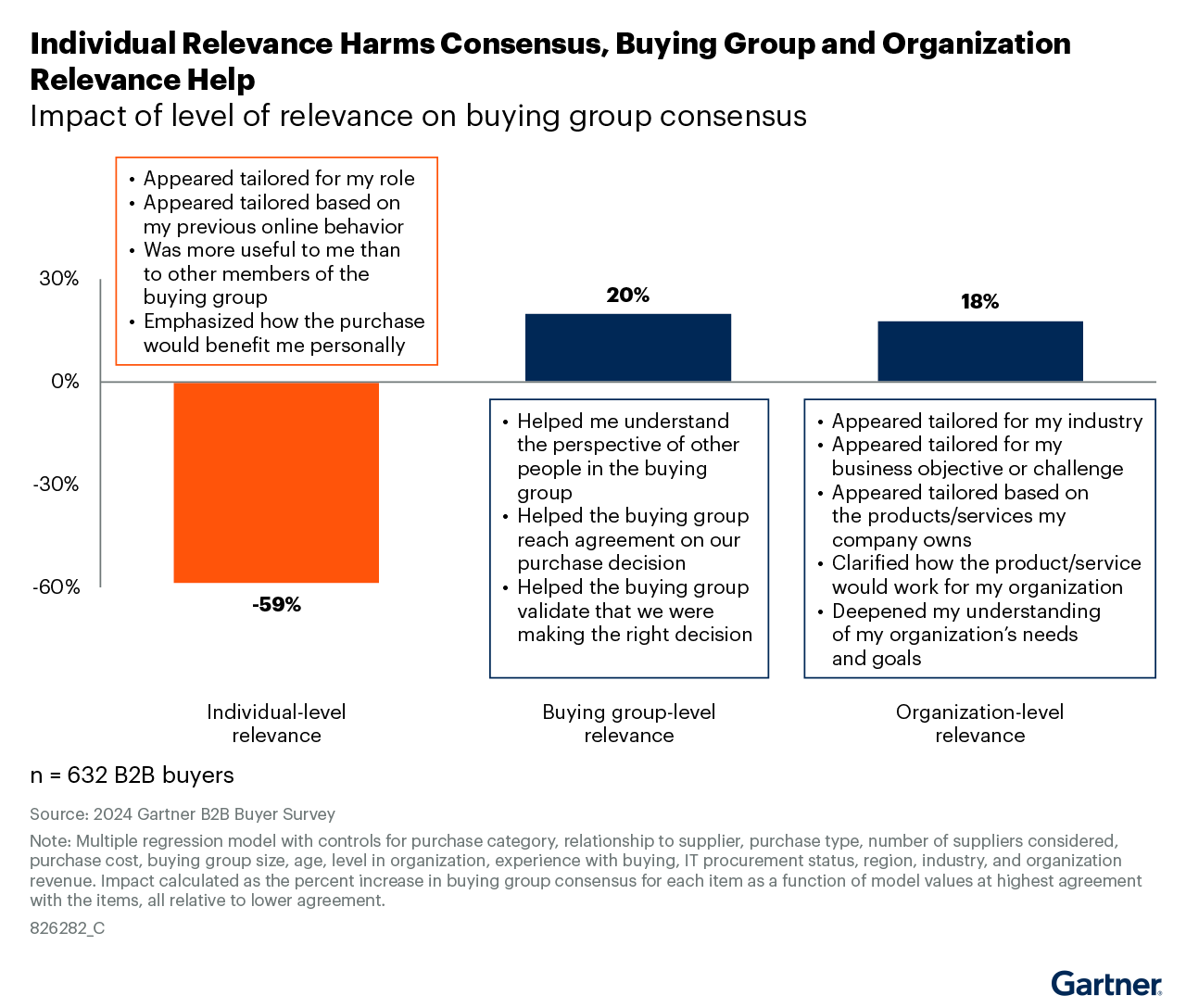
- According to Gartner, 74% of B2B buyer teams show “unhealthy conflict” during the decision process. Gartner also reports that buying groups range from 5 to 16 people across as many as 4 functions. That is the reality that growth tests have to work inside.
 (Source image)
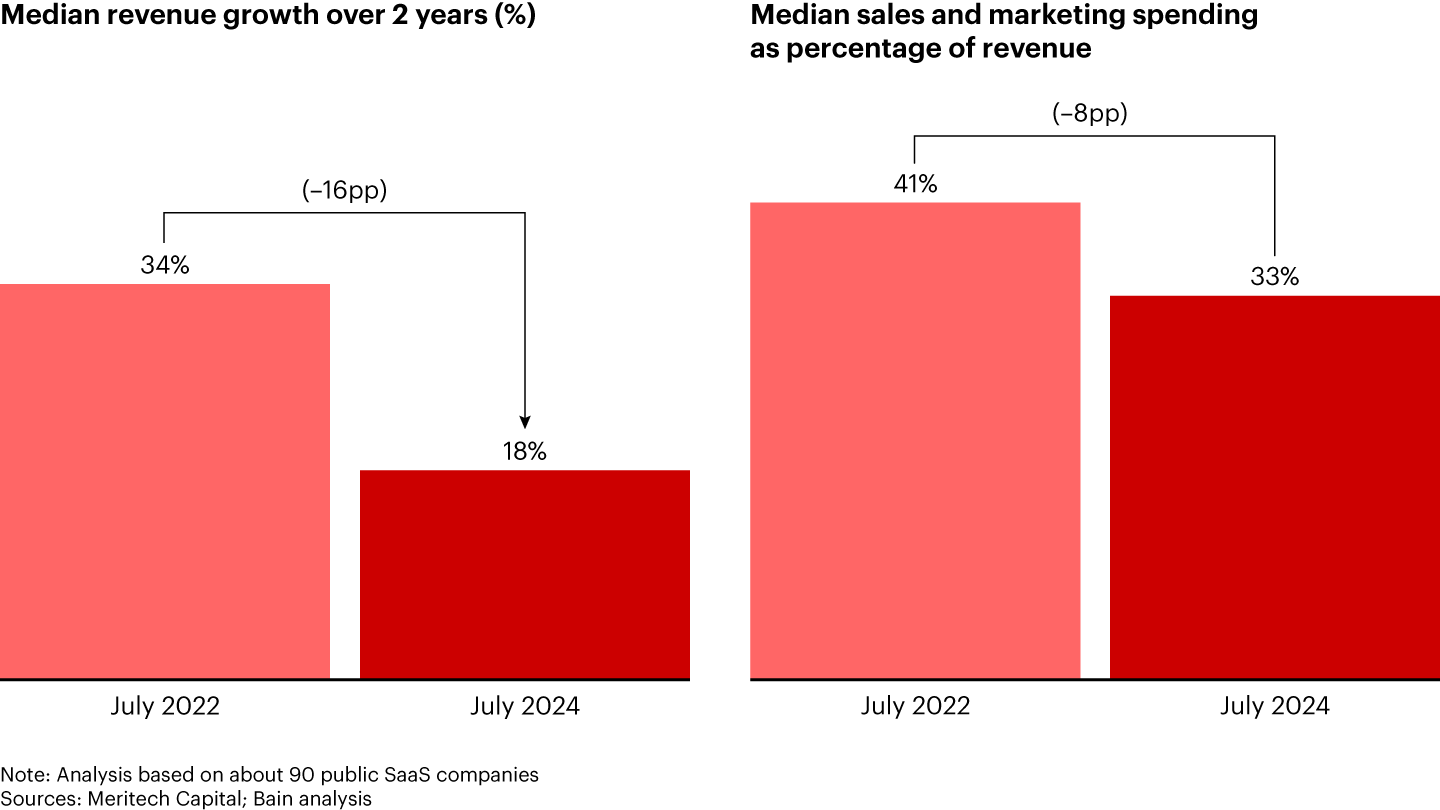
 - Efficiency pressure is also higher than it was a few years ago. A Bain & Company report found that median annual revenue growth declined by 16% over 2 years across about 90 publicly traded SaaS companies. When growth is harder to achieve, weak experiments become more expensive faster.
 (Source image)
These are some of the reasons why consumer-style growth playbooks usually break at scale. They assume faster decisions, fewer stakeholders, lower risk, and cleaner attribution.
B2B SaaS needs a more disciplined approach to filtering. Rapid testing works best when it improves a clear constraint, such as:
- Weak message-market fit
- Low-quality traffic
- Slow demo conversion
- Delayed follow-up
- Poor onboarding completion
- Unclear nurture paths
- Gaps between marketing and sales
Testing gets risky when it becomes a way to avoid harder decisions. Creative tests rarely solve weak positioning. More channels usually make a broad ICP noisier. Campaign reports do not settle disagreements about lead quality.
The real test is simple: does the experiment help qualified buyers move with less confusion, less delay, or less wasted effort? If not, it is probably an activity in disguise.
| Tip: If your tests keep producing activity but not better outcomes, the issue may not be execution. It may be the content strategy underneath it. These 10 B2B content marketing mistakes show where teams lose clarity, create noise, and make growth harder to scale. |
Which Growth Levers Create Real B2B SaaS Growth?
Strong B2B SaaS growth teams do not need an endless amount of tactics. They need a smaller yet focused set of levers that change acquisition cost, conversion quality, payback, retention, and expansion.
The most useful question is not “What should we try next?”
It is “Which lever improves growth efficiency fastest for our business right now?”
| Growth Lever | Use It When | What to Test First | Metrics to Watch | Risk if Ignored |
| Positioning Clarity | Traffic is healthy, but conversion is weak | Message hierarchy, ICP-specific proof, pain-point framing | Demo rate, message match, sales feedback | Rising CAC and weak pipeline quality |
| Demand Capture | Buyers are searching, but competitors win the click | Paid search, SEO pages, comparison content, review visibility | High-intent traffic, SQL rate, cost per opportunity | Missed pipeline from active buyers |
| Demo and Funnel Conversion | Interest exists, but the handoff is weak | Forms, routing, proof placement, follow-up speed | Visit-to-demo, demo-to-opportunity, no-show rate | Slower pipeline velocity |
| Onboarding and Activation | Trials or new customers stall early | Welcome flow, activation prompts, time-to-value steps | Activation rate, onboarding completion, time to value | Lower retention and weaker expansion |
| Retention and Expansion | Growth depends on account value | Usage triggers, expansion paths, customer proof | Gross retention, net revenue retention, and expansion rate | Payback pressure and flat LTV |
| Discoverability and Proof | Buyers need validation before sales | Reviews, third-party proof, comparison pages, customer stories | Branded search, review traffic, influenced pipeline | Lower trust and slower sales cycles |
| Partner and Channel Leverage | Reach depends on trusted ecosystems | Co-marketing, partner offers, marketplace presence | Partner-sourced pipeline, close rate, CAC by source | Higher acquisition costs and slower scale |
Demand Capture and Intent-Based Acquisition
Demand capture brings you closer to buyers who already have a problem, are under budget pressure, or are on a vendor shortlist.
This is where paid search, high-intent SEO, category pages, comparison pages, review-site visibility, branded search protection, and bottom-of-funnel content matter most.
These plays work because they meet buyers when they are already looking for answers.
Start here when:
- You have a clear market demand, but competitors capture more of it
- Your paid spend brings traffic that does not convert
- Your organic traffic skews too top-of-funnel
- Buyers search for alternatives, comparisons, pricing, or implementation proof
- Sales hears the same objections before prospects book a demo
The test is simple: can you capture more qualified demand without creating more sales noise?
This is where focused B2B demand-generation services tend to outperform broader lead-gen programs that chase traffic without sufficient intent filtering.
The goal is not just more traffic. The goal is to have more buyers who are closer to a real decision.
Conversion and Onboarding Improvement
Acquisition often gets too much credit. Conversion and onboarding often decide whether growth is actually efficient.
For many SaaS teams, the best next move is not a new channel. It is fixing the points where qualified buyers slow down, drop off, or lose confidence.
Start here when:
- Demo requests are strong, but opportunity creation is weak
- Form fills are high, but sales reject too many leads
- Follow-up takes too long
- Demo no-show rates are rising
- Trial users stall before they reach value
- New customers need too much handholding before activation
This is where small tests can change the model. You might test form friction, proof placement, demo routing, nurture timing, pricing-page clarity, onboarding prompts, or sales handoff rules.
These tests may not sound flashy. Good. Flashy is usually expensive. The goal is to reduce wasted demand before adding more.
Expansion, Retention, and Discoverability
Retention is where growth proves itself.
If customers do not stick around, paid efficiency worsens over time. If expansion is weak, CAC payback takes longer. If buyers cannot find proof before sales get involved, conversion gets harder than it needs to be.
This is why discoverability belongs in the growth conversation. Buyers validate your claims across search results, peer reviews, third-party content, communities, and AI-generated summaries.
Growth gets easier when the market can confirm your value before your team has to explain it.
Start here when:
- New customers activate, but usage drops later
- Expansion depends too much on the account manager’s effort
- Sales cycles slow down because buyers need more proof
- Review presence is weak
- Comparison content is thin
- Customer proof does not match your strongest use cases
The goal is to build trust more effortlessly. That means clearer proof, stronger customer stories, better review coverage, and expansion paths tied to actual product value.
| Tip: If you want the content side of this system, our Playbook Behind Top B2B SEO and Content Strategies breaks down how leading teams build content programs around buyer intent, distribution, and conversion. |
How Do Top Brands Balance B2B SaaS Brand Growth and Performance?
The strongest SaaS teams do not treat brand and performance like opposing ideas. They use each for what it does best.
Brand reduces friction, making buyers more confident. Performance captures demand and provides a clear path to act. Why?
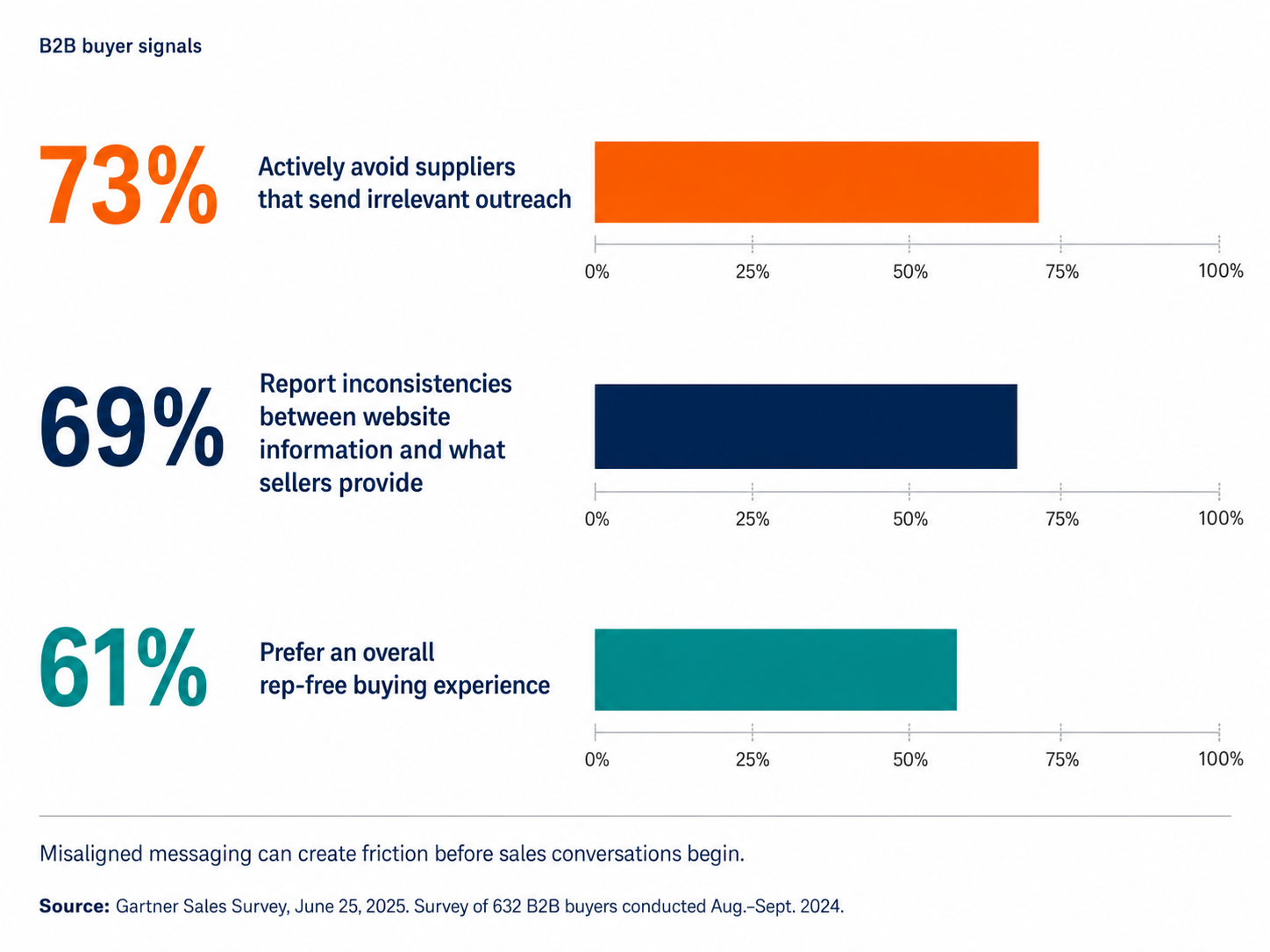
Many buyers are trying to make progress before speaking with sales. According to the Gartner Sales Survey, 61% of B2B buyers prefer an overall rep-free buying experience. Gartner also found that 73% actively avoid suppliers that send irrelevant outreach.
In the same research, Gartner also found that 69% of B2B buyers report inconsistencies between website information and what sellers provide. That kind of mismatch can slow decisions before a deal reaches the pipeline.
Your brand and performance programs need to answer questions such as:
- Why should this problem matter now?
- What makes your point of view credible?
- Who is this actually built for?
- What proof supports the claim?
- What should the buyer do next?
When those answers change across SEO, paid search, paid social, review sites, landing pages, and sales conversations, trust breaks.
Brand and performance need each other:
- A brand should make the market recognize your point of view.
- Performance should turn that recognition into qualified movement.
- One creates confidence. The other captures demand when the buyer is ready.
The practical test is simple: if your performance program only works when spending is high, you may have a trust problem hiding inside a media problem.
| Tip: For a deeper look at how this shows up in search, the LLM, AI, and GEO Strategy Guide is useful if you’re thinking about how buyers validate brands through AI-generated answers before they reach your site. |
What Should Teams Measure When Hacking B2B SaaS Growth?
If an experiment cannot connect to a business outcome, it is probably just creating another report.
That does not mean every test needs immediate revenue proof. It means your team needs to know the difference between a useful early signal and a metric that proves the model is getting healthier.
Early signals help you decide whether to keep testing. Revenue metrics help you decide whether the test deserves more budget, more sales attention, or a bigger role in the growth plan.
| Early Signal | Revenue Metric It Should Connect To | What It Helps You Decide |
| Click-through rate | Cost per qualified opportunity | Is the message attracting the right buyers? |
| Qualified traffic share | SQL rate | Are we reaching accounts where sales can actually work? |
| Landing-page conversion rate | Demo-to-opportunity rate | Is conversion improving quality, not just volume? |
| Demo-book rate | Pipeline velocity | Are buyers moving faster into real sales conversations? |
| Sales-accepted lead rate | Win rate | Do sales trust the demand marketing is creating? |
| Activation rate | Retention | Are new users reaching value early enough to stay? |
| Onboarding completion | CAC payback | Are customers getting value fast enough to support efficient growth? |
| Target-account content engagement | Influenced pipeline | Is content helping the right buyers move forward? |
Early signals can be misleading when read in isolation. For example:
- A higher landing-page conversion rate may look good until demo quality drops.
- More content engagement may look good until none of it comes from target accounts.
- A lower cost per lead may look good until sales reject the volume.
That is why growth teams need 2 views of performance:
- Learning metrics: These show whether friction is dropping in one part of the funnel.
- Business metrics: These show whether the experiment improves acquisition, conversion, retention, or expansion.
Leadership does not need every test detail. They need to know whether the business is getting healthier. That means reporting should focus on:
- CAC
- CAC payback period
- Pipeline velocity
- Win rate
- Average contract value
- Activation rate
- Retention
- Expansion
- LTV
Modern SaaS growth should not be measured solely by lead volume. It should be measured by how well marketing helps buyers move from interest to pipeline, revenue, and account growth.
| Tip: For SEO and content specifically, The Definitive Guide to B2B SEO and Content Trends is a useful next step because it shows how to prioritize content bets, match how buyers research, and prove impact beyond traffic. |
Checklist for a Stronger Growth-Hacking Mindset in Scaling Teams
Before you add another channel, campaign, or test, pressure-test the operating model.
Use this checklist to find the gaps that usually hide behind “we need more growth.”
|
If this sounds basic, good. Most teams do not break growth because they lack ideas. They break it because they lack discipline.
A tighter growth-hacking mindset for scaling usually means saying no more often, not testing more often.
Build B2B SaaS Growth That Lasts With Directive
Many SaaS teams do not need more marketing activity. They need cleaner alignment.
Growth slows when paid, SEO, content, CRO, and sales optimize for different outcomes, as well as:
- When campaigns generate interest that sales cannot capitalize on.
- When reporting stops at leads.
- When no one can explain which part of the funnel is actually improving.
That is why the better question is rarely, “Which channel should we add next?”
It is, “Which constraint is holding back efficient growth, and what system will fix it?”
That same thinking applies to growth hacking B2B SaaS. The goal is not to find a clever hack. It is to build a growth model that learns faster, converts better, and wastes less effort as you scale.
If you are ready to sharpen your experiments, focus on the levers that move revenue, and connect marketing performance to business outcomes, explore Directive’s B2B SaaS growth marketing agency approach.
See our work, or even better, book a demo.
Growth Hacking B2B SaaS FAQs
What Is Growth Hacking in B2B SaaS?
Growth hacking in B2B SaaS is focused on experimentation across acquisition, conversion, activation, retention, and expansion. The goal is to find the constraints slowing growth and test ways to improve them. Strong growth hacking connects experiments to pipeline quality, CAC payback, retention, and revenue.
How Is Growth Hacking Different From Growth Marketing?
Growth hacking usually focuses on faster experiments tied to a specific growth constraint. Growth marketing covers the broader system behind long-term revenue growth, including brand, positioning, lifecycle marketing, demand capture, conversion, retention, and expansion. The 2 should work together, especially as the company scales.
Why Does Growth Hacking Matter for B2B SaaS Brands?
Growth hacking matters because B2B SaaS teams need to learn where growth is slowing down. The right experiments can reduce wasted spend, improve funnel efficiency, increase sales confidence, and help more qualified buyers move from interest to pipeline and revenue.
How Long Does B2B SaaS Growth Hacking Take to Work?
Early signals can appear within a few weeks, especially for tests tied to messaging, landing pages, demo conversion, or onboarding. Revenue impact usually takes longer because it depends on sales cycle length, deal complexity, activation quality, and how quickly the team acts on what it learns.
What Blocks B2B SaaS Growth the Most?
Common blockers include weak positioning, broad ICPs, channel sprawl, poor sales and marketing alignment, slow handoffs, low activation, and incomplete measurement. Growth usually improves when teams identify the biggest constraint first and then test against it with clear success metrics.