







The B2B Shopping Campaign Gap Most Teams Never See
The B2B Shopping Campaign Gap Most Teams Never See
Most B2B companies have products buyers want and platforms buyers can theoretically use. What they do not have is a shopping strategy that makes those two things find each other. Whether you are a SaaS company selling seats through a software marketplace, a manufacturer moving industrial parts through wholesale portals, or a services firm offering bundled packages through a digital storefront, the problem looks the same: the product data is incomplete, the shopping campaigns are built on B2C logic, the feeds are structured for catalog management instead of search relevance, and the team measuring all of it is looking at clicks instead of qualified pipeline. The platform is not the problem. The shopping strategy running through it is.
This list covers 18 of the strongest B2B shopping platforms available in 2026, from enterprise ecommerce environments built for complex account pricing and buyer hierarchies to wholesale marketplaces, branded ordering portals, and the specialized agency that makes product discovery translate into revenue across technology, industrial, and services businesses. We evaluated each entry on platform capability, buyer experience quality, industry recognition, client outcomes, and fit for the range of B2B use cases these platforms serve. Whether you are choosing a platform for the first time, reconsidering an underperforming shopping channel, or looking for the partner who can drive qualified traffic to the platform you already have, this list covers the full picture.
TL;DR — Top 5 B2B Shopping Ad Agencies
TL;DR — Top 5 B2B Shopping Ad Agencies
- Directive: We are the B2B shopping agency that turns product data, shopping campaigns, and retail media into qualified pipeline across technology, industrial, and services businesses. While every platform on this list can host your catalog, we make sure the right buyers actually find it. We partner with clients like SPI to build shopping programs rooted in ICP targeting, feed precision, and DiscoverabilityOS, so every click comes from a company that could actually become a customer.
- SparkLayer: The open-source composable B2B shopping platform for brands with complex catalogs, multi-ERP environments, and buying workflows that standard platforms cannot handle. Shopware’s native B2B Suite delivers RFQ tools, approval workflows, custom pricing, and customer portals on an API-first architecture that gives teams genuine control over the buyer experience.
- OroCommerce: The purpose-built B2B shopping platform for manufacturers and distributors managing complex buying hierarchies. OroCommerce combines ecommerce, CRM, CPQ, and marketplace functionality in a single solution, giving enterprise teams the account structure, quote workflows, and pricing logic they need to support sophisticated industrial buying relationships. Trusted by over 130 enterprise B2B clients across industrial and distribution verticals.
- Salesforce B2B Commerce: The enterprise shopping platform for B2B teams already running revenue operations inside Salesforce. Built natively on the Salesforce platform, it gives manufacturers and distributors a unified system for account-specific catalogs, contract pricing, and buyer self-service, all connected to CRM, Service Cloud, and Agentforce AI. The strongest option for organizations where sales intelligence and buyer shopping behavior need to live in the same system.
- commercetools: The leading composable B2B shopping platform for enterprise brands that need complete architectural freedom. commercetools surpassed $100B GMV run-rate in Q1 2026 and gives organizations the modular building blocks to design exactly the buyer shopping experience their customers expect, without the constraints of a monolithic platform. Strong fit for enterprises with complex technical environments and multi-region shopping operations.
Key Advantages of Working With a B2B Shopping Ad Agency
Key Advantages of Working With a B2B Shopping Ad Agency
Most B2B teams treat shopping as a platform problem. Pick the right marketplace, wire up the right ecommerce stack, and buyers will come. They don’t. The platform is the starting line. What determines whether the investment pays off is what happens after launch: who’s running the shopping campaigns, how your product data is structured, and whether performance is tied to revenue. That holds for SaaS, industrial distribution, and professional services alike.
You Get Shopping Campaigns Built Around How B2B Buyers Actually Evaluate and Purchase
B2B buying isn’t consumer shopping. Technology buyers, ops managers, and business leaders research across channels for weeks before making contact, and a program built for one will underperform for the others. A B2B shopping agency builds around your ICP’s buying behavior, putting products in front of qualified decision makers during the research phase. That means structuring feeds around the terms buyers actually use, running campaigns on the platforms where they evaluate options, and bidding around account-level fit rather than raw conversion volume. Most internal teams have imported a B2C playbook and are measuring the wrong outcomes. Done right, traffic converts because it was qualified before it arrived.
Because agencies manage shopping programs across technology, industrial, and services clients simultaneously, they accumulate cross-vertical pattern recognition around what product data structures, bidding strategies, and campaign architectures actually drive qualified pipeline in each context. You benefit from that expertise immediately rather than paying for the 12-month learning curve of building it internally.
You Get Product Feed Expertise That Most B2B Teams Dramatically Underestimate
Product feed quality is the single most underestimated performance variable in B2B shopping, and the problem shows up differently across verticals. For technology companies, it often means software listings with generic descriptions that fail to communicate differentiated value to buyers evaluating 6 competitors in the same category. For industrial brands, it means SKU data with incomplete specifications that make products ineligible to surface for the exact technical search terms buyers use to find them. For services firms, it means offer structures that are never packaged in a way that shopping channels can read and serve. In each case, the ceiling on shopping performance is set by feed quality before the first campaign ever launches. Google Shopping, Amazon Advertising, and retail media networks use feed data to determine eligibility, relevance, and placement, and the difference between a well-structured feed and a passable one is often the difference between appearing for your highest-intent buyer searches and not appearing at all.
The ongoing maintenance dimension matters as much as the initial build. Catalogs and offerings change, pricing evolves, and new products or services enter the lineup across every vertical. Feed management at scale requires systematic quality control and regular update cadence that most internal teams cannot sustain alongside their other responsibilities. Agencies that specialize in B2B shopping treat feed quality as a continuous performance program, not a setup task that gets revisited once per quarter.
You Connect Shopping Performance to Pipeline, Not Just Traffic and Click Metrics
Most B2B teams measuring shopping performance are looking at impressions, clicks, and ROAS. Those metrics describe what happened during the ad interaction. They do not tell you whether the buyers clicking your listings are in your ICP, whether those companies are in active buying cycles, or whether shopping activity is influencing pipeline downstream. A B2B shopping agency builds measurement frameworks that connect product visibility and shopping engagement to what actually matters: which account segments are showing up in your traffic, which offerings correlate with deal velocity, and how shopping touchpoints influence closed revenue across technology, industrial, and services buyer journeys. This kind of attribution requires integrating shopping data with CRM and sales intelligence in a way most internal teams have not built. The payoff is clarity: you stop optimizing for traffic volume and start optimizing for traffic that shows up in your pipeline.
This measurement infrastructure is also what allows shopping programs to improve over time rather than plateau. When you can see which queries, audience segments, and offer types generate the highest-quality pipeline across your verticals, you can make deliberate investment decisions about where to deepen feed optimization, bidding concentration, and creative development. That feedback loop separates programs that compound in effectiveness from ones that generate stable but unremarkable results year after year.
You Stay Ahead of Retail Media, AI Shopping, and Channel Changes That Reward Early Movers
The B2B shopping landscape is shifting faster than most teams can track internally, and the implications look different depending on your vertical. Technology companies need to be visible in software marketplace and AI-assisted vendor discovery environments where SaaS buyers increasingly shortlist solutions. Industrial brands need to build presence in retail media networks on procurement platforms before competitors establish category dominance. Services firms need to structure their offers in ways that emerging shopping and discovery channels can actually surface to relevant buyers. AI-powered search is also reshaping how buyers across all three verticals discover options in Google Shopping, generative search, and third-party procurement tools, requiring a different approach to feed structure, content depth, and bidding than traditional shopping campaigns. B2B shopping agencies stay close to these changes because it is their entire focus. When platform requirements shift or new retail media formats emerge, agencies adapt programs in real time rather than flagging it as a to-do for the next strategy review. You benefit from that ongoing attention without having to hire for it internally.
1. Directive Consulting
1. Directive Consulting
B2B shopping ads agency and feed management engineered for ICP traffic

We built our Shopping services around a single observation: most B2B companies have invested in the platform but not in the strategy that makes it generate revenue. The catalog is loaded, the storefront looks credible, and the team is running shopping campaigns. But the feeds are structured for data management rather than search relevance, the campaigns are built on B2C logic that does not translate to B2B buying behavior, and there is no measurement connecting shopping activity to qualified pipeline. We solve that problem across technology companies, industrial brands, and services firms. Our Shopping team provides Google Shopping management alongside Microsoft and retail media campaigns, with a strategy built around ICP targeting and feed precision specific to your vertical and buyer type. We optimize product data, structure feeds for buyer intent, manage bidding architecture around account fit, and build reporting that connects shopping performance to revenue rather than stopping at clicks.
Beyond shopping campaigns and feed management, we integrate our Shopping practice with the full Directive system. Our SEO and GEO teams ensure your products and services are discoverable across traditional search and AI-powered discovery. Our RevOps team connects shopping data to your CRM so you can see exactly how product visibility influences pipeline across your buyer segments. Our Performance Creative team develops product-level and offer-level creative that converts across retail media placements. DiscoverabilityOS™ guides everything, ensuring your brand surfaces wherever your buyers are evaluating options before they ever engage your sales team. We partner with companies like SPI to build shopping programs accountable to revenue, not activity. If your shopping investment is not generating measurable pipeline, we would like to change that.
Services: B2B Shopping Campaigns, Product Feed Management, Retail Media, Google Merchant Center Optimization, Marketplace Advertising, Commerce Strategy, Paid Search, SEO, GEO, Performance Creative, RevOps
Standout Clients: SPI, Unilog, Zoro Tools
Best For: B2B manufacturers and distributors ready to connect their ecommerce investment to measurable pipeline growth through shopping campaigns, feed strategy, and commerce-native performance marketing.
Why Choose Directive:
- Shopping programs built around B2B procurement cycles and ICP targeting, not repurposed B2C campaign structures
- Full integration of commerce, SEO, GEO, paid search, creative, and RevOps into one accountable revenue system
- DiscoverabilityOS methodology ensures product visibility across search, AI search, retail media, and marketplace channels simultaneously
2. SparkLayer
2. SparkLayer
The B2B wholesale buying layer built for brands that want enterprise shopping without starting over
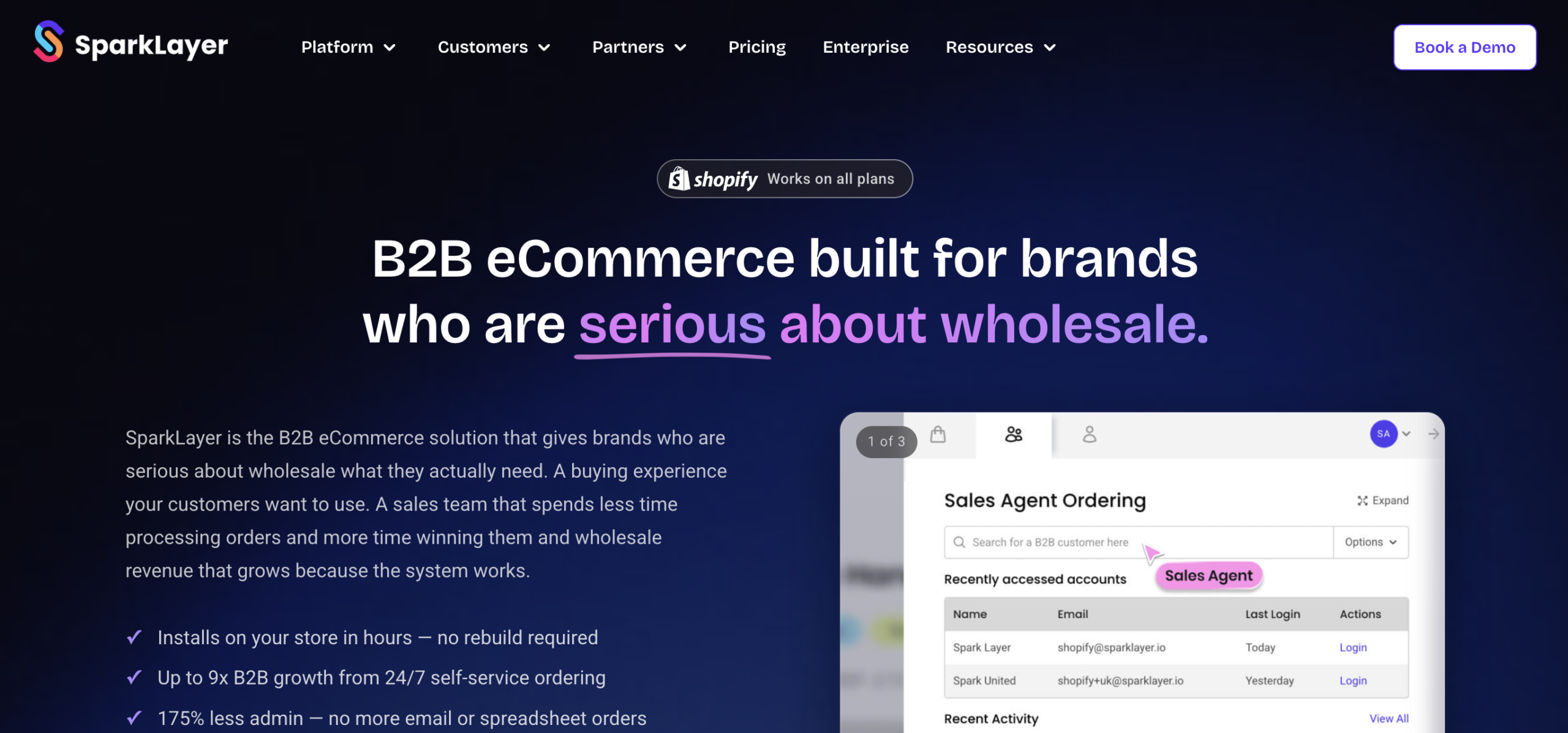
SparkLayer solves a problem that thousands of B2B brands run into the moment their wholesale volume starts growing: the platform they already have does not support the buying experience their accounts expect. Rather than ripping out a working Shopify or BigCommerce store and migrating to a full enterprise platform, SparkLayer layers a complete B2B wholesale buying environment on top of what already exists. Company account management, tiered pricing, a native quote engine, a sales rep portal, and an AI cart that reads purchase orders and builds carts automatically — all added without a platform migration. That last feature matters more than it sounds for technology companies managing software license renewals, industrial distributors processing repeat equipment orders, and services firms whose clients reorder in consistent patterns. The AI Intelligent Cart means buyers who prefer to work in email or spreadsheet do not have to change how they order: they send a file, SparkLayer reads it, and the cart is built. Over 3,000 brands rely on SparkLayer to run their B2B wholesale operations, and the platform starts at $49 per month, which puts enterprise-grade buying infrastructure within reach well before a brand reaches enterprise scale.
The Sales Rep Portal is where SparkLayer separates itself from simpler B2B add-ons. It is not a backend admin panel. It is a full storefront interface that lets reps toggle between customer accounts, build carts on behalf of buyers, access purchase history, and complete orders without pulling the buyer into an unfamiliar flow. For B2B teams where reps drive a significant portion of wholesale volume, that functionality removes one of the most common friction points in the digital ordering transition. SparkLayer integrates natively with Shopify, BigCommerce, and Wix, which means implementation is measured in hours rather than months and does not require a dedicated development sprint to get live. For brands that have outgrown native B2B features but are not ready to commit to a full platform overhaul, SparkLayer is the most practical path to a buying experience that actually works for wholesale accounts.
Services: B2B Wholesale Storefront, Company Account Management, Tiered Pricing, Sales Rep Portal, Native Quote Engine, AI Intelligent Cart, B2B Checkout, Payment Terms, Shopify Integration, BigCommerce Integration
Standout Clients: Unico Nutrition, Fairfax & Favor, Ooni
Best For: Shopify and BigCommerce merchants running serious wholesale operations who need a complete B2B buying environment without migrating to a dedicated B2B platform.
Why Choose SparkLayer:
- Adds a full B2B wholesale buying layer to existing Shopify or BigCommerce stores without migration, including rep portal, quoting, and company account management
- AI Intelligent Cart reads buyer purchase orders and spreadsheets and builds the cart automatically, removing friction from high-frequency repeat ordering
- Entry pricing from $49 per month makes enterprise-grade wholesale buying infrastructure accessible before brands reach enterprise scale
3. NuORDER by Lightspeed
3. NuORDER by Lightspeed
Where brands stop managing wholesale in spreadsheets and start selling in digital showrooms
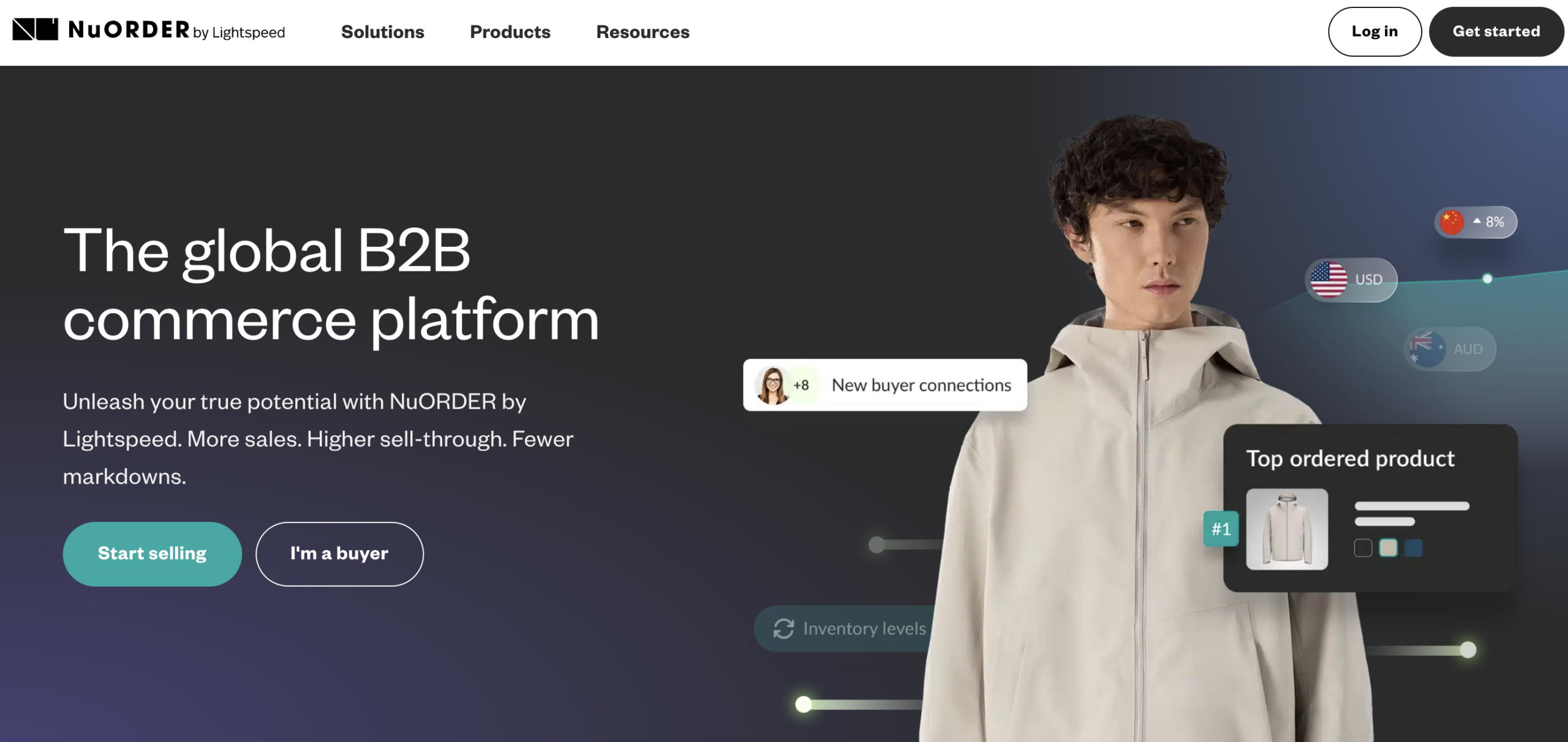
NuORDER changed the math on wholesale buying for consumer goods brands by replacing the combination of PDF linesheets, email threads, and manual order entry with a platform built around how buyers and sellers actually want to work together. Brands create digital showrooms, buyers browse interactive catalogs from any device, orders are placed in real time, and inventory updates as they do. That shift sounds incremental until you look at what it removes from both sides: the rep chasing down a PO that got lost in an inbox, the buyer emailing for stock confirmation before placing an order, the back-office team re-entering orders by hand. NuORDER connects over 3,000 brands with 500,000 retailers and processes more than $38 billion in orders annually, which is a scale that reflects how thoroughly it has become the operating infrastructure for wholesale in the categories it serves, spanning fashion, beauty, home goods, lifestyle, and technology accessories. For brands in those verticals, being on NuORDER is increasingly less of a competitive advantage and more of a baseline expectation from retail buyers who have normalized digital wholesale ordering.
The Sales Rep tools are where NuORDER earns its keep for brands with field teams. Reps can access buyer purchase history, build carts, and complete orders on behalf of retail accounts, which accelerates the market appointment cycle and reduces the time between a buyer seeing a collection and placing a commitment. The platform’s integration with Lightspeed Retail means buyers can access NuORDER brands directly within their POS system, shortening the discovery-to-order path for retail accounts that have already adopted Lightspeed. The consolidated shipping model, which lets retailers place a single order across multiple brands, reduces freight costs and inventory risk in a way that makes multi-brand ordering more likely. For technology companies selling accessories or hardware through retail channels and industrial brands with retail distribution partnerships, NuORDER is worth understanding even if your core business is not apparel.
Services: Digital Showroom, Wholesale Catalog Management, Order Management, Inventory Tracking, Integrated Payment Processing, Sales Rep Portal, Analytics & Reporting, Market Week Support, Lightspeed Integration
Standout Clients: Lacoste, Rag & Bone, Kendra Scott
Best For: Brands in fashion, beauty, home goods, and lifestyle that need to digitize their wholesale sales process and connect with a large, active retail buyer network through digital showrooms and streamlined ordering.
Why Choose NuORDER:
- 500,000+ retail buyers across 3,000+ brands make it the most active wholesale buying network in consumer goods verticals
- Sales Rep Portal and digital showroom remove the manual catalog and order management friction that defines traditional wholesale for most brands still operating on spreadsheets
- Consolidated shipping and Lightspeed integration reduce ordering friction for retail buyers, increasing multi-brand purchase frequency
4. JOOR
4. JOOR
The wholesale buying platform where fashion and luxury brands connect with 650,000 global retail accounts

JOOR built its platform around a specific and underserved problem: premium brands selling wholesale need a buying environment that reflects the quality of what they sell. A PDF linesheet emailed to a retail buyer does not do that. A generic wholesale portal with stock imagery and basic order forms does not do that either. JOOR does. The platform connects over 14,000 brands with more than 650,000 buyers in 150 countries through virtual showrooms built around customizable templates, high-resolution visuals, videos, and interactive linesheets that let buyers browse and commit to collections the same way they experience the brand itself. Shoppable lookbooks, digital whiteboards, and shareable collection links give buyers curation tools that actually match how premium retail buyers think about buying decisions. For brands that have spent years building a brand identity and then handed wholesale buyers a spreadsheet to place orders against, JOOR represents a fundamentally different standard for what the buying experience can be. Gucci, Prada, and Calvin Klein use the platform, which signals the level of brand sensitivity JOOR is built to support.
JOOR Pay is the operational piece that makes the buying experience complete. It supports multiple currencies and digital payment methods, handles settlements, and offers flexible payment terms that reduce the friction of cross-border wholesale transactions — a material advantage for brands building global retail distribution without a dedicated treasury operation. Real-time reporting gives brands visibility into which buyers are engaging with specific collections and where orders are in the approval process, which replaces the guesswork of traditional wholesale with data that actually supports buying cycle management. For technology brands selling through premium retail channels and services firms with high-end distribution relationships, JOOR’s positioning and buyer network are worth understanding. The platform’s strength is not just in what it does functionally — it is in the signal it sends to retail buyers about how seriously a brand takes the wholesale relationship.
Services: Virtual Showroom, Digital Wholesale Catalog, JOOR Pay, Real-Time Reporting, Retailer Management, Interactive Linesheets, Order Tracking, Multi-Currency Support, Shoppable Lookbooks
Standout Clients: Gucci, Prada, Calvin Klein
Best For: Fashion and luxury brands that need a premium wholesale buying environment for managing collections, connecting with global retail buyers, and presenting product in a way that maintains brand integrity throughout the sales process.
Why Choose JOOR:
- 650,000+ buyers across 150 countries provide immediate access to a premium global retail buying network without building global distribution from scratch
- Virtual showroom experience maintains brand standards through high-resolution presentation, interactive lookbooks, and curated collection tools rather than generic order forms
- JOOR Pay handles multi-currency settlement and flexible payment terms, reducing cross-border wholesale transaction friction for brands with global retail distribution
5. Faire
5. Faire
The wholesale marketplace that gave independent brands a buyer network they could not have built on their own

Faire understood something most wholesale platforms missed: the independent brand selling to boutique retailers does not have a sales team, does not have a rep agency, and cannot afford to attend every trade show where their buyers are shopping. What they have is a product buyers want, if buyers could only find it. Faire built the infrastructure that solves that problem at scale, connecting over 100,000 brands with 700,000 retailers worldwide and growing to over $600 million in annual revenue with year-over-year growth exceeding 40% in recent quarters. The platform’s model is structured specifically to reduce the risk of wholesale for both sides: retailers get net 60 payment terms and free returns on first orders, which removes the inventory commitment that keeps small buyers from trying new vendors. Brands get access to a global retailer network and an AI-powered discovery engine that matches them with relevant buyers based on category, style, and buying history, shortening the path from brand discovery to first order. For technology companies selling accessories, gadgets, or software-adjacent physical products through boutique retailers, and for services brands with physical product lines or packaged offerings that translate to retail, Faire’s buyer network is worth evaluating seriously.
The platform’s financial performance reflects how genuinely it has changed wholesale economics for the brands and buyers using it. Net dollar retention consistently above 110% signals that buyers who start on Faire keep buying and buy more over time, not just making a trial order and disappearing. European growth is running at nearly double the North American rate, which suggests the platform’s model translates well across markets. The consolidated shipping model, which lets retailers place a single order across multiple Faire brands, reduces freight costs and makes multi-brand buying more practical for smaller retailers. At a $5.2 billion valuation, Faire is not a niche tool for craft brands. It is a mature wholesale buying infrastructure that has become the default operating environment for independent wholesale trade in most of the product categories it serves.
Services: Wholesale Marketplace, Net 60 Payment Terms, Free Returns on First Orders, AI-Powered Brand Discovery, Consolidated Shipping, Retailer Network Access, Brand Analytics, Automated Invoicing
Standout Clients: Rifle Paper Co., Paddywax, Herbivore Botanicals
Best For: Independent and emerging brands in home goods, gifts, beauty, food and beverage, and lifestyle that need to build or scale wholesale distribution to boutique and specialty retail buyers without a dedicated sales team.
Why Choose Faire:
- 700,000+ active retail buyers provide immediate wholesale distribution access without cold outreach, trade shows, or rep agencies
- Net 60 payment terms and free returns on first orders reduce buyer risk, accelerating new account acquisition and first-order conversion for emerging brands
- AI-powered brand-retailer matching and consolidated shipping reduce friction on both sides of the wholesale transaction, driving higher repeat purchase rates
6. MarketTime
6. MarketTime
Wholesale order writing for the categories that built trade shows and now need to digitize them
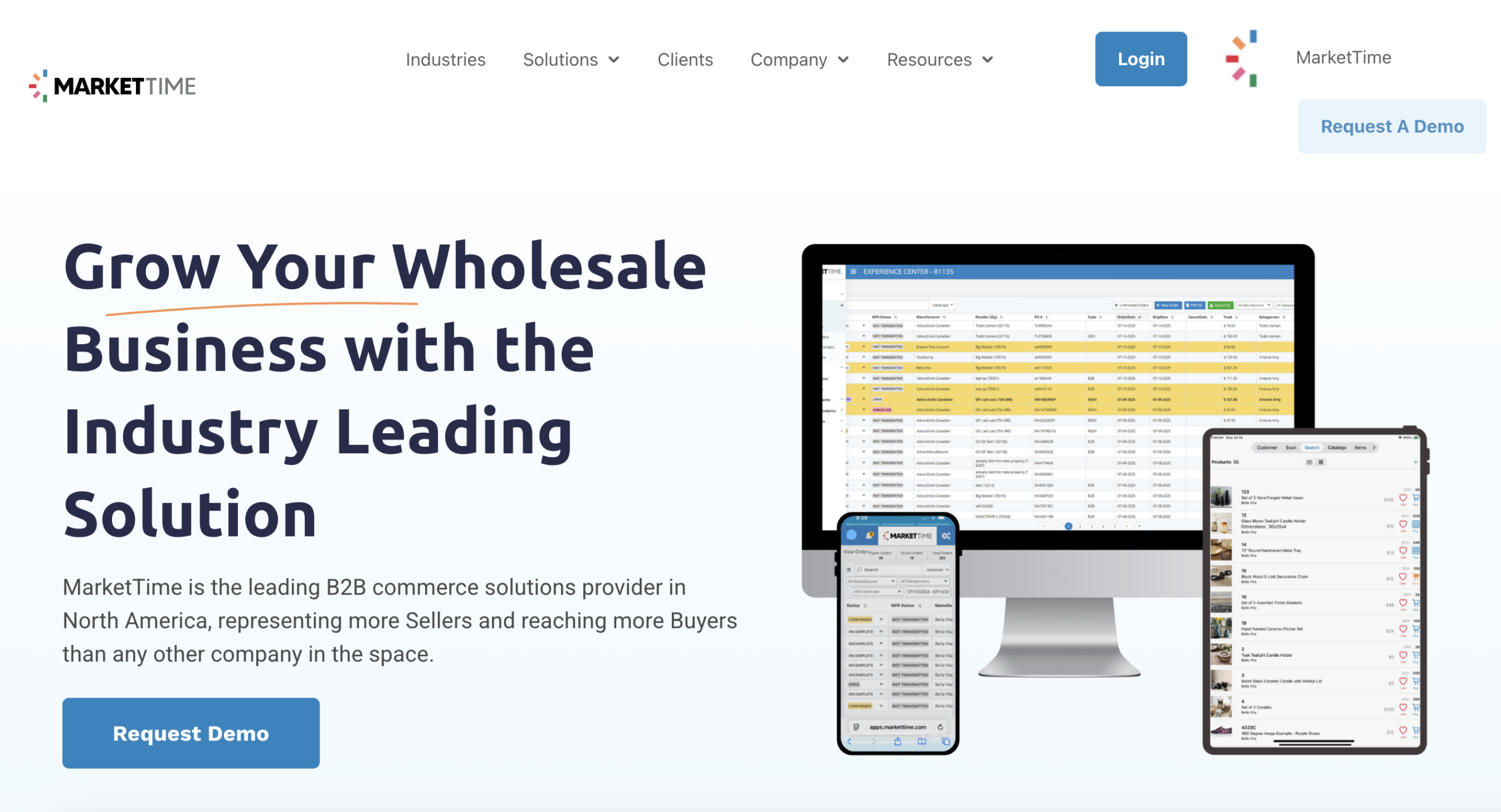
MarketTime serves a B2B wholesale universe that most general-purpose platforms do not understand well enough to build for: the toys, gifts, home décor, seasonal goods, and specialty apparel manufacturers whose buying cycles run through market weeks, showroom appointments, and rep-driven order writing rather than inbound digital ordering. The platform supports the full wholesale workflow for those environments, from digital catalog and mobile order writing to inventory management, analytics, and sales rep portals, with an offline mobile capability that ensures reps can write orders in any environment including trade show floors where connectivity is routinely unreliable. The Tableau-powered mtView module brings modern business intelligence to wholesale operations that have historically tracked performance through spreadsheets and end-of-season reports, giving teams visibility into order trends, rep performance, and inventory movement in real time rather than after the buying window closes. MarketTime’s merger with EMUN in late 2025 strengthened its position specifically in the gift and specialty goods sector, combining two platforms that had each built deep expertise in the same vertical. For industrial and services brands selling through specialty retail channels, dealer networks, or rep agencies that still operate through seasonal buying cycles, MarketTime is worth understanding as an operational infrastructure choice.
What MarketTime does well is reflect how wholesale actually works in its target categories rather than how a software company thinks it should work. Seasonal buying windows, trade show appointment coordination, showroom visit tracking, and volume-based promotional pricing structures that shift by time of year are built into the platform’s logic rather than grafted on through workarounds. The website plugin gives brands a branded wholesale ordering experience directly within their own site, so buyers can self-serve without being redirected to a third-party marketplace. Integration with QuickBooks, NetSuite, and Shopify handles the downstream accounting and fulfillment workflows that make the front-end buying experience operationally complete. For manufacturers in categories where the trade show floor still drives a meaningful share of annual wholesale volume, MarketTime provides the digital infrastructure to capture that volume more efficiently before, during, and after the show.
Services: B2B Wholesale Order Writing, Digital Catalog, Wholesale Marketplace, Inventory Management, Sales Rep Portal, Mobile Ordering, mtView Analytics, QuickBooks Integration, Shopify Integration, Trade Show Support
Standout Clients: American Greetings partners, Enesco, seasonal goods manufacturers across gift and home décor verticals
Best For: Manufacturers and sales agencies in home décor, gifts, toys, and seasonal goods that need wholesale order management built around rep-driven and trade show buying cycles rather than inbound digital ordering.
Why Choose MarketTime:
- Purpose-built for gift, home décor, and seasonal goods wholesale, with order writing, rep portal, and catalog tools that reflect how buying in those categories actually works
- Offline mobile ordering ensures reps can write orders anywhere, including trade show floors where connectivity is unreliable and every appointment counts
- mtView analytics powered by Tableau replaces end-of-season reporting with real-time visibility into order trends, inventory, and rep performance
7. B2B Wave
7. B2B Wave
A self-service B2B ordering portal for distributors who need to go digital without a project that takes a year
B2B Wave is for the wholesaler, distributor, or manufacturer that has been managing buyer orders through spreadsheets, email, and phone calls and knows it is time to change but is not willing to spend six figures and six months finding out if digital ordering actually works for their business. The platform delivers a complete B2B ecommerce storefront with customer-specific pricing, a digital product catalog, privacy groups, order management, and a sales rep portal, all configured without writing code and deployable in weeks rather than months. That speed and accessibility matter most for technology companies with reseller or VAR channels, industrial distributors with established buyer accounts, and services firms packaging recurring offerings into a self-service ordering environment. The platform’s interface is clean enough that buyer adoption is significantly easier than enterprise platforms carrying feature sets most SMB wholesale teams will never use. B2B Wave connects with QuickBooks, Xero, Sage, Brightpearl, and other accounting systems, so the ordering front end feeds directly into the financial workflows teams are already running rather than creating a new data silo.
The sales rep portal is a practical feature for teams transitioning away from phone and email ordering where rep relationships carry most of the volume. Agents can log in on behalf of customers, build carts, and generate orders without requiring buyers to navigate the portal themselves, which reduces the adoption friction in accounts where the rep is the relationship. Bulk product import and export handles large catalog updates efficiently, which matters for distributors managing thousands of SKUs where keeping the digital catalog current is a real operational burden. B2B Wave does not try to be SAP Commerce Cloud. It tries to be the most practical and accessible path to a functioning self-service ordering portal for businesses that have outgrown manual processes but are not yet at enterprise scale, and it executes on that more reliably than platforms that try to cover the full enterprise spectrum.
Services: B2B Ecommerce Storefront, Customer-Specific Pricing, Digital Catalog, Order Management, Sales Rep Portal, Privacy Groups, ERP Integration, QuickBooks Integration, Bulk Product Import, Inventory Sync
Standout Clients: Mid-sized distributors, manufacturers, and wholesalers across technology, industrial, and food service verticals
Best For: Wholesalers, distributors, and manufacturers that need an accessible, no-code path to digital B2B ordering without the implementation complexity or cost of enterprise platforms.
Why Choose B2B Wave:
- No-code configuration enables a fully functional B2B ordering storefront in weeks, with custom pricing, catalogs, and a rep portal set up without development resources
- Strong accounting integrations with QuickBooks, Xero, Sage, and Brightpearl connect the ordering front end directly to existing financial workflows
- Practical entry pricing and straightforward feature set designed for growing wholesale businesses that need digital ordering without enterprise overhead
8. Globy
8. Globy
Cross-border B2B trade discovery for brands ready to find buyers beyond their existing markets
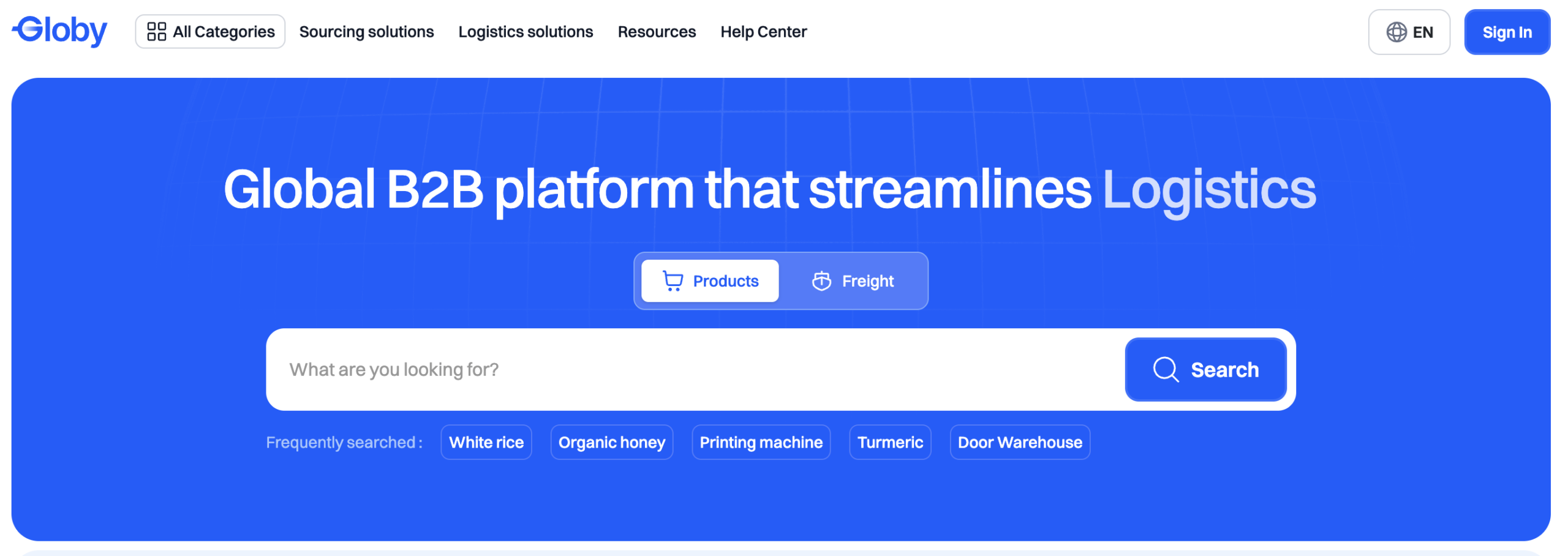
Globy operates in the part of B2B commerce that most platforms ignore: the moment when a manufacturer or distributor has saturated their existing buyer relationships and needs to find new ones in markets they do not already have distribution in. The platform combines a B2B product sourcing marketplace with logistics tools including a freight rate calculator, a directory for unclaimed and overstayed cargo, and global shipping support, giving businesses a single environment for both finding trade partners and managing the logistics of moving goods across borders. The Quick Logistics feature lets users calculate shipping costs across carriers and routes in real time, which is useful for evaluating the actual landed cost of an global sourcing or distribution decision before committing to it. Globy does not charge commissions on product uploads, which gives suppliers a lower-friction path to building a presence on the platform compared to commission-heavy marketplace models. For technology companies looking to find global resellers, industrial manufacturers seeking new export buyers, and services firms exploring cross-border distribution partnerships, Globy provides a dedicated discovery environment for those connections.
The platform is not a managed marketplace with the transaction volume of Amazon Business or the curation of Faire. It is a trade discovery and logistics tool that serves businesses where finding the right global partner is the primary constraint on growth. Supply chain diversification has become a strategic priority for most B2B organizations following the disruptions of the early 2020s, and platforms that help companies identify alternative suppliers or new global buyers address a genuine operational need rather than a speculative one. For industrial brands in particular, where raw materials sourcing and component supply involve cross-border relationships that can span dozens of countries, Globy’s logistics tools and supplier directory provide infrastructure that generic B2B marketplaces were not built to support. It is a niche tool that serves its niche well, and for companies with active global trade ambitions, it fills a gap that most other platforms on this list do not touch.
Services: Global B2B Marketplace, Supplier Directory, Buyer Network, Freight Rate Calculator, Quick Logistics, Product Discovery, Unclaimed Cargo Directory, Global Trade Connections
Standout Clients: Global manufacturers, commodity traders, and importers across automotive, industrial, and consumer goods sectors
Best For: Manufacturers, distributors, and traders seeking to expand into new global markets, identify alternative suppliers, or connect with global wholesale buyers outside their existing distribution network.
Why Choose Globy:
- Dedicated global trade discovery environment spanning multiple sectors and geographies, with tools built for cross-border wholesale rather than adapted from domestic marketplace models
- Integrated freight rate calculator and logistics support cover the full global trade evaluation and execution workflow in one platform
- No commission model for supplier listings lowers the barrier to building a presence compared to fee-heavy marketplace alternatives
9. Amazon Business
9. Amazon Business
The procurement marketplace where 6 million business sellers compete for the attention of enterprise buyers
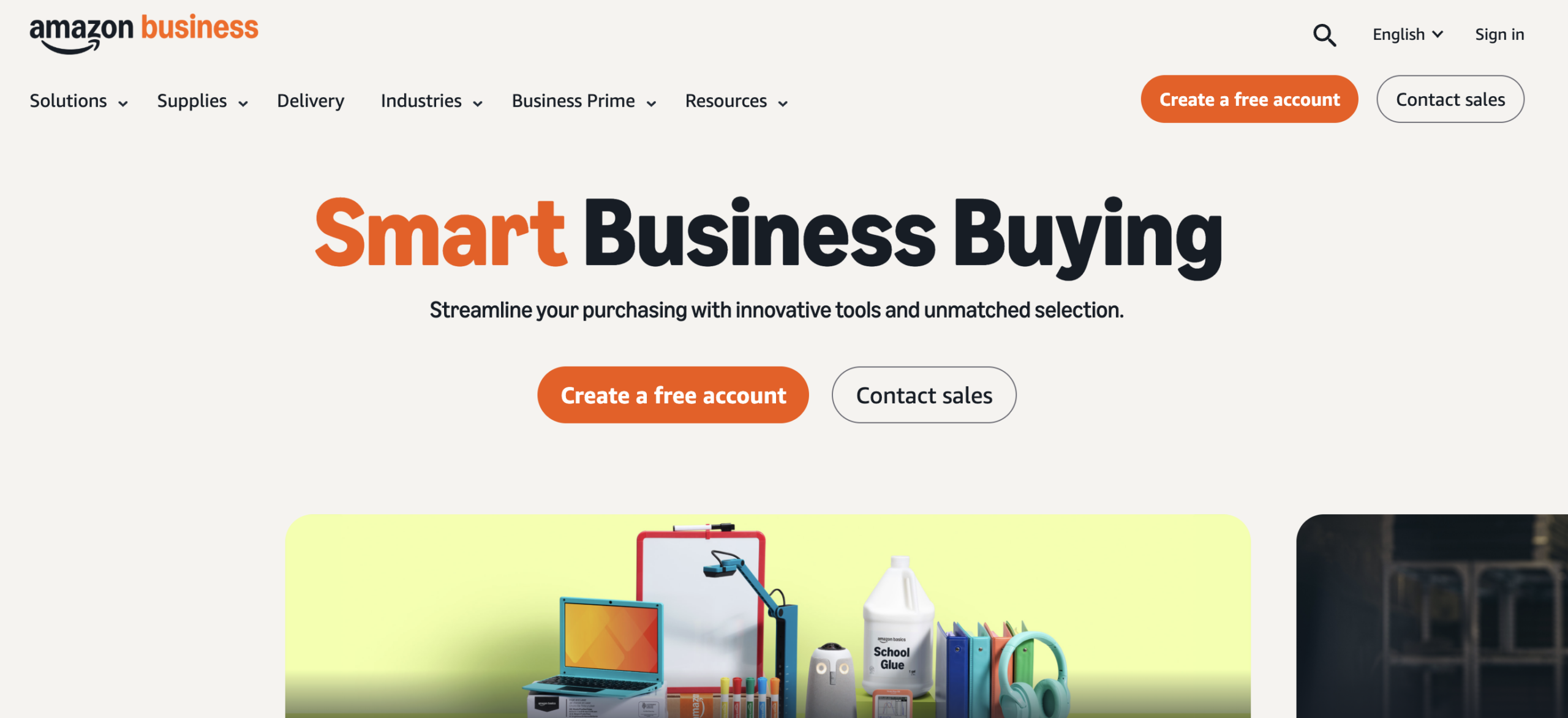
Amazon Business is where B2B procurement has been quietly consolidating for the past decade, and most manufacturers and distributors are either optimizing their presence there or ceding that ground to competitors who are. The platform processes over $35 billion in annual B2B sales through a seller base exceeding 6 million business vendors, with an integrated purchasing assistant that drove a 60% conversion lift among B2B buyers in early 2026. For technology companies, industrial brands, and services firms that sell physical products or accessories, the question is not whether their buyers are shopping on Amazon Business. It is whether their products are showing up correctly when those buyers search. Multi-user account structures, approval workflows, guided buying controls, and eProcurement punch-out integration with Ariba and Coupa give enterprise procurement teams the governance infrastructure they need to manage purchasing through the platform without losing control of spend. Business Prime adds free shipping, spend analytics, and exclusive bulk pricing that increase buyer loyalty and purchase frequency across vendor relationships.
The strategic implication for sellers is straightforward: Amazon Business is a retail media environment as much as a marketplace, and the brands investing in optimized listings, sponsored product placements, and Business-only pricing are the ones winning shelf space in the digital procurement aisle. Getting on the platform is table stakes. Getting found, maintaining visibility against competitive listings, and connecting Amazon Business sales activity to broader pipeline and revenue reporting are where most internal teams fall short. For manufacturers and distributors in categories where buyers are actively procuring on Amazon Business, treating it as a passive listing channel rather than a managed shopping program is how market share quietly transfers to competitors who are paying closer attention.
Services: B2B Marketplace, Business Prime, Multi-User Account Management, Spend Analytics, Guided Buying, Approval Workflows, Business-Only Pricing, Bulk Purchasing, eProcurement Punch-Out, Retail Media Advertising
Standout Clients: Uber, ExxonMobil, Allstate
Best For: Manufacturers and distributors looking to reach enterprise procurement buyers at scale on the highest-traffic B2B procurement marketplace, with built-in purchasing governance tools for enterprise buyer organizations.
Why Choose Amazon Business:
- 6 million+ business sellers and a purchasing assistant with proven 60% conversion lift make it the highest-traffic B2B procurement marketplace available, with or without optimization
- Enterprise procurement tools including guided buying, approval workflows, and eProcurement punch-out integrate with existing Ariba, Coupa, and SAP procurement stacks
- Retail media capabilities let brands invest in visibility within the marketplace, turning passive listings into managed shopping programs with measurable sales impact
10. VTEX
10. VTEX
AI-native composable commerce for enterprise brands managing B2B and B2C simultaneously
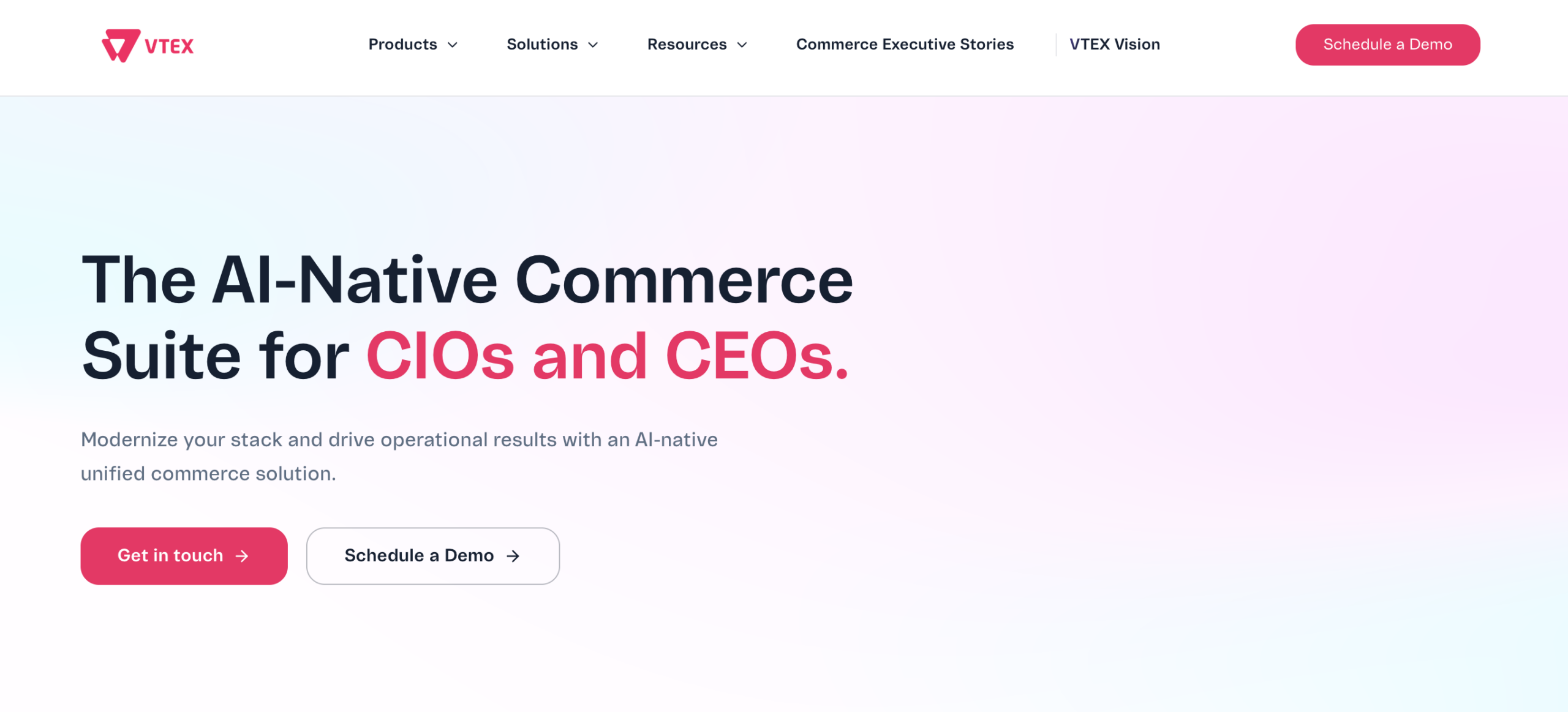
VTEX occupies an interesting space in enterprise commerce: it is the platform of choice for organizations that need to run sophisticated B2B and B2C commerce simultaneously on a single composable architecture. The platform’s Pragmatic Composability approach lets businesses combine native VTEX services with best-of-breed third-party applications, giving enterprise teams the flexibility of a composable stack without the full implementation complexity of building everything from API components. VTEX supports B2B-specific capabilities including account hierarchies, custom pricing, order management, and marketplace management alongside a complete B2C commerce feature set, making it the strongest option for brands selling to both business buyers and end consumers from the same infrastructure. In April 2026, VTEX announced its AI-native commerce suite, placing AI at the core of its architecture rather than as a layer on top of it. The B2B Commerce with AI Quotation feature generates quotes from files or voice input, accelerating sales cycles and improving conversion on high-consideration purchases. VTEX processes commerce for customers in 40+ countries and has demonstrated significant momentum with B2B brands globally.
Whirlpool, Motorola, and Briggs & Stratton are among the enterprise brands that have deployed VTEX to power their digital commerce operations, organizations that deal with the full complexity of managing multi-market, multi-channel commerce at scale. VTEX’s marketplace management capabilities are particularly strong for brands that want to operate their own multi-vendor marketplace alongside or in place of a traditional product catalog, a growing strategy among industrial distributors looking to expand their supplier network without the inventory risk. The platform’s order management system handles complex fulfillment scenarios, multi-warehouse routing, and drop-ship logistics, which are requirements that commodity ecommerce platforms typically cannot meet without significant custom work. For enterprise brands that need to consolidate B2B and B2C commerce on a single platform with genuine AI capabilities, VTEX is one of the few platforms that can credibly deliver on all of it.
Services: B2B and B2C Digital Commerce, Marketplace Management, AI Quotation, Order Management System, CMS, Promotions Engine, Multi-Channel Commerce, Fulfillment Integration, AI-Native Commerce Suite
Standout Clients: Whirlpool, Motorola, Briggs & Stratton
Best For: Enterprise brands managing complex B2B and B2C channels simultaneously, especially those operating across multiple markets or running multi-vendor marketplace models.
Why Choose VTEX:
- Pragmatic Composability approach delivers flexibility without full composable implementation complexity, supporting both B2B and B2C on one platform
- AI-native commerce suite includes AI Quotation from files or voice, accelerating B2B sales cycles on high-consideration purchases
- Strong marketplace management capabilities for brands building multi-vendor distributor networks alongside traditional product catalogs
11. Sana Commerce
11. Sana Commerce
B2B shopping powered directly by your ERP data, not synchronized to a copy of it
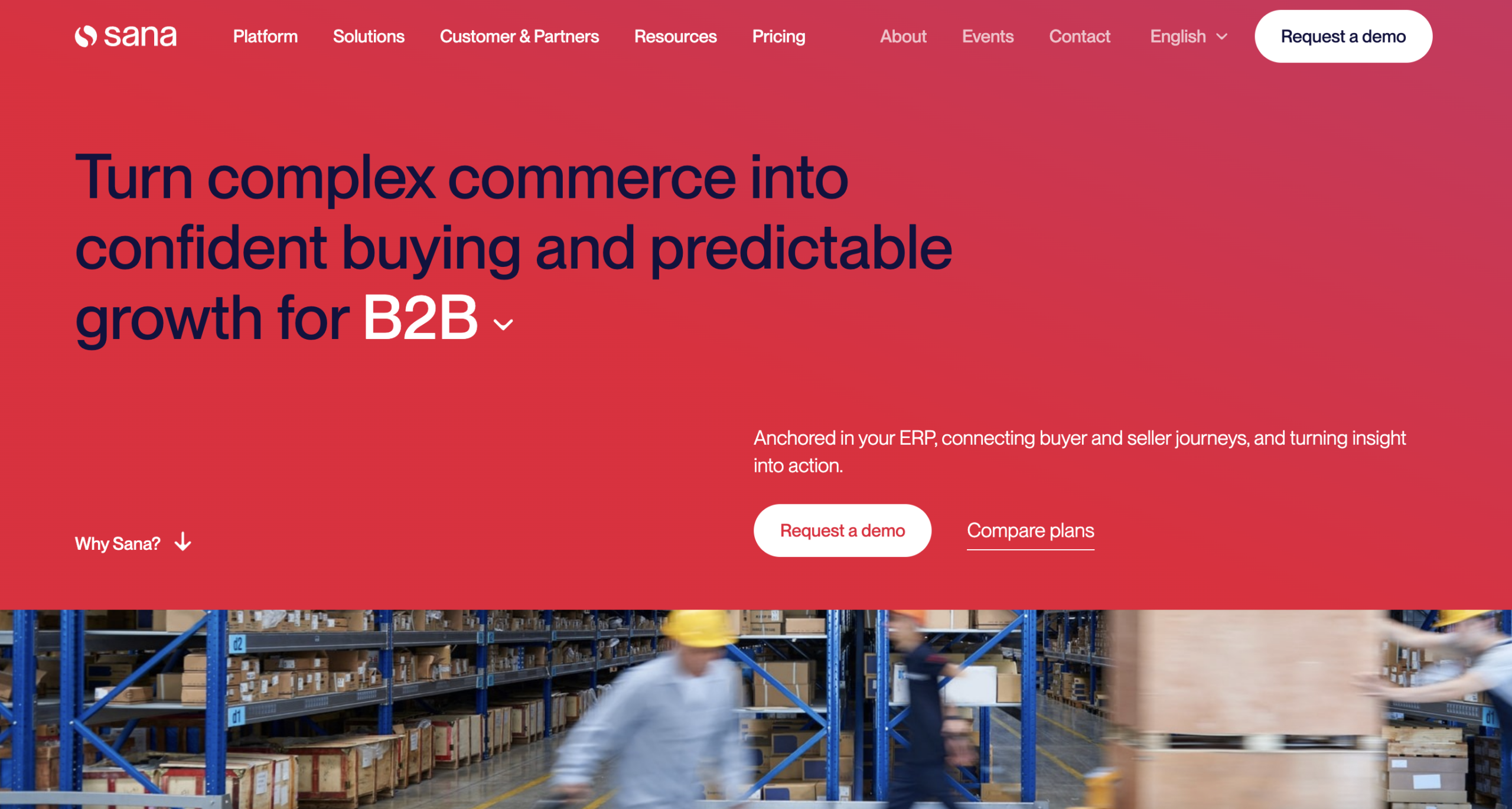
Sana Commerce is built on a premise that sounds obvious once you hear it: your ERP already has everything your buyers need to make a purchasing decision, so why is your shopping platform working from a synchronized copy of that data instead of the real thing? The platform integrates natively with SAP and Microsoft Dynamics, pulling real-time product information, inventory levels, customer-specific pricing, and order history directly from the ERP into the buyer portal without a separate PIM layer, middleware stack, or scheduled sync that introduces latency and error. For technology companies running NetSuite or Dynamics licensing systems, industrial distributors managing large inventory networks, and services firms with contract-specific pricing structures, the implications are significant. Buyers see what is actually available at the prices they actually have, with lead times that reflect current warehouse reality rather than last night’s data pull. That sounds basic. It is genuinely difficult to maintain at scale on platforms that treat ERP data as a feed to be managed rather than a live system to connect to directly. Sana Commerce powers over 1,500 web stores worldwide and has been recognized in the Gartner Magic Quadrant for Digital Commerce for 4 consecutive years.
The speed-to-value advantage of ERP-native architecture is real. Because integration is native and product data comes directly from the system of record, implementation timelines are significantly shorter than platforms requiring separate data migration and synchronization strategies. Michelin Group, Ravensburger, and Akzo Nobel have deployed Sana Commerce to power their B2B ordering environments at a scale where catalog complexity, customer-specific pricing, and real-time inventory accuracy are not optional. The platform’s self-service features — repeat ordering, invoice tracking, RMA management, and customer portals — drive buyer self-sufficiency and reduce customer service overhead, which compounds over time into measurable operational cost reduction. For B2B teams that have spent years managing the friction of keeping ecommerce product data aligned with the ERP, Sana Commerce removes the problem at the root rather than adding more tooling to manage it.
Services: ERP-Native Ecommerce, SAP Integration, Microsoft Dynamics Integration, Real-Time Product Data, Customer Portals, Self-Service Ordering, Invoice Management, Repeat Ordering, Inventory Visibility, RMA Management
Standout Clients: Michelin Group, Ravensburger, Akzo Nobel
Best For: B2B manufacturers and distributors running SAP or Microsoft Dynamics that need a shopping portal powered directly by ERP data, eliminating synchronization overhead and product data discrepancies.
Why Choose Sana Commerce:
- Native SAP and Microsoft Dynamics integration delivers real-time pricing, inventory, and customer data directly from the ERP without middleware, eliminating the data quality issues that undermine most B2B shopping experiences
- Shorter implementation timelines than platforms requiring separate PIM layers and synchronization strategies, with faster time to a live buying environment
- Recognized in the Gartner Magic Quadrant for Digital Commerce for 4 consecutive years across manufacturing, distribution, and specialty wholesale deployments
12. OroCommerce
12. OroCommerce
The B2B shopping platform built from scratch for manufacturers and distributors, not adapted for them
OroCommerce makes a claim most B2B platforms cannot substantiate: it was designed exclusively for B2B from the first line of code. That distinction matters because most enterprise ecommerce platforms were built for consumer or D2C buying and then extended for B2B through additional modules, workarounds, and custom development that creates technical debt every time a new business requirement comes up. OroCommerce started with the actual complexity of manufacturer and distributor buying environments — account hierarchies, tiered pricing across buyer segments, RFQ and CPQ workflows, multi-website management, and a native CRM — and built the platform around those requirements as first-class capabilities rather than afterthoughts. The result is a shopping environment where the things that define B2B buying, including custom pricing by customer group, quote-to-order workflows, and multi-warehouse inventory visibility, work reliably without requiring months of configuration to get right. Over 130 enterprise B2B clients trust the platform, and Gartner recognizes OroCommerce as a Visionary in its Magic Quadrant for Digital Commerce.
PartsBase runs its entire $2 billion aviation parts network on OroCommerce, using the native CRM to manage relationships across thousands of buyer and seller accounts. Azelis runs 150 regional portals from a single OroCommerce instance, which is a scale of multi-website management that most platforms handle through complex custom architecture rather than native functionality. OroCommerce’s recent AI expansion, including a transition to Google Gemini models for faster and more accurate catalog search and buyer recommendations, signals investment in the capabilities that will define B2B shopping performance over the next several years. For technology companies with complex software licensing structures, industrial manufacturers with large configurable product catalogs, and services firms managing contract-specific buying rules, OroCommerce provides a B2B shopping foundation that does not require adapting a consumer platform to serve a fundamentally different kind of buyer.
Services: B2B Ecommerce, CRM Integration, CPQ, Marketplace Management, Multi-Website, Customer Portal, Quote Management, Tiered Pricing Rules, DAM, Inventory Management, AI Search
Standout Clients: PartsBase, Azelis, Purfresh
Best For: Manufacturers and distributors with complex account hierarchies, multi-channel sales structures, and high-volume B2B requirements that need a platform built specifically for those constraints rather than adapted to them.
Why Choose OroCommerce:
- Purpose-built for B2B from the ground up, with native CRM, CPQ, and multi-website management as first-class platform capabilities rather than bolt-on modules
- Handles account hierarchy, tiered pricing, and approval complexity that most B2B teams work around on platforms originally designed for consumer buying
- Proven at enterprise scale: PartsBase runs a $2B aviation network on OroCommerce and Azelis manages 150 regional portals from one instance
13. Shopware
13. Shopware
Open-source composable B2B shopping for brands with complexity better than standard platforms

Shopware occupies a genuinely useful position in the B2B shopping platform landscape: it is enterprise-capable and composable without requiring the full engineering overhead that platforms like commercetools demand. The B2B Suite delivers customer portals, approval workflows, a native RFQ engine, custom pricing, and quote-to-order conversion on an open-source, API-first architecture that gives technical teams real control over platform behavior without locking them into a vendor’s prescribed technical path. That combination makes Shopware particularly strong for technology companies managing software bundle configurations, industrial brands running large configurable product catalogs with variant logic that standard platforms cannot handle cleanly, and services organizations packaging complex offers across multiple buyer segments. The platform supports thousands of SKUs and complex product variant structures without performance degradation, which matters when catalog depth and technical specification accuracy are what buyers are evaluating. Grohe deployed Shopware’s B2B Suite to manage its demanding wholesale requirements, and Beijer Ref grew ecommerce from 0.1% to 15% of total revenue within 36 months of implementation.
The middleware-driven integration approach gives brands operating across multiple ERP systems and regional pricing structures, like REIFF Group, a way to centralize product logic, pricing, and availability across every sales channel from a single Shopware instance rather than managing separate configurations per market. REIFF used that architecture to eliminate manual pricing corrections across its distribution network and build a scalable self-service buying foundation for its industrial buyer base. Shopware’s North American presence is growing alongside its strong European enterprise base, making it a credible option for brands operating across both markets. For teams that want composable flexibility without a full custom-build timeline, Shopware sits at a useful middle point between the opinionated enterprise platforms and the API-only composable tools that require building nearly everything from scratch.
Services: B2B Suite, Customer Portals, RFQ & Quote Management, Custom Pricing Engine, Approval Workflows, Complex Catalog Management, ERP Integration, API-First Architecture, Multi-Channel Commerce, AI-Powered Product Search
Standout Clients: Grohe, REIFF Group, Beijer Ref
Best For: Technology, industrial, and services brands with complex catalog structures, multi-ERP environments, or configurable product requirements that need composable B2B shopping infrastructure without a full custom engineering build.
Why Choose Shopware:
- Native B2B Suite with RFQ tools, approval workflows, and customer portals covers complex buying workflows across technology, industrial, and services verticals without custom development
- Open-source, API-first architecture gives development teams genuine control over platform behavior and integration with existing ERP, pricing, and product systems
- Enterprise-capable without enterprise-only implementation overhead, sitting between opinionated platforms and fully composable tools that require building from scratch
14. commercetools
14. commercetools
API-first composable B2B shopping for enterprises that need to build the buyer experience themselves

commercetools is the platform for enterprise B2B organizations that have concluded no existing platform will deliver exactly the buyer experience their business requires, and have both the technical resources and the long-term roadmap to build it themselves. The platform provides the modular building blocks — account hierarchy management, role-based permissions, custom pricing, tiered pricing, Business Unit-specific catalogs, quote workflows, approval processes, recurring orders — and leaves the architecture of how those components connect to the team building on top of them. That is a meaningful distinction from platforms that make those architectural decisions for you. commercetools surpassed $100B GMV run-rate in Q1 2026, a milestone that reflects how broadly the platform has been adopted across enterprise commerce at a scale where custom architecture delivers genuine competitive advantage. The MACH architecture (Microservices, API-first, Cloud-native, Headless) gives technical teams the flexibility to integrate any front-end technology, ERP, CRM, or third-party service without platform constraints determining what is possible. For technology companies with sophisticated self-serve buying portals, industrial enterprises with highly specialized procurement workflows, and services organizations with complex entitlement and pricing structures, commercetools provides a foundation that can accommodate almost any requirement given sufficient technical investment.
The tradeoff is real and worth stating plainly: commercetools is not a platform that ships with a ready-made B2B storefront or a quick-launch implementation path. BIC built a B2B portal serving 100+ countries on it. Dawn Foods built distributor self-service. Vistaprint built enterprise ordering. Those are outcomes that required skilled engineers, a clear architecture vision, and a willingness to invest in building before seeing the full return. Organizations that approach commercetools as a plug-and-play solution consistently underperform relative to those that treat it as an infrastructure investment with a deliberate build plan. For enterprises that expect their shopping environment to evolve significantly over the next 5 years and need a foundation that will not constrain that evolution, commercetools is the right long-term architectural bet.
Services: API-First B2B Commerce, Business Unit Management, Custom Pricing, Quote & Approval Workflows, Inventory Management, Cart & Order Management, Multi-Currency, Search & Discovery, Composable Commerce Architecture
Standout Clients: BIC, Dawn Foods, Vistaprint
Best For: Enterprise B2B organizations with complex technical requirements, multi-region operations, and development teams capable of building and maintaining a composable shopping architecture over the long term.
Why Choose commercetools:
- MACH architecture delivers complete flexibility to build exactly the B2B buying experience your business requires without platform constraints determining what is possible
- Surpassed $100B GMV run-rate in Q1 2026, demonstrating enterprise-scale reliability across organizations with highly custom shopping requirements
- Native B2B capabilities including Business Unit management, tiered pricing, and approval workflows support complex wholesale structures without custom development of core features
15. BigCommerce B2B Edition
15. BigCommerce B2B Edition
Native wholesale functionality for mid-market brands that need more than a basic storefront
BigCommerce B2B Edition is an add-on to BigCommerce Enterprise that delivers purpose-built wholesale functionality without the implementation complexity of legacy enterprise platforms. The platform supports multi-tier organizational structures, role-based access, customer-specific catalogs, tiered pricing, bulk invoice payments, and multi-branch account management, covering the core requirements of most mid-market wholesale operations without custom development. Multi-storefront management allows organizations to run separate buyer environments for different brands, regions, or customer segments from a single backend, which simplifies governance for businesses operating across multiple channels or geographies. The platform’s open API architecture gives development teams flexibility to integrate with existing ERP, CRM, and PIM systems without being locked into a prescribed technical stack. For mid-market technology, industrial, and services brands that need more B2B buying capability than a basic ecommerce store provides but are not ready to commit to the overhead of an enterprise platform built for SAP environments, BigCommerce B2B Edition occupies a practical middle ground.
Customer-specific pricing is where BigCommerce B2B Edition removes friction that smaller platforms require workarounds to address. Merchants create distinct price lists for individual customers or customer groups behind individual logins, so a high-volume enterprise account and a smaller regional buyer see completely different pricing structures without manual intervention. The platform’s headless implementation option gives teams front-end flexibility while preserving the B2B pricing and account logic they have built in the backend. For growing manufacturers and distributors that need a scalable wholesale shopping foundation with a reasonable implementation timeline, BigCommerce B2B Edition delivers a functional starting point that can extend as business requirements evolve.
Services: B2B Wholesale Storefront, Company Account Management, Custom Pricing & Catalogs, Bulk Ordering, Quote Management, Role-Based Access, Net Payment Terms, Multi-Storefront, Headless Commerce, ERP Integration
Standout Clients: Avery Dennison, Hestan Commercial, Carter’s
Best For: Mid-market to enterprise B2B brands that need robust native wholesale functionality and customer-specific pricing without extensive custom development investment.
Why Choose BigCommerce B2B Edition:
- Native customer-specific pricing and catalog management handles core wholesale pricing complexity without custom development in most mid-market scenarios
- Multi-storefront management supports separate buyer environments for different brands, regions, or customer segments from a single backend
- Open API architecture supports integration with existing ERP, CRM, and PIM systems without platform lock-in
16. Adobe Commerce
16. Adobe Commerce
Deep customization and AI merchandising for enterprise B2B shopping at scale
Adobe Commerce, built on the Magento foundation, is one of the most configurable B2B shopping platforms available for enterprise organizations with requirements that more opinionated platforms cannot accommodate. Company accounts with multiple buyers, roles, and purchasing permissions replicate complex internal procurement structures in the storefront. Shared catalogs, contract pricing, purchase order management, and quote negotiation are native capabilities, covering the core wholesale workflows that define most manufacturing and distribution buying cycles. The approval hierarchy functionality is built for enterprise procurement: junior buyers build carts, transactions are held until designated approvers authorize spend, and the audit trail documents the approval chain. Adobe Sensei AI powers merchandising, product recommendations, and search relevance, giving B2B teams intelligent optimization capabilities that most platforms require expensive integrations to deliver. Adobe Commerce is designed for organizations with complex multi-brand operations, large and frequently changing catalogs, and deep customization requirements that surface limitations in more opinionated platforms. The implementation timeline and ongoing maintenance investment reflect that positioning.
The partner ecosystem of certified Adobe Commerce implementation agencies gives enterprise teams strong options for deployment and support, which matters for a platform where the path to a functioning B2B shopping environment involves meaningful configuration work. Adobe Commerce is widely deployed across manufacturing, wholesale distribution, and specialty retail, with particular strength in organizations running multiple storefronts across brands or geographies from a single instance. For businesses with $5M+ in revenue, complex multi-channel B2B requirements, and a technical team or agency partner capable of realizing the platform’s potential, Adobe Commerce delivers a buying environment that can be shaped around almost any business requirement.
Services: B2B Company Accounts, Shared Catalogs, Custom Pricing, Quote Negotiation, Purchase Orders, Multi-Site Management, AI Merchandising, ERP Integration, B2B Payment Management, Progressive Web App
Standout Clients: Helly Hansen, Mitsubishi Electric, HP
Best For: Enterprise organizations with complex multi-brand operations, large product catalogs, and deep customization requirements that standard platforms cannot accommodate without significant workarounds.
Why Choose Adobe Commerce:
- Native B2B suite covers company accounts, shared catalogs, PO management, and approval hierarchies for enterprise wholesale buying without requiring custom development of core workflows
- Adobe Sensei AI delivers intelligent merchandising, search, and product recommendations across B2B shopping environments
- Highly configurable architecture supports virtually any B2B buying model, with a certified implementation partner ecosystem for deployment and long-term support
17. Salesforce B2B Commerce
17. Salesforce B2B Commerce
Shopping and CRM in one system for B2B teams already living inside Salesforce
For organizations already running their revenue operations inside Salesforce, B2B Commerce offers something no other platform can: shopping functionality built directly on the same infrastructure as the CRM, Service Cloud, and marketing automation stack. The integration is not a connector or a nightly sync. It is the same data model, so sales reps see what their accounts have ordered online, service teams access order history without switching systems, and marketing can trigger nurture sequences based on shopping behavior. That unified view changes how teams collaborate across a buying cycle where the same account might be researching products in the shopping portal, asking a service question through support, and talking to a sales rep simultaneously. Account-specific catalogs, contract pricing, bulk ordering, self-service reorder portals, and Agentforce AI-powered recommendations cover the core wholesale shopping requirements for most B2B organizations. The platform serves manufacturing, wholesale distribution, healthcare, food and beverage, and technology verticals at enterprise scale.
The Salesforce ecosystem is both the platform’s greatest advantage and its primary constraint. Teams already invested in Salesforce get a commerce layer that extends their existing investment rather than creating a new system to manage. Teams that are not yet on Salesforce CRM take on the cost and complexity of the broader ecosystem to reach the commerce platform’s full potential. For organizations that have already made that commitment, Salesforce B2B Commerce connects shopping activity to the rest of the revenue operation in a way that external platforms cannot replicate through integration alone.
Services: Account-Specific Catalogs, Contract Pricing, Bulk Ordering, Self-Service Reorder Portals, CRM Integration, Agentforce AI Commerce, Order Management, Multi-Site Management, B2B Checkout, Einstein Recommendations
Standout Clients: GE Healthcare, Unilever, Toyota
Best For: Enterprise organizations already invested in Salesforce CRM that need shopping and revenue operations to function as a unified system with a single source of customer truth.
Why Choose Salesforce B2B Commerce:
- Native integration with Salesforce CRM, Service Cloud, and marketing automation creates a unified customer record across buying, service, and sales touchpoints
- Agentforce AI delivers personalized product recommendations, dynamic pricing, and intent-aware search across B2B shopping environments
- Strong vertical depth across manufacturing, wholesale distribution, healthcare, and technology for enterprise-scale operations already inside the Salesforce ecosystem
18. SAP Commerce Cloud
18. SAP Commerce Cloud
Enterprise B2B shopping for organizations where the ERP and the storefront need to be the same system
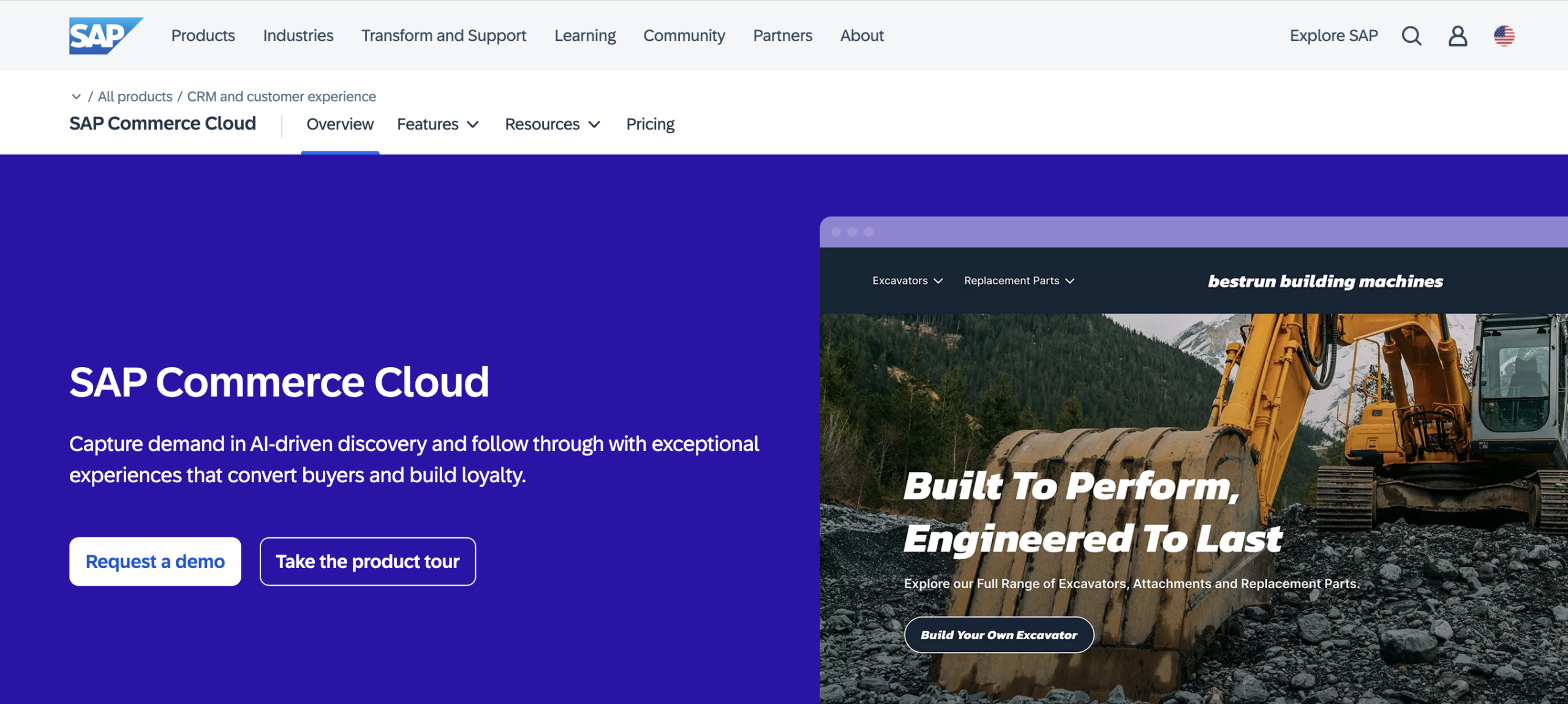
SAP Commerce Cloud is the natural endpoint for large enterprises that run their business on SAP ERP and need their shopping environment to reflect that data in real time. The native integration with SAP S/4HANA, SAP CRM, and the broader SAP CX suite means customer records, contract pricing, product data, and inventory levels flow from the ERP into the shopping environment without the latency, data quality risk, and integration overhead of third-party middleware. For organizations where contract pricing is contractually complex, customer-specific assortments are a regulatory or relationship requirement, and order management must connect directly to supply chain systems, that native architecture is not a nice-to-have. It is the only approach that reliably maintains data accuracy at the scale and complexity these organizations operate at. The platform supports B2B and B2B2C models, customer self-service portals, guided selling, AI-powered merchandising, and multi-channel commerce across web, mobile, and assisted service. SAP Commerce Cloud is built for enterprise manufacturing and automotive industries where catalog scale, buyer-specific pricing, and real-time ERP data synchronization create requirements that most other platforms cannot meet without significant custom development.
Implementation timelines are measured in months, and the platform requires skilled technical resources to configure, maintain, and extend. For organizations already SAP-centric, that complexity is manageable because the rest of the technical stack is built around the same ecosystem. For organizations evaluating SAP Commerce Cloud without an existing SAP foundation, the total cost of ownership warrants careful analysis before committing. The platform consistently outperforms competitors in enterprise manufacturing, automotive, and industrial distribution environments where the ERP is the authoritative system for every downstream business process.
Services: B2B/B2C Digital Commerce, Customer-Specific Catalogs, Contract Pricing, Quote Management, CMS, OMS, AI Merchandising, SAP ERP Integration, Multi-Channel Commerce, Guided Selling
Standout Clients: Bosch, Bridgestone, Schaeffler
Best For: Large enterprises deeply embedded in the SAP ecosystem that need native integration between ERP data and a shopping environment capable of handling enterprise-scale catalog and pricing complexity.
Why Choose SAP Commerce Cloud:
- Native SAP ERP integration keeps customer records, contract pricing, and inventory synchronized in real time without middleware risk
- Built for enterprise-scale catalog complexity, customer-specific assortments, and B2B procurement compliance workflows in manufacturing and industrial distribution
- Strong vertical depth in manufacturing, automotive, and industrial distribution with pre-built accelerators for common enterprise use cases
What to Consider When Hiring a B2B Shopping Ad Agency
What to Consider When Hiring a B2B Shopping Ad Agency
Before committing to an agency partner for B2B shopping, the most important question is not which platforms they have managed but how clearly they can connect shopping activity to qualified pipeline for your specific vertical. A strong B2B shopping agency should be able to describe how they structure product feeds for buyer intent, how they build campaign architecture around your ICP rather than generic conversion volume, and how their measurement framework ties shopping impressions and clicks to CRM outcomes. Look for partners who understand the structural difference between B2B and B2C shopping — whether you are a technology company selling through software marketplaces, an industrial brand sourcing through procurement platforms, or a services firm packaging offers for digital discovery, the buying behavior and campaign architecture each requires look nothing like consumer shopping programs. Evaluate feed management depth specifically, because most agencies that say they do shopping are doing campaign management on top of feeds they never actually improve. Ask how they approach retail media beyond Google Shopping, and how they think about AI-powered discovery environments that are increasingly influencing how B2B buyers across technology, industrial, and services verticals evaluate options. Directive’s Shopping service is built to drive qualified pipeline across all 3 of our verticals: our feed strategy, campaign architecture, and retail media programs are designed to generate the right traffic and connect that activity to the revenue metrics your leadership team actually cares about.
Choosing the Right B2B Shopping Ad Partner
Choosing the Right B2B Shopping Ad Partner
The 18 platforms and partners on this list represent the best B2B shopping infrastructure available in 2026, spanning enterprise ecommerce environments, vertical wholesale marketplaces, software and services storefronts, branded ordering portals, and the agency layer that makes product discovery translate into qualified pipeline. The range exists because there is no single correct answer for B2B shopping — the right platform for a SaaS company selling through a software marketplace looks nothing like the right platform for an industrial distributor running a self-service ordering portal or a services firm packaging offers for digital buyers. What is consistent across the list is this: the platform is a prerequisite, not a strategy. The companies generating real revenue from shopping have invested equally in the platform and in the programs running on top of it.
The B2B organizations winning at shopping in 2026, whether they are in technology, industrial, or services, treat product discovery as a performance discipline. They have clean, structured feeds built for buyer intent in their specific category. They run retail media and shopping campaigns where their buyers actually evaluate options. They measure shopping performance in the language of pipeline, not impressions. And they have a partner who understands how B2B buying behavior in their vertical differs from consumer shopping intent well enough to build programs that account for it. If you are ready to make your shopping investment generate revenue instead of just activity, book a call with our B2B Shopping ads agency team and we can show you exactly what that looks like for your business.