








Key Takeaways
|
A global B2B marketplace does not scale by copying another platform or following the same approach as everyone in the “landscape”.
It scales by solving one hard trust, access, or repeat-demand problem better than the alternatives.
Alibaba.com, Amazon Business, and Faire prove that point in 3 different ways:
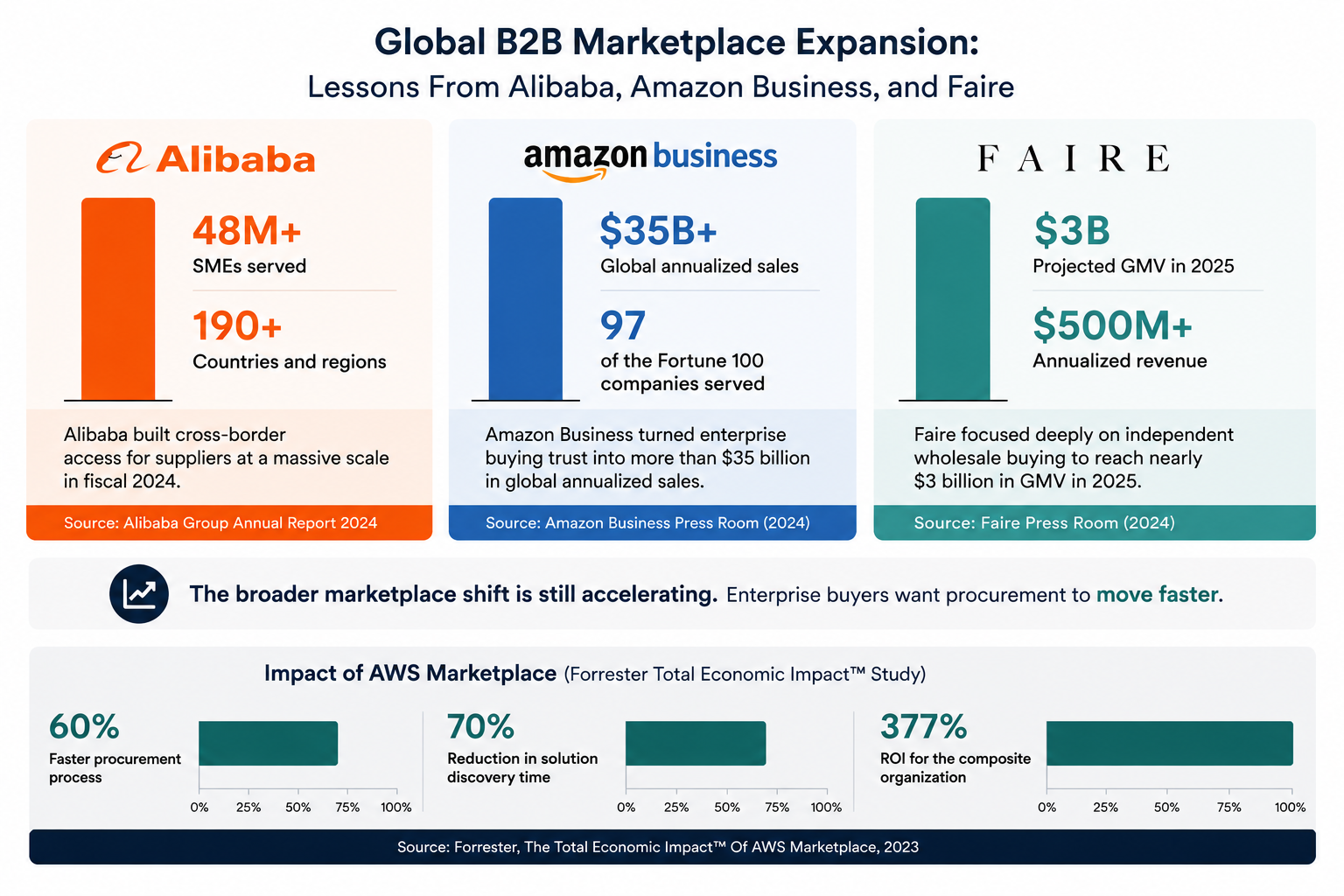
- Alibaba built cross-border access for suppliers at a massive scale, serving more than 48 million SMEs across over 190 countries and regions in fiscal 2024.
- Amazon Business turned enterprise buying trust into more than $35 billion in global annualized sales and serves 97 of the Fortune 100 companies.
- Faire projected nearly $3 billion in GMV in 2025 after focusing deeply on independent wholesale buying. And it is annualizing at more than $500 million in revenue.
The broader marketplace shift is still accelerating. Enterprise buyers want procurement to move faster.
The Forrester Total Economic Impact™ of AWS Marketplace study found that organizations using AWS Marketplace saw a 60% faster procurement process, a 70% reduction in solution discovery time, and a 377% ROI for the composite organization.
The lesson for B2B leaders is clear: global reach starts with focus.
The platform that wins usually solves one core market problem first, then builds trust, liquidity, and repeat usage around it.
How Leading Companies Build a Global B2B Marketplace Without Copying One Playbook
Marketplace expansion works when leaders understand the strategic bet behind the model.
Alibaba, Amazon Business, and Faire all built large B2B marketplaces.
But they did not scale through the same playbook. Each one solved a different problem first.
- Alibaba focused on cross-border supplier access.
- Amazon Business reduced procurement friction in a familiar buying environment.
- Faire went narrow, solving wholesale discovery and ordering for independent retailers and brands before expanding more broadly.
That difference is crucial. Often, new and inexperienced marketplaces copy the visible layer. They copy search, listings, checkout, supplier pages, or ads.
The harder work is choosing which side of the market to win first and which buying problem to solve better than anyone else.
| Company | Core Strategic Bet | What It Solved | Transferable Lesson |
| Alibaba | Supplier access at a cross-border scale | Helped global buyers find manufacturers and suppliers | Build trust around the fragmented supply before adding more control |
| Amazon Business | Procurement convenience inside a trusted buying environment | Made business purchasing easier for organizations already familiar with Amazon | Use existing buyer trust to reduce adoption friction |
| Faire | Narrow wholesale workflow for independent retailers and brands | Made discovery, ordering, terms, and repeat buying easier | Win a specific workflow before expanding the market |
| Cloud marketplaces | Procurement-aligned software buying | Helped enterprises buy through cloud commitments and approved systems | Marketplace fit often depends on procurement behavior |
For B2B Commerce teams, this is the first strategic filter. Before expanding, decide which market problem your platform can solve.
What Made Alibaba’s Global B2B Marketplace Model Work?
Alibaba is the cleanest example of an global B2B marketplace built around supplier access.
Its model worked because it made the fragmented global supply easier to discover.
Buyers did not need to own every factory, shipping lane, or trade relationship on Alibaba.
They needed a reliable way to find suppliers, compare options, and reduce uncertainty in cross-border sourcing.
That is why Alibaba’s expansion lesson is not “own everything.” It is “make access useful enough to create scale, then keep adding trust.”
A few choices made that possible:
- Supplier access came first. Alibaba created a way for global buyers to find manufacturers and suppliers across markets.
- Trust layers made the scale more usable. Trade assurance, supplier verification, reviews, payment tools, and sourcing support reduced buyer uncertainty.
- Supplier enablement expanded the platform. Alibaba.com gave sellers tools to market, transact, and support buyers across borders.
- AI became part of the sourcing layer. Alibaba announced AI Mode in 2025, describing it as agentic AI embedded in B2B sourcing.
At the same time, Alibaba reported a 57% YoY increase in European order volume and a 50% increase in the number of active suppliers worldwide.
The practical lesson is that global reach does not always require full control from day 1.
Alibaba scaled by first enabling a large supplier network, then adding trust, data, payments, and sourcing intelligence around the transaction.
For teams building a cross-border B2B marketplace, that sequence matters:
- Scale without trust creates noise.
- Trust without supply depth creates limited utility.
How Did Amazon Business Turn Existing Trust Into Marketplace Expansion?
Amazon Business solved procurement challenges for organizations already trusting Amazon’s buying experience.
Amazon Business did not need to convince buyers that the Amazon interface worked. Many users already understood the experience.
The B2B challenge was to make the buying environment fit procurement rules, budget controls, tax handling, approvals, and account structures.
Amazon Business’s model works because it reduces adoption friction inside organizations:
- Procurement familiarity lowers training burden. Buyers know how to search, compare, and order.
- Enterprise controls make the model acceptable. Multi-user accounts, spend visibility, guided buying, and extended terms help teams manage purchasing.
- Fulfillment expectations carry over. Buyers associate Amazon with availability, delivery speed, and operational reliability.
- Business Prime adds workflow value. Business Prime is available in 10 countries and includes tools such as Spend Visibility, Guided Buying, and Spend Anomaly Monitoring.
The strategic lesson is simple: trust can be an expansion wedge.
Amazon Business did not start from an abundance of cross-border suppliers.
It expanded by making business buying feel easier, safer, and more controlled for organizations already familiar with the marketplace.
For leaders, that raises an important question: where do buyers already trust you?
If the answer is procurement ease, fulfillment reliability, category coverage, or compliance support, expansion should build around that advantage.
Why Did Faire Win by Focusing Narrowly Instead of Globally First?
Faire did not start by trying to become the broadest global trading platform.
It focused on a painful wholesale workflow for independent retailers and brands.
- Independent retailers needed better ways to discover products, place orders, manage terms, and reduce buying risk.
- Brands needed better access to retailers without relying only on trade shows, reps, or fragmented wholesale relationships.
Faire was built around that workflow first. The results show how a narrow wedge can create scale.
Faire now partners with hundreds of thousands of retailers and brands globally, and continues to expand geographically.
The important lesson is that “global” does not always mean “broad” at the start.
Faire’s model worked because it made one workflow better for both sides:
- Retailers could discover new brands with less risk.
- Brands could reach qualified wholesale buyers.
- Terms and ordering became easier to manage.
- Repeat usage grew as retailers found more brands through the platform.
For marketplace leaders, Faire shows why a niche focus can become an advantage for expansion.
A focused workflow builds trust, liquidity, and retention before the platform expands into additional markets.
Which Lessons From These Marketplace Leaders Actually Transfer?
The point is not to copy Alibaba, Amazon Business, or Faire.
The point is to understand which strategic choice made each model work.
Every marketplace needs liquidity, trust, and repeat demand. But the order matters.
- Some platforms need supplier density first.
- Others need buyer trust.
- Some need procurement integration.
- Others need one workflow that creates repeat use.
| Strategic Choice | Alibaba Lesson | Amazon Business Lesson | Faire Lesson |
| Marketplace wedge | Supplier access | Procurement convenience | Independent retail wholesale |
| Trust mechanism | Trade assurance, verification, and AI sourcing | Enterprise controls, familiar buying experience, fulfillment | Terms, discovery, repeat ordering |
| Expansion path | Cross-border scale | Enterprise adoption | Category and country expansion |
| Risk to avoid | Scale without trust | Convenience without differentiation | Niche focus without liquidity |
| Transferable question | Which supply problem do we solve first? | Which buying friction can we remove? | Which workflow can we own deeply? |
This is where the marketplace expansion strategy becomes practical.
A worldwide B2B trading platform should not start with a generic goal like “go global.” It should start with a sharper decision:
- Which side of the market needs the most help?
- Which trust barrier blocks adoption?
- Which workflow creates repeat usage?
- Which market has enough density to learn quickly?
- Which operating dependency could break the promise?
Those answers matter more than surface features, because:
- A platform can have a polished interface and still fail if buyers do not trust supply quality.
- It can have strong suppliers and still stall if demand is too scattered.
- It can enter a new country and still struggle if localization, payments, tax, or logistics are treated as afterthoughts.
The transferable lesson is focus. Pick the first strategic bet, prove it, then expand from strength.
What Should Leaders Do Before Expanding a Worldwide B2B Trading Platform?
Before expanding, leaders need a clear readiness check.
Global expansion adds complexity fast. It can affect supply quality, trust, payment terms, buyer support, compliance, logistics, and GTM execution.
The question is not only whether a market looks attractive. The question is whether the platform can deliver a reliable buying experience there.
Use this framework before committing major resources.
| Readiness Factor | What to Validate | Warning Sign |
| Buyer concentration | A clear buyer segment with repeated need | Demand is too broad to message clearly |
| Supplier liquidity | Enough relevant supply to create choice | Buyers cannot compare credible options |
| Trust mechanism | Verification, terms, protection, or proof | Buyers need offline validation to proceed |
| Localization | Language, currency, tax, compliance, and category norms | Expansion requires too many manual workarounds |
| Operating dependency | Logistics, fulfillment, payments, or partner requirements | The platform promises more than operations can support |
| Repeat demand | Reasons for buyers to return often | Marketplace use becomes one-off sourcing |
| GTM focus | Clear positioning by market or segment | Expansion messaging sounds generic |
This is also where disciplined testing matters.
Teams can borrow a useful lesson from B2B SaaS growth hacking: test the constraint before scaling the system.
In marketplace expansion, that might mean testing supplier onboarding, buyer acquisition through channels such as Google Shopping, localized messaging, or repeat ordering before entering the full market.
The best expansion plans are specific. They define the buyer segment, the trust mechanism, the category wedge, and the first proof point needed to scale.
Build a Smarter Marketplace Expansion Strategy with Directive
Marketplace expansion creates pressure across positioning, demand generation, buyer acquisition, and partner growth.
That is where many B2B commerce teams need more than channel execution.
They need a clearer strategy for which market to enter, which buyer segment to prioritize, how to position the marketplace, and how to prove revenue impact as the model scales.
Directive’s B2B Commerce work helps teams connect market clarity, Customer Generation, and GTM execution.
For marketplace businesses, that means building demand around the buyers most likely to convert, strengthening differentiation, and tying performance back to pipeline and revenue.
If your team is building, scaling, or repositioning a marketplace, Directive’s marketplace agency approach can help turn an expansion strategy into a clearer growth plan.
Global B2B Marketplace FAQs
What Is a Global B2B Marketplace?
A global B2B marketplace is a digital platform where businesses buy and sell across countries or regions. It helps buyers compare suppliers, products, terms, pricing, and availability in one environment.
How Is an Global B2B Marketplace Different From a Local One?
An global B2B marketplace involves greater complexity in supplier diversity, localization, compliance, currency, payments, logistics, and trust. Local marketplaces can often rely on simpler operating assumptions.
Why Is Alibaba Often Used as the Global B2B Marketplace Example?
Alibaba.com is often used as an example because it has built massive cross-border access to suppliers. Its model shows how supplier scale, trust layers, and trade support can help buyers source across markets.
Is Amazon Business a True Global B2B Marketplace?
Yes, but its model differs from traditional cross-border trade marketplaces. Amazon Business is strongest where procurement convenience, enterprise controls, familiar buying behavior, and fulfillment infrastructure matter.
What Should Companies Validate Before Expanding to Global Markets?
Companies should validate buyer concentration, supplier liquidity, trust mechanisms, localization needs, operating dependencies, repeat demand, and GTM focus before scaling into new markets.