







Your Product Feed Is Deciding What Buyers Can Find and Buy
Your Product Feed Is Deciding What Buyers Can Find and Buy
A product feed can look healthy in a spreadsheet and still be quietly disqualifying half the catalog. B2B manufacturers and distributors have more ways for that to happen than most, from missing MPNs and tangled parent-child relationships to contract pricing, quote-only products, and ERP exports built for internal operations instead of buyer discovery. The consequences surface everywhere product data travels. Shopping campaigns lose eligible inventory, marketplaces misclassify products, AI engines receive thin context, and media teams pay to promote SKUs that should never have entered the auction. Feed management is no longer catalog housekeeping. It is commercial infrastructure.
The strongest partners do more than clean columns and clear Merchant Center warnings. They decide how the catalog and your advertising campaigns should be structured, which attributes reflect procurement intent, how margin and inventory should control promotion, and who owns data quality after launch. That distinction matters because plenty of providers can move data between systems, but far fewer can connect product data to B2B search behavior and profitable growth. This list ranks 15 product feed management agencies and managed-service partners by feed expertise, operating model, catalog scale, channel coverage, and fit for complex B2B commerce teams.
TL;DR: Top Product Feed Management Agencies
TL;DR: Top Product Feed Management Agencies
- Directive: The strongest choice for B2B manufacturers and distributors that need feed strategy tied to profitable media outcomes. Its Commerce team combines catalog diagnostics, part-number and specification optimization, margin-based SKU treatment, multi-channel syndication, and ongoing governance within DiscoverabilityOS™. Directive is best for companies that want feed decisions connected to shopping and marketplace performance, RFQ paths, revenue measurement, and the wider buyer journey.
- Feedoptimise: Combines a flexible feed platform with hands-on managed operations for teams that want technical depth without staffing every feed task internally. Its team supports mapping, enrichment, migrations, globalization, experimentation, monitoring, and error resolution across complex catalogs. It is best for brands that value collaborative execution and want transparent control over the rules behind their feeds.
- ZATO: A paid search micro-agency with a dedicated Google Merchant Center monitoring and management practice. Its offering is unusually clear about ownership, with separate options for advisory monitoring, hands-on management, audits, and feed transitions. ZATO is best for ecommerce teams and agencies that need an experienced specialist to protect Shopping performance without replacing the rest of their media operation.
- FeedArmy: Concentrates on Google Shopping feed management, Merchant Center diagnostics, ecommerce Google Ads, and suspension consultation. Its published case studies show a feed-first approach to identifier cleanup, title optimization, image compliance, attribute completion, and recurring refinements. FeedArmy is best for lean teams that need practical Google-specific help and direct access to a technical practitioner.
- ShoppingIQ: ShoppingIQ combines product feed technology with managed optimization and shopping campaign support across Google, Microsoft, Meta, TikTok, and emerging commerce channels. It is best for mid-market B2B sellers that want cleaner catalog data and stronger SKU-level advertising decisions without investing in an enterprise-scale data transformation.
Key Advantages of Working With a B2B Product Feed Management Agency
Key Advantages of Working With a B2B Product Feed Management Agency
The right B2B product feed management agency turns fragmented catalog data into a strategic advantage across discoverability, media efficiency, margin protection, and channel growth.
Turn Catalog Eligibility Into Revenue Capacity
For a catalog-heavy B2B company, eligibility is inventory in the commercial sense. A missing identifier or incorrect taxonomy can prevent an otherwise viable SKU from appearing before a buyer ever evaluates price, availability, or fit. The right agency measures feed health against revenue opportunity, not just the percentage of errors cleared. That means prioritizing high-margin and high-intent products, restoring suppressed inventory, and understanding which gaps are actually constraining demand capture. Executive teams gain a clearer view of how much market access the catalog can support and where product data is limiting growth. Feed work becomes a capacity decision instead of a maintenance ticket.
Protect Margin Before Media Starts Spending
Flat feeds invite flat bidding, and flat bidding is dangerous when SKU economics vary widely. B2B catalogs often mix replenishment products, strategic loss leaders, bulky items, quote-only equipment, and high-margin components inside the same taxonomy. A capable agency builds custom labels and treatment logic around gross margin, stock position, price competitiveness, lifecycle stage, and conversion path. Those signals let media teams separate products that deserve aggressive promotion from products that should route to an RFQ or remain excluded. The result is not simply a cleaner feed. It is a defensible link between catalog strategy, advertising investment, and gross margin contribution.
Create One Governed Product Story Across Channels
Google, Microsoft, Amazon Business, Meta, distributor portals, and AI discovery surfaces all interpret product data differently. Without governance, each new destination becomes another fork of the catalog and another place for pricing, attributes, or availability to drift. A product feed management agency can establish a source of truth, transformation rules, and channel-specific outputs without forcing every system to use identical language. That creates operating leverage for commerce teams and reduces the launch cost of entering new markets or platforms. It also makes ownership visible when a field fails, because the organization can trace the issue from source data to channel output. Scale becomes less dependent on heroic spreadsheet work from the one person who knows where everything lives.
Make Product Data Useful to Buyers and Machines
Procurement teams search by part number, material, certification, voltage, compatibility, and technical specification because those details determine whether a product can be approved. Shopping platforms and AI systems need the same specificity to match the right product to the right request. A strong agency enriches titles and attributes around that shared need instead of applying consumer merchandising formulas to a B2B catalog. This improves discoverability while helping buyers validate fit faster once they land on the site. It also creates a stronger data foundation for SEO, paid media, marketplace listings, and sales enablement. The catalog stops behaving like an internal database export and starts working like a revenue asset.
1. Directive
1. Directive
Product feeds built for B2B revenue

We built our Product Feed Management offering for B2B manufacturers and distributors whose catalogs were never designed for modern commerce. We start with a feed health diagnosis across attribute completeness, GTIN and MPN coverage, taxonomy accuracy, price compliance, and channel eligibility. Our team then restructures titles and product data around the way procurement teams actually search, including part number, specification, compatibility, material, and certification. We create SKU treatment logic that separates products to advertise, products to route to an RFQ, and products to exclude. That logic is grounded in gross margin contribution, inventory position, competitive context, and the conversion path each product can realistically support. As a GoDataFeed & BigCommerce partner, we use its platform to centralize, transform, and syndicate product data from ERP or PIM source systems to Google, Microsoft, Amazon Business, Meta, Shopify, and distributor portals. We leverage our partners automation and validation capabilities to give our strategists a reliable technical foundation for managing complex catalogs across channels. DiscoverabilityOS™ connects that infrastructure to how buyers find and evaluate products across search, marketplaces, and AI research environments. The result is a feed program built to increase qualified visibility and profitable revenue, not merely earn a cleaner diagnostics screen.
Our model works best when feed decisions need to influence the rest of the growth system. We use shopping performance, search-term data, and LLM prompt tracking to refine titles, attributes, custom labels, and product treatment over time. Paid media teams gain better inputs for campaign segmentation and bidding, while SEO and content teams gain clearer product language for category and product pages. Our conversion strategy keeps direct-purchase SKUs and quote-led products on the right paths instead of forcing every buyer into the same transaction. Lifecycle Marketing can then use accurate product and customer data to support replenishment, cross-sell, and repeat revenue. Revenue Operations helps connect RFQ activity and downstream sales outcomes back to the catalog decisions that created them. We monitor disapprovals weekly, refresh catalog signals monthly, and review architecture quarterly so performance does not erode as products and platform requirements change. For B2B leaders, that creates one accountable system spanning feed quality, media efficiency, pipeline creation, and gross margin impact.
Product Feed Management Services: Feed Health Audit, Title and Attribute Optimization, GTIN and MPN Enrichment, Custom Label Architecture, Multi-Channel Feed Syndication, Feed Governance and Monitoring.
All Services: Shopping Ads, Marketplace Ads, Lifecycle Marketing, PR, Influencer, Organic Social, Paid Social, Paid Media, Programmatic, Content, Performance Creative, Revenue Operations, Startups.
Standout Clients: AVI-SPL, 24Hr Supply, AxisCare.
Best For: B2B manufacturers and distributors that need complex feed infrastructure tied to shopping performance, RFQ pipeline, and profitable commerce growth.
Why Choose Directive:
- Our partnerships with GoDataFeed and BigCommerce combine scalable feed technology with the B2B commerce strategy needed to improve campaign performance and protect margin.
- We connect SKU-level feed decisions to media performance, pipeline, and revenue instead of treating data quality as an isolated technical metric.
- Our Commerce, Performance, and Revenue Operations capabilities give clients one partner for product discovery, campaign execution, conversion, lifecycle growth, and measurement.
2. Feedoptimise
2. Feedoptimise
Managed feeds without the black box

Feedoptimise sits between a self-service platform and a managed feed operations team, which gives clients flexibility in how much execution they retain. The company has worked in feed management since 2011 and supports customers across North America, Europe, and other global markets. Its managed service covers feed processing, data enrichment, channel sync, AI optimization, title rewrites, smart labeling, category mapping, variant grouping, price monitoring, and stock updates. Specialists translate commercial goals into filters, mappings, templates, and rule logic inside the platform. The service also supports source connections, launch readiness, migrations, globalization, monitoring, and error resolution. Feedoptimise can work with standard ecommerce platforms, custom APIs, common feed formats, or website crawling when a usable source feed does not exist. Its change history and rollback controls give technical teams a clearer audit trail than ad hoc spreadsheet processes. That combination makes it a credible option for B2B catalogs that require both operational support and visibility into the mechanics.
The model is particularly useful for teams that want to collaborate with a feed specialist rather than hand every decision to a black box. Clients can make changes alongside the managed team or delegate day-to-day feed operations completely. Reusable templates and channel rules help reduce the effort required to launch additional feeds or markets. AI enrichment can improve titles, descriptions, images, and attributes, while human oversight remains important for technical product language and edge cases. Feedoptimise also supports controlled tests on titles, images, labels, and other feed elements. Its broader ecommerce orientation means B2B companies should confirm how the team will handle contract pricing, RFQ products, technical taxonomies, and source-system constraints. Teams should also define which performance signals will drive ongoing feed changes, because the platform can support more logic than a vague brief will use. For organizations with internal commerce expertise, it offers a practical way to add execution capacity without surrendering control.
Services: Managed Feed Operations, Feed Setup and Mapping, Data Enrichment, AI Feed Optimization, Channel Syndication, Platform Migrations, Globalization, Feed Analytics, A/B Testing, Monitoring, Error Resolution.
Best For: Mid-market and enterprise commerce teams that want hands-on feed operations with transparent rules, flexible source connections, and shared control.
Why Choose Feedoptimise:
- Its managed team can operate the feed while internal specialists retain access to the same rules, history, and controls.
- Its migration, globalization, and custom-source capabilities suit organizations with more complicated data stacks than a standard storefront export.
- Its testing and rollback features give teams a safer framework for improving product content without making irreversible catalog-wide changes.
3. ZATO
3. ZATO
Merchant center under expert watch

ZATO is a specialist paid search micro-agency with a standalone Google Merchant Center management service. Founder Kirk Williams has focused on Google Shopping and paid search for more than a decade, and the agency has worked with shopping campaigns since 2011. The feed practice grew from the team’s experience watching catalog errors undermine otherwise sound campaign strategy. ZATO offers continuous Merchant Center monitoring, hands-on feed management, one-time feed audits, and feed setup or transition projects. Its management tier includes custom-label strategy, attribute optimization, supplemental feeds, issue resolution, and pre-launch review of feed changes. The agency prices recurring service by SKU count and publishes the scope of each tier, which makes the buying process unusually concrete. It also offers white-label feed support for agencies that need specialist depth behind their own client relationship. This narrow focus gives ZATO credibility with teams that want deep Google expertise instead of a broad commerce transformation.
In practice, ZATO is strongest when Merchant Center health and shopping performance are the immediate priorities. The monitoring tier identifies problems and provides recommendations, while the management tier takes a more active role in implementation and coordination. One-time projects can support replatforming, provider changes, catalog restructuring, or the first serious audit of an inherited account. The micro-agency model gives clients access to senior specialists but may not provide the cross-channel operational coverage of a larger feed platform. B2B teams selling through Amazon Business, distributor portals, or multiple marketplaces should confirm how much of that ecosystem sits within scope. They should also determine whether their internal development team can execute fixes that originate outside Merchant Center. For companies with capable ecommerce infrastructure and a vulnerable Google Shopping program, the focused model can be a feature rather than a limitation. ZATO is the partner to consider when one expensive feed error would cost more than maintaining expert oversight.
Services: Merchant Center Monitoring, Feed Management, Feed Audits, Feed Setup and Transitions, Custom Label Strategy, Attribute Optimization, Supplemental Feed Management, Google Shopping Management, PPC Consulting, White-Label Feed Support.
Best For: Ecommerce teams and agencies that need dedicated Google Merchant Center oversight from a small group of senior paid search specialists.
Why Choose ZATO:
- Its service tiers clearly separate advisory monitoring from hands-on feed management, so buyers can match scope to internal capacity.
- Its published SKU-based pricing and defined response expectations make the operating model easier to evaluate before procurement begins.
- Its Google Shopping specialization is useful when feed risk is concentrated in Merchant Center and the broader commerce stack already has owners.
4. FeedArmy
4. FeedArmy
Technical feed fixes that protect visibility

FeedArmy is a specialist practice focused on Google Shopping feeds, ecommerce Google Ads, Merchant Center audits, and account suspension consultation. The company publishes detailed technical guidance and case studies that show how feed corrections affect eligibility and campaign performance. Its work covers missing identifiers, variant attributes, image compliance, title quality, feed migration, structured data, and Merchant Center configuration. Several published examples isolate feed improvements before larger bid or campaign changes, which gives buyers a clearer view of what the data work accomplished. FeedArmy also supports recurring refinements rather than treating a clean launch as the end of the engagement. The practice is closely associated with technical practitioner Emmanuel Flossie and an extensive library of Merchant Center education. Its service menu is narrower than a full commerce agency, but that focus makes the positioning easy to understand. B2B sellers with urgent feed problems may appreciate the direct, problem-solving orientation.
FeedArmy is a practical fit for teams that need someone to enter the account, diagnose the issue, and implement specific corrections. The case-study approach shows experience with catalogs ranging from consumer accessories to emergency medical equipment. Its emphasis on titles, identifiers, images, availability, and structured data covers many of the fields that suppress B2B product visibility. The agency can also connect feed improvements to shopping campaign management when the client wants one owner for both layers. Organizations with extensive ERP transformation needs or multi-marketplace syndication should verify whether the engagement can support that wider architecture. The model may depend more heavily on Google-centric tools and supplemental feeds than on rebuilding a master data layer. Buyers should therefore bring a clear view of their source systems, catalog size, update cadence, and approval issues to the initial conversation. For lean commerce teams, FeedArmy offers focused expertise without the overhead of a broad strategic retainer, especially when feed health has become a visible blocker to paid search performance.
Services: Google Shopping Feed Management, Ecommerce Google Ads Management, Google Shopping Audits, Merchant Center Suspension Consultation, Feed Migration, Attribute Optimization, Structured Data Fixes, Performance Improvement.
Best For: Lean ecommerce teams that need direct technical help with Merchant Center, feed eligibility, and Google Shopping performance.
Why Choose FeedArmy:
- Its public case studies demonstrate a feed-first diagnostic process across identifiers, titles, images, structured data, and account settings.
- Its narrow service menu keeps the engagement centered on the technical issues most likely to block Google Shopping visibility.
- Its combination of feed and campaign management helps smaller teams avoid splitting responsibility between multiple specialists.
5. ShoppingIQ
5. ShoppingIQ
Smarter feeds and sharper SKU decisions

ShoppingIQ combines proprietary feed technology with managed services for retailers and catalog-driven businesses. Its platform gives teams one environment for editing, optimizing, monitoring, and distributing product data across shopping channels. The technology supports Google, Microsoft, Meta, TikTok, and emerging ChatGPT shopping placements. Retail specialists can manage feed audits, attribute optimization, channel configuration, advertising strategy, and ongoing performance improvements. Its rule-based tools help teams segment products, update attributes, manage stock signals, and adjust feeds without waiting for development resources. ShoppingIQ also connects product data to bidding and reporting, allowing commercial performance to inform feed decisions at the SKU level. Published case studies show experience supporting brands including Dr. Vranjes Firenze, Samia Kamar, and Czech & Speake. This combination of technology and practitioner support makes ShoppingIQ a practical choice for teams that want feed operations and shopping campaign strategy under one roof.
The model works best for companies that need more than a feed connector but do not require a large enterprise data transformation. Teams can use the platform independently or rely on ShoppingIQ’s managed service for execution and oversight. Its SKU-level performance data can help identify which products deserve more visibility and which are consuming budget without producing sufficient return. B2B sellers can apply the same logic to segment products by margin, availability, product priority, or purchasing path. The platform is designed primarily around retail advertising, so manufacturers and distributors should define requirements for part numbers, technical specifications, compatibility data, and RFQ-only products during onboarding. Buyers should also confirm how source data corrections will be coordinated when the problem begins inside an ERP, PIM, or ecommerce platform. Companies with highly customized infrastructure may still need internal technical resources to support integration and catalog governance. For mid-market B2B sellers, ShoppingIQ offers a manageable way to connect cleaner product data with stronger shopping campaign decisions.
Services: Product Feed Management, Managed Feed Services, Feed Audits, Product Data Optimization, Channel Syndication, Google Shopping Ads, Microsoft Shopping Ads, Meta Catalog Ads, TikTok Shopping Ads, Shopping Ad Management, Retail Strategy.
Standout Clients: Dr. Vranjes Firenze, Samia Kamar, Czech & Speake.
Best For: Mid-market B2B sellers that want feed optimization, channel distribution, and shopping campaign support within one managed platform.
Why Choose ShoppingIQ:
- Its managed-service model gives lean commerce teams access to feed specialists without requiring them to operate the platform alone.
- Its SKU-level rules and reporting help connect product data decisions to advertising efficiency and commercial performance.
- Its support for several shopping and social channels gives growing sellers a practical foundation for expanding beyond Google.
6. Sales & Orders
6. Sales & Orders
Feed management meets shopping execution

Sales & Orders offers a Feed Manager, Shopping Ads Manager, and managed services for ecommerce advertisers. The platform connects store data to Google, Microsoft, Meta, Pinterest, and Snapchat while monitoring feed issues. Its feed tools support product-data optimization, automated synchronization, and the ongoing maintenance required to keep ads eligible. The company also publishes vertical-specific material for automotive, medical, technology, furniture, retail, and other product categories. That range gives it some useful context for merchants whose catalog logic differs by industry. Its educational content emphasizes product titles, descriptions, images, color normalization, and custom labels. The custom-label approach can segment products by margin, seasonality, supplier, or other commercial variables. Sales & Orders is therefore more than a file-transfer utility, even though its center of gravity remains Shopping advertising.
The service is best used by teams that want feed execution and campaign tooling in the same environment. Automated connections reduce the manual work of keeping prices, availability, and product details synchronized across advertising channels. Managed services can add practitioner support for companies that do not want to own daily optimization. B2B sellers should confirm how the team will represent part numbers, specifications, quote-only products, and account-specific pricing. They should also ask whether success will be measured at the product, campaign, revenue, or margin level. The platform’s industry coverage may help with category-specific setup, but complex manufacturers could still require deeper ERP or PIM work upstream. Companies that already have a sophisticated media agency should clarify responsibility for bidding, feed labels, and performance changes. For smaller and mid-sized advertisers, the combined platform can simplify an operating model that would otherwise involve several vendors.
Services: Feed Manager, Managed Services, Shopping Ads Management, Product Data Optimization, Feed Monitoring, Channel Integrations, Custom Labels, Google Shopping, Microsoft Shopping, Meta Catalog Management.
Best For: Small and mid-market ecommerce advertisers that want feed management and Shopping campaign support inside one platform relationship.
Why Choose Sales & Orders:
- Its integrated feed and ads products reduce the handoff between catalog maintenance and campaign execution.
- Its vertical coverage includes automotive, medical, and technology categories that can involve more technical product data than standard retail.
- Its managed-service option gives lean teams a path to execution without requiring them to operate every platform feature themselves.
7. OuterBox
7. OuterBox
From product data to paid growth

OuterBox is an ecommerce marketing agency that has worked across paid media, SEO, analytics, CRO, design, and development since 2004. Its dedicated Google Shopping feed management offering focuses on the product data and operating systems behind Shopping performance. The team handles Merchant Center setup, feed creation, attribute mapping, inventory sync, diagnostics, policy compliance, and product-level reporting. It also brings Shopping campaign management, ecommerce SEO, technical SEO, analytics, and conversion expertise into the same engagement. That range matters for B2B catalogs because a missing MPN, inaccurate price, or poorly structured product page cannot always be fixed inside the feed itself. OuterBox supports Shopify, Magento, WooCommerce, BigCommerce, custom ecommerce platforms, and third-party feed tools. Its Google Premier Partner status strengthens its fit for companies that want feed optimization connected directly to paid campaign execution. Case studies for GPI Meters and Fanuc World provide adjacent evidence of its ability to turn industrial catalogs and ecommerce programs into measurable paid media growth.
OuterBox works best for companies that want one agency accountable for the feed, the campaigns using it, and the product pages receiving the traffic. Engagements can begin with an audit of Merchant Center, source data, platform sync, account structure, tracking, and landing-page performance. Feed gaps may then be addressed through source-catalog cleanup, supplemental feeds, attribute rules, structured data, or platform changes. The paid media team can organize campaigns around categories, product priorities, inventory conditions, and custom labels once the underlying data is dependable. Ongoing management covers title optimization, identifier cleanup, diagnostics, price and availability updates, promotion mapping, testing, and reporting. Its broader ecommerce model is useful when catalog problems cross departmental lines and require coordination between merchandising, development, marketing, and analytics teams. Buyers should clarify how far the engagement extends into ERP data, complex distributor pricing, channel-specific exports, and RFQ routing because its core feed service is built primarily around Google Merchant Center. For B2B manufacturers and distributors that need feed management tied closely to Shopping revenue, OuterBox offers a practical middle ground between a standalone feed platform and a conventional PPC agency.
Services: Google Shopping Feed Management, Merchant Center Setup and Integration, Feed Creation and Attribute Mapping, Product Data Optimization, Inventory Automation and Sync, Feed Diagnostics and Policy Compliance, Large Catalog and Multi-Store Support, Google Shopping Campaign Management, Ecommerce SEO, Analytics, Conversion Rate Optimization.
Standout Clients: GPI Meters, Fanuc World.
Best For: B2B manufacturers, distributors, and ecommerce companies that want product feed management integrated with paid media, analytics, and post-click optimization.
Why Choose OuterBox:
- Its team can address feed problems across Merchant Center, ecommerce platforms, product pages, tracking, and paid campaigns instead of treating each system separately.
- Its experience with industrial and large-catalog ecommerce makes it a stronger fit for B2B sellers than agencies built exclusively around consumer retail.
- Its combined feed and campaign capabilities help companies connect cleaner product data to measurable Shopping revenue.
8. DataFeedWatch
8. DataFeedWatch
Platform control with human support

DataFeedWatch provides product feed software and a recurring managed service for retailers, brands, and agencies. The platform supports more than 2,000 channels, platforms, and marketplaces, with tools for mapping, enrichment, validation, categorization, segmentation, and testing. Its managed service adds a named account manager, structured onboarding, feed-quality work, compliance monitoring, custom labels, scripts, and recurring check-ins. The team can optimize titles and attributes, standardize data, detect unexpected product-count changes, and troubleshoot channel policy issues. Managed-service specialists bring experience across Google Shopping, Meta, TikTok, Pinterest, Criteo, Awin, and custom channels. The company also offers one-time projects for migration, advanced expansion, custom feeds, and specialized scripts. Published customer evidence includes large global brands as well as mid-sized merchants and agencies. The result is a credible option for teams that like the accessibility of a feed platform but need accountable humans attached to delivery.
DataFeedWatch works best when internal marketers want visibility into their feed rules but do not want to become feed operators. Its custom-label and automation capabilities can support margin tiers, bestsellers, low-performing products, and other segments used in campaign design. Attribute enrichment and title optimization help improve discovery across both advertising and marketplace environments. The managed team can also take on migration work when an organization is replacing another feed provider. B2B companies should specify how technical attributes, MPNs, certifications, and quote paths need to appear in each channel. The service is broad enough to support large catalogs, although complex source-system remediation may still require internal data or development resources. Its published response and task-turnaround expectations give buyers a useful starting point for service-level discussions. For teams seeking a hybrid of software control and named specialist support, DataFeedWatch offers a well-developed middle path.
Services: Managed Feed Service, Feed Mapping, Attribute Enrichment, Title Optimization, Channel Compliance, Custom Labels, Rules and Scripts, Feed Migration, Custom Feed Setup, Training, Multi-Channel Syndication.
Standout Clients: Adidas, Decathlon, United RV.
Best For: Retailers, brands, and agencies that want an accessible feed platform backed by a named specialist and defined service expectations.
Why Choose DataFeedWatch:
- Its managed service assigns accountable specialists instead of routing every request through a general support queue.
- Its broad channel coverage and customizable rules help teams scale feed logic beyond a single advertising platform.
- Its combination of self-service visibility and recurring expert execution suits marketing teams that want control without daily operational burden.
9. WakeupData
9. WakeupData
Flexible feeds for global commerce
WakeupData is a product feed management platform with expert support and a strong European ecommerce footprint. The company helps marketers transform, enrich, filter, and distribute feeds across advertising and commerce channels. Its capabilities include image transformation, website crawling, competitor price monitoring, dynamic text ads, local inventory support, and content syndication. Teams can merge multiple data sources into a master feed and create custom exports for different destinations. Hourly feed runs can keep price, promotion, and stock data closer to real time. WakeupData also offers training and a partnership program for agencies building feed expertise internally. Client stories and testimonials show adoption by brands, retailers, and agency teams operating across multiple markets. The company has since joined forces with Channable, which gives buyers access to a broader product and organizational ecosystem.
WakeupData is a sensible fit for commerce teams that want flexible transformation tools and close support during setup. Its crawling capability can create a workable source when the storefront or backend cannot produce a reliable feed. Image and pricing tools add levers that conventional attribute mapping platforms may not emphasize. Those features can be useful for competitive product categories, although B2B buyers should decide whether price comparison is appropriate for their channel strategy. The platform’s European roots and CSS offering are especially relevant to companies advertising across European markets. Manufacturers with deep technical catalogs should validate how well the system can preserve specification detail and manage parent-child relationships at scale. Since the offering blends platform features, support, and partner enablement, buyers should be explicit about which tasks the provider will own after launch. For brands expanding across markets and channels, WakeupData brings useful flexibility without requiring every transformation to happen upstream.
Services: Product Feed Management, Feed Transformation, AI Enrichment, Image Transformation, Crawl and Scrape, Competitor Price Monitoring, Content Syndication, Local Inventory Ads, Dynamic Text Ads, Training.
Standout Clients: Bang & Olufsen, Rains, Shoppster.
Best For: European and global ecommerce teams that need flexible feed transformation, market expansion support, and specialized add-on tools.
Why Choose WakeupData
- Its website crawling and multi-source merge capabilities can create usable feeds when source systems are incomplete or fragmented.
- Its image transformation, pricing intelligence, and dynamic-ad features extend feed work beyond basic compliance and field mapping.
- Its agency training and partnership options support organizations that want to build more feed expertise inside their own team.
10. 1Digital Agency
10. 1Digital Agency
Feed repair with ecommerce firepower
 1Digital Agency is a full-service ecommerce firm with a dedicated Google Shopping feed management offering. Its feed work covers Merchant Center diagnostics, disapproval repair, title and description enrichment, GTIN and MPN normalization, taxonomy mapping, shipping, tax, variants, and custom labels. The agency also coordinates feeds with Performance Max, Free Listings, Local Inventory Ads, Demand Gen, and AI shopping surfaces. Its service page names Feedonomics, DataFeedWatch, Channable, GoDataFeed, and Feedview among the specialized platforms its team can operate. That platform fluency gives clients options when a native storefront feed is not sufficient. The agency supports Shopify, BigCommerce, Adobe Commerce, and WooCommerce environments. As a broader ecommerce partner, it can also address PPC, SEO, development, design, migration, and storefront experience. This range makes 1Digital more useful when feed problems are connected to an outdated ecommerce implementation.
The agency’s model is best for companies that need both catalog repair and improvements to the destination receiving shopping traffic. Its audit process examines Merchant Center health, identifiers, search terms, and campaign structure before enrichment and relaunch. Custom labels can reflect margin, lifecycle, price bands, hero products, and inventory velocity. The team then monitors feed health and campaign performance on a recurring basis. B2B sellers should verify how much of the work is tailored to procurement behavior rather than the agency’s larger consumer ecommerce base. Industrial catalogs may also require custom development or source-data changes beyond the feed layer. The benefit of the full-service model is that those issues can remain within one partner when scope and accountability are clear. The tradeoff is that organizations seeking pure feed specialization may find some platform-first providers more narrowly focused, while mid-market companies with intertwined feed, advertising, and storefront problems may value 1Digital as a practical consolidated option.
Services: Google Shopping Feed Management, Merchant Center Diagnostics, Disapproval Resolution, Attribute Enrichment, Taxonomy Mapping, Custom Labels, Supplemental Feeds, Performance Max, Ecommerce PPC, Ecommerce Development, SEO.
Standout Clients: Location Sound.
Best For: Mid-market ecommerce companies that want feed management coordinated with paid media, storefront development, and broader digital commerce work.
Why Choose 1Digital Agency:
- Its team can work across native commerce feeds and several leading specialized feed platforms.
- Its full-service ecommerce capabilities help when product data problems are tied to storefront development, migration, SEO, or paid media execution.
- Its label strategy connects feed structure to margin, product lifecycle, inventory velocity, and campaign segmentation.
11. Inflow
11. Inflow
Feed optimization inside the media engine
Inflow is an ecommerce marketing agency with dedicated Google Shopping management and product feed optimization within its paid search practice. The company combines automation with human oversight across budgets, bids, categories, seasonality, products, devices, and audiences. Its shopping service includes product and category analysis as well as recommendations for Merchant Center feeds. Inflow is a Google Premier Partner and supports ecommerce brands across paid search, paid social, SEO, conversion optimization, analytics, email, and SMS. The agency’s published work includes a tiered shopping structure designed to separate search intent and improve bidding control. Its case studies show experience with catalogs ranging from specialist products to very large assortments. Senior strategists monitor campaigns and adjust the approach as business goals and performance change. The agency is therefore strongest when product feed work needs to serve an actively managed acquisition program.
Inflow’s approach makes sense for brands that view the feed as one lever inside a wider ecommerce marketing system. The team can optimize product data while also changing campaign structure, audience strategy, and conversion experience. That reduces the risk of fixing feed fields without addressing where traffic goes or how budget is allocated. B2B organizations should assess whether their sales motion, quote paths, and technical product logic fit an agency built primarily around ecommerce revenue. They should also clarify whether Inflow will implement source-data changes or provide feed recommendations for another team to execute. The agency’s multi-channel services are useful for companies that want coordinated acquisition rather than a standalone feed operator. Its human-led positioning may appeal to teams concerned about allowing Performance Max to make every allocation decision. Large manufacturers with complex ERP transformation needs may still require a more specialized data-infrastructure partner, while ecommerce-led B2B sellers can use Inflow to connect feed improvements to the campaign and conversion decisions that determine actual return.
Services: Google Shopping Management, Product Data Feed Optimization, Ecommerce PPC, Paid Search, Paid Social, SEO, Conversion Optimization, Analytics and Reporting, Email Marketing, SMS Marketing.
Standout Clients: Vitrazza, KEH Camera, Atrantil.
Best For: Ecommerce-led brands that want product feed optimization integrated with Google Shopping, paid media, and conversion strategy.
Why Choose Inflow:
- Its feed work is evaluated within an actively managed shopping program instead of being separated from bidding and campaign structure.
- Its ecommerce-only orientation gives the team context across product pages, acquisition channels, analytics, and conversion performance.
- Its senior-strategist model is useful for teams that want human judgment layered over automated shopping campaigns.
12. Logical Position
12. Logical Position
Product feed support at media scale

Logical Position is a large performance marketing agency with deep ecommerce PPC experience and formal partnerships across Google, Microsoft, Meta, Amazon, and other platforms. Its service menu includes PPC management, ecommerce PPC, SEO, paid social, email, SMS, and Amazon advertising. Shopping feed work appears within broader acquisition engagements, including localization, campaign restructuring, and product expansion. The agency has published case studies involving global feed translation and large product catalogs. Its scale provides access to specialized teams, established reporting processes, and experience across many retail categories. The company also holds Google Premier Partner status and other major platform credentials. Unlike the feed-first specialists higher on this list, Logical Position approaches product data through the lens of media execution. That makes it a better fit when feed optimization is one requirement inside a larger paid acquisition program.
Logical Position can support companies that want one agency operating multiple performance channels at meaningful spend levels. Its global work shows the ability to coordinate localized product feeds with market selection, campaign structure, and budget strategy. Large teams may also provide continuity and broader coverage when a client has many active campaigns or business units. B2B manufacturers should confirm whether the assigned team has direct experience with MPN-driven demand, quote products, distributor conflict, and margin-based SKU segmentation. They should also ask who owns feed architecture when the source data requires changes inside an ERP or PIM. The agency’s broad scope can simplify vendor management, but only if feed governance has a clearly named owner. Businesses that need a technically rebuilt master feed may prefer a specialist or platform partner working alongside Logical Position. For established advertisers, however, the agency earns a place on this list as the scaled option that can connect feed changes to a substantial media program and a wider set of demand channels.
Services: Ecommerce PPC, Google Shopping, PPC Management, Amazon Advertising, SEO, Paid Social, Email Marketing, SMS Marketing, Global Campaign Expansion, Feed Localization.
Standout Clients: WOLFpak, Cleaning Supply Mart, Orange Insoles.
Best For: Established ecommerce advertisers that need feed-related shopping work within a larger multi-channel performance marketing engagement.
Why Choose Logical Position:
- Its agency scale supports large advertising programs, multiple channels, and global campaign operations.
- Its platform partnerships can help teams coordinate shopping, search, social, marketplace, and lifecycle execution under one relationship.
- Its published ecommerce work shows experience connecting localized feeds and campaign strategy to market expansion.
13. VersaFeed
13. VersaFeed
White-glove management for complex catalogs
VersaFeed is a full-service product feed management firm built for enterprise retailers, brands, and agencies with complex catalog architectures. The company has spent 19 years solving feed challenges and positions its managed service around turn-key onboarding, custom integrations, channel optimization, and round-the-clock monitoring. Its platform can import product data from common ecommerce systems, proprietary backends, and virtually any feed format. Dedicated account teams then transform that source data into channel-ready outputs for search, shopping, social, display, affiliate, and other destinations. VersaFeed also supports product categorization, supplemental files, exclusions, feed modifications, and performance feedback loops. The company says it processes 1.2 billion items each day, which signals an operating model designed for scale rather than occasional catalog cleanup. Its client roster includes large retailers and brands such as Hudson’s Bay, New Era Cap, and Kroger. That mix of software, custom engineering, and ongoing human support makes VersaFeed especially relevant when a feed must bridge multiple internal systems and high-volume marketing channels.
In practice, VersaFeed is strongest for organizations that want feed operations owned by a specialist team rather than added to an already crowded media role. Its onboarding process connects source systems, configures transformations, establishes delivery schedules, and builds monitoring into each stage. Account experts can then adjust feed logic as channel requirements, inventory conditions, promotions, and campaign goals change. Feedback integrations bring channel and campaign data back into the system so optimization does not stop at technical compliance. B2B manufacturers should ask how the team will model part numbers, technical specifications, quote-only products, and distributor-specific restrictions before rollout. They should also define how margin, availability, and geographic eligibility will control which SKUs reach each destination. The white-glove model can reduce internal workload, although teams that want to manipulate every rule themselves may prefer a more self-service platform. For enterprises with messy source systems and little appetite for manual feed maintenance, VersaFeed offers a mature managed option with technical depth.
Services: Managed Product Feeds, Custom Feed Integrations, Product Categorization, Feed Optimization, AI Enrichment, Supplemental Files, Channel Syndication, 24/7 Monitoring, Performance Feedback Integrations.
Standout Clients: Hudson’s Bay, New Era Cap, Kroger.
Best For: Enterprises that need white-glove feed management across proprietary source systems, large catalogs, and many advertising destinations.
Why Choose VersaFeed:
- Its full-service model gives complex enterprises dedicated specialists for onboarding, custom integrations, optimization, and ongoing monitoring.
- Its platform and engineering team can accommodate proprietary backends and unusual feed requirements instead of forcing every catalog into a standard connector.
- Its feedback integrations help connect channel performance to continuing feed changes rather than stopping once the data passes validation.
14. Lengow
14. Lengow
One catalog across global channels
Lengow is a European ecommerce platform and services provider whose NetAmplify product centralizes advertising feeds across hundreds of platforms and more than a thousand ad-channel connections. The system imports product data from ecommerce platforms, PIMs, ERPs, and file-based sources, then creates channel-ready structures from one governed catalog. Teams can enrich feeds with inventory, pricing, sales velocity, weather, and competitive data without rewriting the master source. Bulk rules support title changes, seasonal adjustments, exclusions, and custom labels across large assortments. Google diagnostics help surface channel errors, while preview tools give operators a clearer view of what each destination will receive. Lengow also offers Professional Services and dedicated account support for organizations that need more than access to the software. Its published work includes global brands and retailers such as L’Oréal, Nespresso, and Maisons du Monde. The breadth of its channel network makes Lengow a serious option for commerce teams balancing advertising feeds, marketplaces, and global expansion.
Lengow works best when a company needs to launch and manage many localized outputs from a shared catalog. Hourly refreshes and contextual enrichment can help keep price, availability, and promotion data aligned with fast-moving campaigns. Segmentation and exclusion rules let teams separate marketplace inventory, regional assortments, and products that should not receive paid promotion. Case studies show the platform supporting catalogs from tens of thousands to hundreds of thousands of products across multiple countries. B2B companies should confirm whether their internal team, a certified partner, or Lengow’s Professional Services group will own the day-to-day rule changes. They should also test how the platform handles specification-heavy attributes, tiered pricing, and approval-driven products that do not fit a standard retail checkout. The platform’s scale and feature range can be more than a smaller catalog needs, but it can replace a tangle of destination-specific tools for an global enterprise. For brands and distributors that see feed management as part of broader channel execution, Lengow provides a capable operating layer with room to expand.
Services: NetAmplify Product Feed Management, Feed Import, Data Enrichment, Bulk Optimization Rules, Custom Labels and Exclusions, Google Error Diagnostics, Channel Syndication, Professional Services, Marketplace Management, Competitive Price Intelligence.
Standout Clients: L’Oréal, Nespresso, Maisons du Monde.
Best For: Global brands and distributors that need one platform for localized advertising feeds, marketplaces, and multi-country catalog operations.
Why Choose Lengow:
- Its wide integration network supports global expansion without creating a separate feed process for every channel or market.
- Its contextual enrichment and bulk rules give commerce teams more control over inventory, pricing, promotions, and SKU eligibility.
- Its Professional Services and partner ecosystem let buyers choose how much feed execution stays internal and how much is delegated.
15. Rithum
15. Rithum
Enterprise feeds for distributed commerce
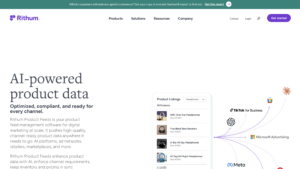
Rithum is an enterprise commerce network that combines product feed software, managed services, marketplace listings, inventory, orders, advertising, and retail operations. Its Product Feeds offering is designed to push channel-ready data to AI platforms, ad networks, retailers, and marketplaces at scale. The platform enriches content with AI, applies channel requirements, and keeps pricing and inventory synchronized with low-latency updates. Automated localization supports language, currency, taxonomy, and regional specifications when brands enter new markets. Rithum also builds compliance alerts, threshold safeguards, outbound-feed analysis, and quality assurance into the managed service. A dedicated feed team handles category mapping, policy issues, and feed-failure monitoring with a stated one-business-day response target. The company sits inside a broader network used by brands and retailers that need product data to support both marketing and commerce operations. That scale makes Rithum most relevant to enterprises whose feed problem is inseparable from marketplace expansion, inventory accuracy, and distributed selling.
Rithum’s model is valuable when a company wants one partner to govern the flow of product data beyond Google Merchant Center. New feeds can launch quickly from a centralized source, while near-real-time updates reduce the risk of advertising or recommending unavailable products. The platform can also test titles, images, descriptions, and categories at the SKU level, then retain winning variants based on measurable uplift. Managed experts give internal teams support for mappings, compliance, quality control, and channel-specific troubleshooting. B2B manufacturers and distributors should map their supplier data, contract rules, product relationships, and marketplace obligations before selecting the full platform footprint. They should also verify which Rithum modules are necessary, because the broader suite may be excessive if the only need is a narrow shopping feed repair. For organizations already expanding through marketplaces or retailer networks, the integrated approach can reduce the handoffs between catalog, media, inventory, and order teams. Rithum is therefore a strong late-list option for enterprise commerce programs that prioritize operational scale and governance over boutique agency attention.
Services: Product Feeds, AI Content Enrichment, Content Transformation, Low-Latency Inventory and Price Sync, Localization, Compliance Monitoring, Feed QA, A/B Testing, Marketplace Listings, Paid Search and Shopping Ads.
Standout Clients: Casando, Cotton On, Stratco.
Best For: Enterprise brands, manufacturers, and retailers that need managed product data across advertising, AI, marketplaces, inventory, and order operations.
Why Choose Rithum:
- Its dedicated feed team adds mapping, compliance, quality assurance, and troubleshooting support to an enterprise-scale platform.
- Its low-latency updates and threshold safeguards help keep pricing, inventory, and channel eligibility aligned across distributed commerce programs.
- Its broader marketplace and operations suite can reduce the number of handoffs between product data, advertising, inventory, and order teams.
What to Consider When Hiring a Product Feed Management Agency
What to Consider When Hiring a Product Feed Management Agency
Start by deciding whether you need feed software, managed feed operations, media strategy, upstream data remediation, or one partner that can coordinate all four. Then ask each agency to show how it would handle the parts of B2B commerce that consumer playbooks routinely miss: part-number and specification search, GTIN and MPN gaps, parent-child relationships, contract or tiered pricing, quote-only products, margin variation, distributor conflict, and catalogs with tens of thousands of SKUs. A serious proposal should define the source of truth, transformation layer, channel outputs, monitoring cadence, ownership model, and escalation path when the feed disagrees with the website or ERP. It should also connect feed changes to measurable outcomes such as eligible revenue, impression coverage, gross margin contribution, qualified RFQs, and product-level conversion rather than celebrating a lower error count in isolation. Review the provider’s channel depth, platform fluency, integration requirements, reporting, and ability to work with Paid Media, SEO, Conversion, Lifecycle Marketing, and Revenue Operations. Most importantly, confirm who will keep improving the system after launch, because a feed that was correct on day one is already aging.
Build a Feed Your Growth Strategy Can Trust
Build a Feed Your Growth Strategy Can Trust
The best product feed management partner makes a complicated catalog easier for platforms to understand, buyers to evaluate, and executives to fund. That requires more than formatting a CSV correctly. It requires a commercial point of view about which products deserve visibility, which attributes matter to procurement, how margin should shape promotion, and where a buyer should go after the click. When those decisions are governed across channels, the feed becomes a shared operating layer for shopping, marketplaces, search, AI discovery, lifecycle campaigns, and sales handoffs.
Directive brings that work into the wider B2B revenue system. We build feed infrastructure around buyer intent and catalog economics, then connect it to paid media, conversion paths, pipeline measurement, and ongoing governance through DiscoverabilityOS™. The goal is not a prettier product export. It is a catalog that earns more qualified visibility and turns it into revenue your leadership team can defend. Explore a partnership with Directive to build the feed foundation your B2B commerce strategy needs.