









Most B2B C-Suites are asking the wrong questions when it comes to their LLM strategies.
“What’s the fastest way to scale our LLM visibility?”
“Can we use AI-generated content to scale faster?”
It sounds like they’re thinking strategically.
They’re not.
Because in 2026, the brands winning in organic search and AI search aren’t relying on a silver bullet, and they’re not choosing between human-generated content and AI-generated content.
They’re asking a different question:
“How do we ensure that our content will actually get surfaced by LLMs?”
If your strategy is built around speed alone, you’re setting yourself up to lose the race.
The Marathon Problem: Why Speed-First Content Strategies Fail
Think about content like a marathon.
Some brands sprint out of the gate:
- Publishing hundreds (or thousands) of AI-generated blogs and articles
- Scaling production at unprecedented speed
- Flooding their site with content with no unique POV
At first this looks like a success:
Tons of content goes live in record time.
Traffic spikes.
Keyword coverage expands.
Visibility increases.
But then, a few months down the line their reporting dashboards tell a different story.
Performance plateaus.
Rankings slip.
Visibility declines.
Third-party citations falter.
Pipeline dries up, and they’re struggling to tell a positive ROI story.
Because they optimized for the first mile as opposed to the full race.
Meanwhile, the brands that win?
Yes, they move fast and scale, but they also sustain performance:
- They build authority with first-party data and unique POVs
- They earn reputable citations and strategically own the full search landscape
- They monitor and maintain rankings and response visibility over time
They don’t just scale content. They scale trust.
We’ve seen this play out firsthand.
In a recent scaled content initiative for our own site, Directive achieved:
- +190% growth in Page 1 keyword rankings (1,152 → 3,337)
- +162% growth in organic traffic
- $2.87M in non-branded revenue generated
This wasn’t driven just by publishing more content faster.
It was driven by aligning human-led content with buyer intent, structuring it for both search and AI visibility, and reinforcing it with authority signals across the ecosystem.
Read the Directive case study here.
How AI-Scaled Content Performs in LLMs and SERPs
There’s a growing perception that AI content creation platforms are the fastest path to growth. However, when you look at actual performance data, the story is more complicated.
Independent studies reinforce this trend. One 16-month analysis of 4,200 articles found that pure AI-generated content ranked 23% lower on average than human-written content targeting the same keywords.
We conducted our own analysis as well. Across several high-growth SaaS brands associated with AI-driven content generation strategies, we observed:
- Declines in keywords ranking in positions 1–3
- Drops in estimated non-brand traffic
- Inconsistent or declining visibility over time
Notably:
- Monday.com saw decreases in top keyword rankings and traffic
- Angi experienced a significant drop in estimated non-brand traffic
- LegalZoom saw organic rankings declined despite an initial spike
Other huge B2B brands like Chime, Sunday, Sprout Social, HubSpot, Notion, and Upwork have all been reported to have invested in AI content workflows and have seen considerable organic ranking declines since April of 2025.
Now, context matters:
- Some brands intentionally prune content and go through content consolidation and rebranding exercises
- Others invest in off-site authority strategies, so while rankings decline, they may have made up for that loss in other channels
But one thing is clear:
AI content alone does not create durable organic growth – it’s not a silver bullet.
The Spike-and-Fall Pattern, Visualized
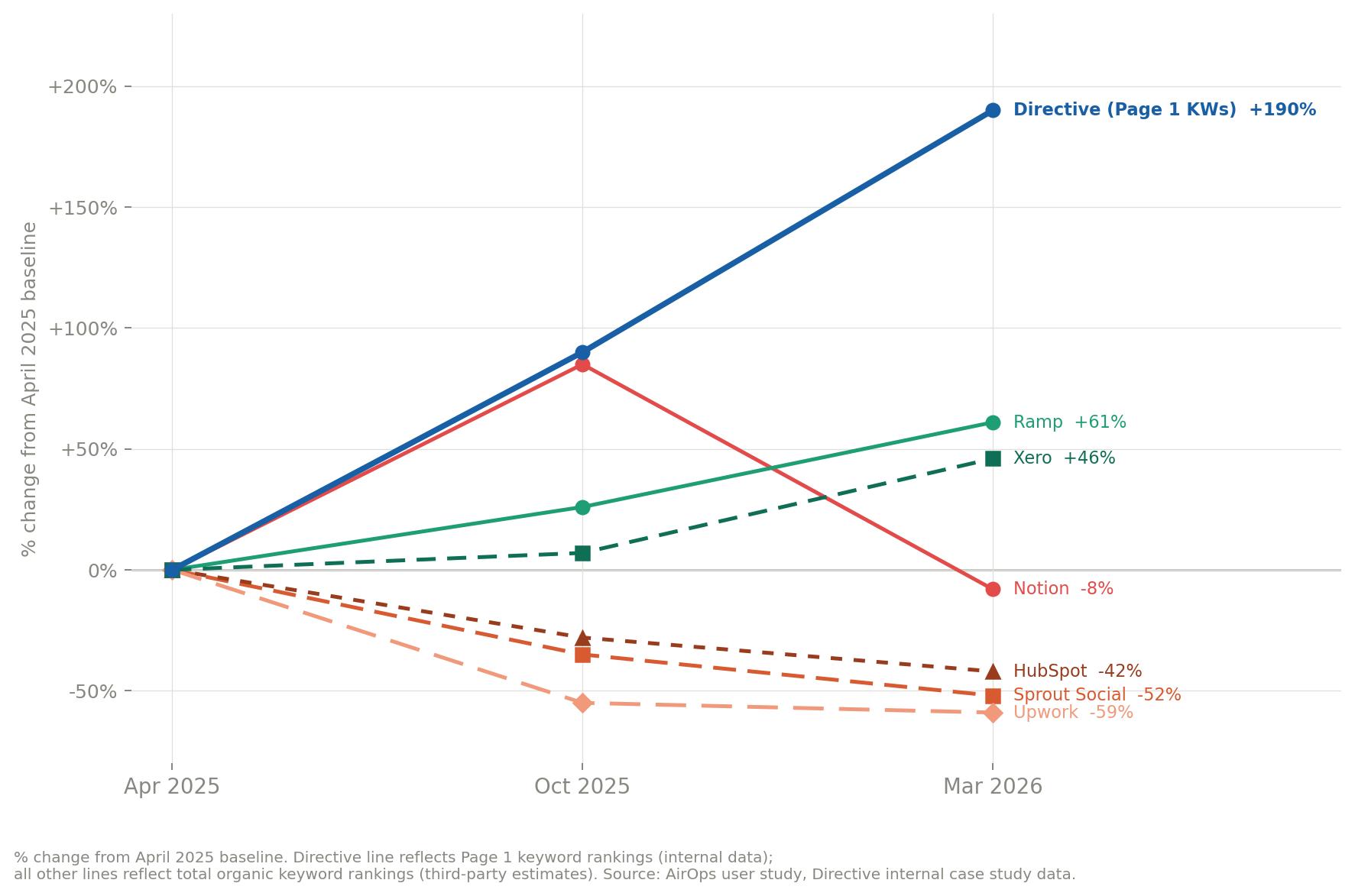
This data comes from a study of 26 brands using AirOps, tracked from April 2025 through March 2026. Everything is indexed to April 2025 so trajectories are comparable regardless of starting scale. Notion’s line captures the pattern most clearly. Rankings nearly doubled by October 2025, then fell below the starting baseline by March 2026. HubSpot lost over 1.27 million keyword rankings across the same period. Sprout Social more than halved. Upwork dropped from 1.9 million to 782,000 ranked keywords.
Not every brand in the dataset declined. Ramp, Xero, and Brex all grew organically through the same window. These are not brands that built authoritative content mapped to buyer intent, backed by strong link profiles and consistent entity presence.
The Directive line sits above all of them. Page 1 keyword rankings grew 190%, from 1,152 to 3,337, generating $2.87M in non-branded revenue. That trajectory held because the content was built for authority, not just visibility velocity.
Let’s Be Clear: AI Content Isn’t the Problem
There’s a lot of bad takes on this topic.
So let’s reset.
AI content is not inherently bad.
In fact, AI can even outperform human content in certain scenarios.
AI content works well when:
- You have high-quality inputs
- You’re solving structured, repeatable problems
- You’re generating supporting or programmatic content
- You’re using it for research, outlining, and synthesis
And here’s the uncomfortable truth:
Great AI content may be better than bad human-generated content.
If a human is producing:
- Generic ideas
- Rewritten content
- No original insight
That content is just as replaceable as AI output. In a world where LLMs synthesize the internet, aggregated, safe and predictable content gets ignored.
Why Human-Generated Content Wins
The highest-performing content today shares a few characteristics:
- It includes proprietary data
- It reflects real-world experience and quotes from SMEs
- It has a clear, differentiated POV
- It makes claims others aren’t making
This is exactly what allows content to sustain performance over time.
In practice, when content includes proprietary insights and is mapped to high-intent search behavior, the impact compounds.
This is where human-led content has a massive advantage. Generally, a human is going to be able to more effectively work these elements into a piece of content more naturally. They can also either speak directly to the subject matter experts who can offer first-party insights or form original opinions themselves.
AI cannot do these things, so they cannot create content with this level of expertise.
Amplifying Authoritative Content with Third-Party Validation
Even with great content and strong content structure, there’s another layer most brands overlook when it comes to scaling their LLM strategy and that is building authority.
LLMs don’t just evaluate your page–they evaluate your presence across the internet.
This includes:
- Quality backlinks
- Brand mentions (Brand articles/resources, Influencers, etc.)
- Media coverage (Third-party articles, podcasts, etc.)
- Community discussions (Reddit, YouTube, Discord etc.)
Entity Mapping: The Hidden Lever Behind LLM Visibility
One of the most overlooked components of AI search performance is entity mapping.
LLMs don’t just evaluate content—they evaluate who is saying it. This means your brand needs to be consistently understood across the web as:
- A specific type of company
- An authority in defined topic areas
- Connected to relevant concepts and categories
Strong entity mapping looks like:
- Consistent brand positioning across your site and third-party sources
- Clear association with priority topics (SEO, GEO, B2B marketing, etc.)
- Alignment between what you publish and how others describe you
When done correctly:
- LLMs recognize your brand faster
- Your content is more likely to be retrieved
- Your authority compounds across channels
When done poorly:
- Your content gets ignored, even if it’s high quality
If LLMs don’t understand who you are, they won’t trust what you say.
Why “Total Search Visibility” Is the Real KPI
If your content strategy is failing, it’s probably a combination of low authority content slop, a lack of authority, and poor entity mapping–all of which is impacting your Total Search Visibility.
Your organic performance, LLM visibility and citation rate, third-party mentions, share of voice across communities, and organic presence all contribute to your Total Search Visibility.
You don’t improve this by throwing money at backlink building or spam-publishing content. It’s about quality outputs then maintaining visibility over time.
This includes:
- Updating content
- Expanding winning topics
- Reinforcing authority signals
- Continuously earning links and mentions
The brands that win long-term aren’t always the ones who start fastest. (Although a little burst of speed can’t hurt, right Vin Diesel?)
The ones that win are the ones who don’t slow down.
So… Human vs. AI Content?
At Directive, we produce human-generated content.
However, we believe in building systems that combine both AI and humans to work together to improve effectiveness and efficiency.
That means:
- Human-led strategy and insight
- AI-enabled efficiency through platforms like Stratos
- Content structured for citation
- Authority scaled and built through digital PR and third-party signals
- Continuous optimization tied to SEO and GEO
Because winning in modern search isn’t just about moving the fastest. It’s about being strong enough to win in the long run. If your content program is scaling but not compounding, let’s talk.