








Key Takeaways
|
Many Software-as-a-Service (SaaS) teams are not necessarily short on channels, campaigns, or growth ideas.
The harder problem is deciding which ones fit the market, the buyer, and the revenue model.
That gap is crucial today. Bain & Company’s B2B Growth Agenda report found that 91% of commercial leaders expect to hit their 2026 growth targets, yet 42% missed their 2025 targets. Confidence is high, but execution is getting harder.
For B2B SaaS teams, the go-to-market (GTM) strategy is where that pressure becomes practical.
It decides who you serve, how buyers should move, what proof they need, and how each team contributes to revenue.
This guide breaks down how to build a B2B SaaS GTM strategy around focus, motion, alignment, and measurable growth. Let’s get started.
What Is a B2B SaaS GTM Strategy? Why Does It Matter for Growth?
A B2B SaaS GTM strategy defines how your company turns market focus into efficient revenue growth.
It connects product, marketing, sales, pricing, and customer success around a specific buyer problem. It also clarifies how the business will reach, convert, retain, and expand the right customers.
But why does it matter for growth?
Growth does not stop at acquisition. Recurring revenue changes the math. Onboarding, product adoption, retention, expansion, and pricing all shape whether the business grows efficiently.
When GTM is unclear, the gaps show up fast:
- Messaging gets broad.
- Channels stop matching the motion.
- Sales and marketing define quality differently.
- Customer success inherits accounts sold on the wrong promise.
A strong GTM strategy should help your team make better decisions about:
- ICP: Which accounts are most likely to convert, stay, and expand?
- Positioning: Why should this buyer care now?
- Motion: Should the path to purchase be product-led, sales-led, or hybrid?
- Messaging: What proof does the buyer need at each stage?
- Pricing and packaging: How should value be bought and expanded?
- Channels: Where will buyers discover, validate, and engage?
- Measurement: Which metrics prove the model is working?
The point is not to coordinate one launch. It is to create a commercial model that your team can continue to use as the market changes.
A clear GTM strategy helps reduce that drift by giving every team the same commercial logic:
- Product knows which problem matters most.
- Marketing knows which pain points and use cases deserve attention.
- Sales knows how to frame value.
- Customer success knows what adoption and expansion should look like.
- Leadership knows which metrics show real progress.
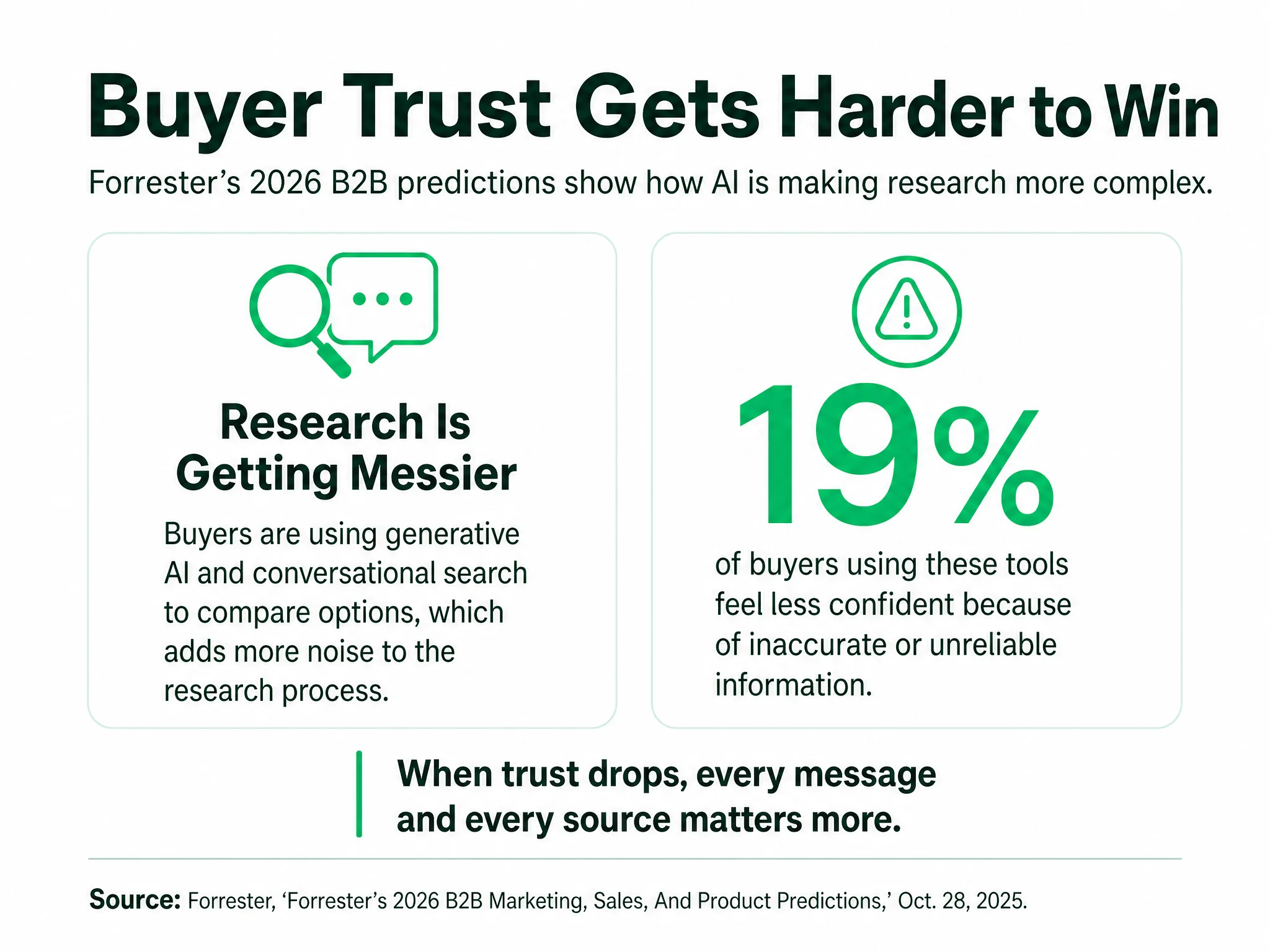
Buyer trust also raises the stakes. Forrester’s 2026 B2B predictions point to a messier research process as buyers use generative AI and conversational search to compare options. Forrester also found that 19% of buyers using these tools feel less confident because of inaccurate or unreliable information.
That makes consistency more important. Buyers need the same story across your website, content, sales conversations, product experience, and customer proof.
| Tip: If buyers are using AI tools to compare options before they reach your site, your content needs to be clear, sourced, and easy to cite. Our LLM, AI, and GEO Strategy Guide breaks down how to build answer-first pages, evidence banks, and citation-ready content clusters. |
What Are the Core Components of a B2B SaaS GTM Strategy?
The best way to think about GTM is as a set of linked decisions, not separate workstreams.
Each choice affects the next one. For example:
- A broad ICP weakens positioning.
- Vague positioning hurts channel efficiency.
- Motion mismatch slows conversion.
- Weak measurement leads to arguments about activity rather than results.
In practical terms, most B2B SaaS GTM strategies come down to a small set of core components.
| GTM Component | Core Question | Why It Matters | Common Risk |
| ICP and Market Focus | Who are we built to win with? | Sets the ceiling for conversion quality and efficiency | Broad targeting that attracts the wrong demand |
| Positioning and Messaging | Why should this buyer care now? | Sharpens differentiation and improves response | Generic claims that sound like every competitor |
| Pricing and Packaging | How should value be bought? | Shapes adoption, deal size, and expansion potential | Packaging that fights the sales motion |
| Motion | How should buyers experience the path to purchase? | Determines sales involvement, onboarding, and proof needs | Product-led or sales-led choices that do not fit reality |
| Channel Mix | Where will buyers discover, validate, and engage? | Supports demand capture and trust building | Too many channels with no dominant growth motion |
| Measurement | What proves GTM is working? | Connects execution to revenue quality and efficiency | Reporting on leads instead of business outcomes |
A strong GTM strategy gives each team a shared way to diagnose the problem before adding more activity.
Which B2B SaaS GTM Strategies Fit Different Growth Motions?
Most SaaS teams choose among 3 broad motions: product-led, sales-led, or hybrid.
The right choice depends on buyer complexity, ACV, onboarding friction, time to value, and the amount of proof the buyer needs before purchase.
Stronger growth is due to flexible GTM models, pricing discipline, and tighter cross-functional coordination.
That is the main point: motion choice is an operating decision, not a trend choice.
| GTM Motion | Best Fit | What It Needs to Work | Common Risk |
| Product-led growth | Lower-friction products with fast time to value | Clear onboarding, accessible pricing, strong activation paths, and in-product proof | Teams assume the product can sell itself before adoption is strong enough |
| Sales-led growth | Higher-ACV deals, complex buying groups, or deeper implementation needs | Strong discovery, business-case content, objection handling, and sales enablement | Sales become too heavy when the product or price point does not need it |
| Hybrid GTM motion | Products where buyers need both product proof and human guidance | Clear handoff rules, intent signals, lifecycle programs, and sales support at the right moments | Self-serve and sales motions compete instead of reinforcing each other |
A hybrid GTM motion is often the most realistic path for B2B SaaS. Buyers may want to explore on their own first, then involve sales when the decision gets more complex.
That choice should shape the rest of your B2B SaaS marketing strategy. Content, paid media, outbound, lifecycle, and onboarding all work differently depending on the motion you choose.
| Tip: Your GTM motion should also shape your content plan. Our playbook for top B2B SEO and content strategies shows how to connect buyer intent, content topics, and CRM impact, so your content supports the pipeline rather than just traffic. |
How Do Strong B2B SaaS Teams Align Execution to the GTM Model?
A GTM strategy only becomes real when execution matches the model on paper.
That means messaging, offers, channels, handoffs, and success metrics should reflect the same buyer, motion, and revenue priorities.
Buyers are doing more research before speaking with sales. Gartner Sales Survey found that 61% of B2B buyers prefer an overall rep-free buying experience. And 73% actively avoid suppliers that send irrelevant outreach.

That raises the bar for relevance long before a seller joins the conversation.
Strong teams turn GTM strategy into coordinated work across content, paid media, outbound, lifecycle, onboarding, sales, and customer success. Each function should reinforce the same commercial model.
Here is what that could look like in practice:
| GTM Area | What Alignment Looks Like | What to Check |
| Messaging | Every channel speaks to the same ICP, pain point, and value story | Do paid, SEO, sales, and onboarding describe the offer the same way? |
| Offers | CTAs match buyer stage, urgency, and motion | Are you asking buyers to book too early or wait too long? |
| Channels | Each channel supports the primary GTM motion | Are channels reinforcing the model or creating random demand? |
| Sales handoff | Sales gets context, intent signals, and clear qualification rules | Do sales know why the buyer raised their hand? |
| Product onboarding | New users reach value in a way that supports the promise | Does onboarding prove the value that marketing and sales sold? |
| Customer success | Adoption and expansion paths match the original use case | Are customers growing from the value they bought first? |
| Measurement | Teams use shared metrics tied to revenue quality | Are teams tracking pipeline, velocity, retention, and payback? |
The goal is not to make every team do the same work. It is to make every team work from the same logic.
- A product-led motion usually needs faster proof, lower friction, and clear activation paths.
- A sales-led motion often requires stronger business case content, objection handling, and stakeholder enablement.
- A hybrid motion needs clean handoffs between self-serve interest and sales support.
That choice should shape the work across the funnel:
- Content should answer the questions buyers ask before they make a sale.
- Paid media should drive the right demand.
- Outbound should reflect the ICP, use case, and buying context.
- Lifecycle should help buyers move without forcing a sales conversation too early.
- Sales should reinforce the same value story buyers saw before the call.
- Customer success should drive adoption tied to the original promise.
When execution lines up this way, GTM stops feeling like separate channel work. It becomes a shared system for moving the right buyers from interest to revenue and expansion.
| Tip: For a closer look at how search and content are changing, our Definitive Guide to B2B SEO and Content Trends explains how to prioritize content bets, match buyer research behavior, and prove SEO impact beyond Google Analytics. |
Common GTM Execution Pitfalls to Watch
Most GTM problems start small. Then they spread across the funnel. Watch for these patterns:
- The ICP keeps expanding. Broad targeting weakens messaging and makes the pipeline harder to qualify.
- The motion does not fit the buying process. A self-serve path can fail when onboarding needs too much support. A sales-led path can feel heavy when buyers want to move faster.
- Channels tell different stories. Buyers lose confidence when paid, SEO, sales, and onboarding frame value differently.
- Sales and marketing define quality differently. Campaign performance becomes a debate when teams do not share pipeline standards.
- Customer success inherits the wrong promise. Retention becomes harder when customers buy into one expectation but experience another.
- Measurement stops at activity. Leads, traffic, and meetings do not prove GTM health on their own.
The fix is usually not more activity. There is tighter agreement on the buyer, motion, promise, handoff, and metrics.
| Tip: If content is one of the places where your GTM message breaks down, the guide 10 B2B Content Marketing Mistakes and How to Avoid Them is a useful gut check. It covers common issues like audience mismatch, weak briefs, poor distribution, and content that does not align with the buyer’s stage. |
Checklist for Evaluating Your B2B SaaS GTM Strategy
Use this as a strategic pressure test, not a scorecard for activity.
- Is your ICP narrow enough to guide real decisions? Your ICP should shape messaging, channels, qualification, pricing, and expansion strategy.
- Can your team explain your differentiation in plain language? If the value story needs too much explanation, buyers will struggle to internalize it.
- Does your GTM motion fit ACV, buyer complexity, and onboarding reality? Product-led, sales-led, and hybrid motions only work when they match how buyers evaluate and buy.
- Does pricing support the way buyers want to evaluate and expand? Pricing should make value easier to understand, buy, adopt, and grow over time.
- Are your channels reinforcing one dominant motion? Paid, SEO, outbound, lifecycle, and partners should support the same GTM logic.
- Do product, marketing, sales, and customer success use the same success metrics? Shared metrics reduce internal debate and make performance easier to diagnose.
- Are you measuring GTM through pipeline quality, CAC, payback, LTV, and conversion? Lead volume can be useful, but it does not prove GTM health on its own.
- Do you know the single biggest GTM bottleneck to fix next? The next move should come from the constraint, not the loudest channel request.
If these questions create more confusion than clarity, the strategy needs work before the channel plan grows.
Build a Stronger B2B SaaS Go-to-Market Strategy with Directive
A strong GTM strategy should show up in how the company operates every week.
It should guide which accounts you prioritize, how you position value, which channels deserve investment, how sales follow up, and how customer success drives adoption.
If execution keeps drifting from the model, the issue is usually not effort. It is a lack of shared commercial discipline.
That is where many SaaS teams get stuck. Product, marketing, sales, and customer success each work hard, but they operate from different assumptions. For example:
- Marketing optimizes for demand.
- Sales optimizes for deal movement.
- Customer success optimizes for account health.
- Leadership tries to connect it all afterward.
A stronger GTM model gives those teams one shared view of the buyer, the motion, the promise, and the metrics. It helps you connect market focus, execution, and revenue outcomes without adding silos.
If your team needs help sharpening positioning, aligning execution, and connecting GTM performance to revenue outcomes, explore Directive’s B2B go-to-market strategy agency approach.
B2B SaaS GTM Strategy FAQs
What Is a B2B SaaS GTM Strategy?
A B2B SaaS GTM strategy defines how your company reaches, converts, retains, and expands the right customers. It connects product, marketing, sales, pricing, and customer success around a clear buyer problem and revenue model.
What Are the Key Parts of a SaaS GTM Strategy?
The key parts of a SaaS GTM strategy are ICP, positioning, messaging, pricing, packaging, motion, channels, and measurement. Each part should support the same buyer, value story, and growth model.
What GTM Motion Is Best for B2B SaaS?
The best GTM motion depends on deal size, buyer complexity, onboarding friction, and time to value. Product-led growth works best when buyers can see value quickly. Sales-led growth fits more complex deals. Hybrid works when buyers need both product proof and sales guidance.
Why Do B2B SaaS GTM Strategies Fail?
B2B SaaS GTM strategies usually fail when teams lose focus. Common causes include a broad ICP, vague differentiation, motion mismatch, weak handoffs, unclear ownership, and disconnected measurement across teams.
How Do You Measure GTM Success in B2B SaaS?
Measure GTM success through business outcomes, not activity alone. Useful metrics include pipeline coverage, CAC, payback period, LTV, conversion quality, sales velocity, retention, and expansion.