







Weekly SEO Metrics: What to Check Weekly (and What to Ignore)
Weekly SEO Metrics: What to Check Weekly (and What to Ignore)
Weekly SEO reporting creates an illusion of control. Dashboards update and numbers fluctuate, leaving B2B teams to operate under the impression that performance is being measured in real time. It’s not. SEO does not operate on a 7-day performance cycle, and Google Search Console is known to lag.
Weekly meetings should focus on protecting growth, not proving it. When teams use weekly data to drive strategy, they often misinterpret directional shifts for trends. This leads to premature strategy adjustments before updates have made a clear impact. Instead, teams can capitalize on weekly meetings as checkpoints to identify and audit key issues to inform future strategy.
By the end of this piece, you will know which metrics deserve week-over-week attention, which can wait, and how to run SEO meetings as operational audits that strengthen strategy and protect pipeline.
How Leading Teams Run Weekly SEO Reviews Without Drowning in Noise
How Leading Teams Run Weekly SEO Reviews Without Drowning in Noise
Weekly reviews should not be a walk-through of every metric on the dashboard. The real work is in isolating outliers and meaningful variances that signal execution gaps, emerging opportunities, or shifts in performance before they compound.
Most teams treat weekly SEO reviews as performance snapshots. That framing limits their value. These meetings should operate as audits built to catch execution gaps, validate what is working, and surface shifts before they compound. The point is not to recap growth. It is to interpret the signals behind the numbers and decide where to intervene early, before a small issue becomes a quarterly setback.
If a weekly meeting doesn’t produce 1-3 actionable next steps with designated owners, it’s theater. This cadence should lay the groundwork for trends to emerge in monthly check-ins and for strategic pivots to take shape in quarterly planning, where patterns in the data generate real insight and metrics shift from performative reporting to meaningful direction.
These meetings work differently depending on content velocity. For high-growth teams, they serve as an early warning system. For smaller teams pushing monthly updates, this cadence may actually be counterproductive.
Weekly SEO Metrics: 4 Functional Budgets
Weekly SEO Metrics: 4 Functional Budgets
Most of the metrics teams review weekly are unnecessary. If a metric moves but does not require immediate action, it’s noise. To combat this, teams should hone in on metrics that can genuinely change in 5-7 days. These should be the focus of action in the next week’s sprint.
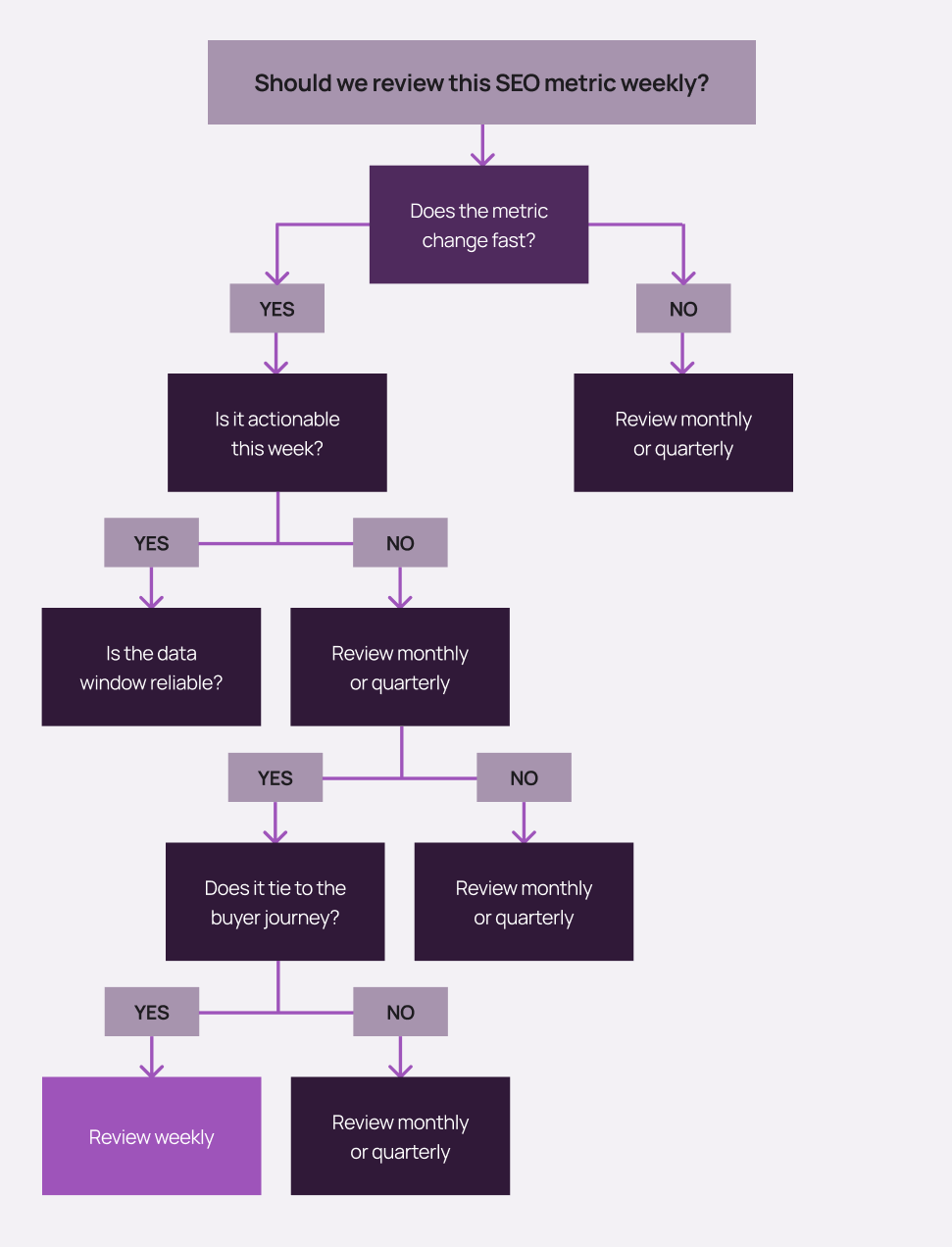
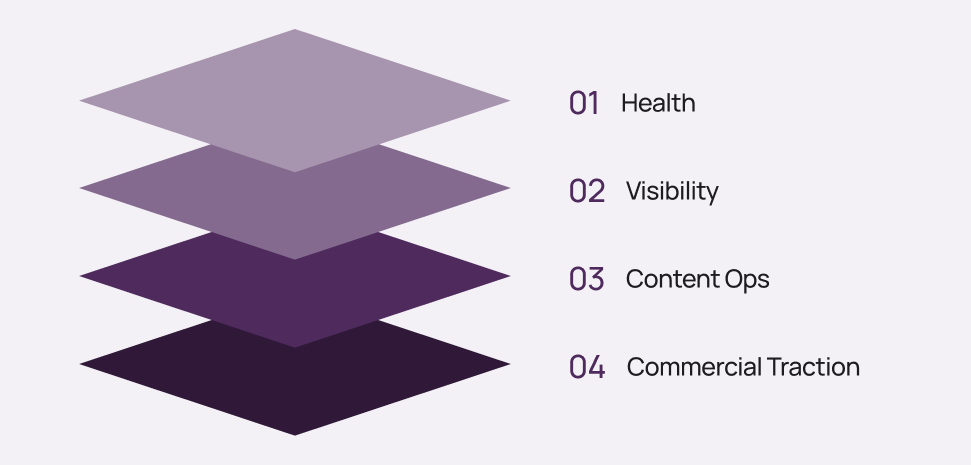
Here are 4 functional buckets that can organize your team’s weekly SEO reporting. While important, not every bucket requires deep analysis every week.
Bucket 1: Early-Warning Visibility Signals (Direction, Not Victory Laps)
Visibility metrics are the leading indicators of search health: look for directional changes, not verdicts.
- Google Search Console performance (Impressions and Clicks): This is your source of truth. To gain an accurate picture, you must analyze the 7-day view against a broader 4-week view. If site impressions have improved but clicks are declining, SERP feature updates or stagnant metadata are working against you.
- Organic click-through rate (CTR): Monitor CTR for your top revenue-driving pages. Even a 2% drop on a high-intent page can be a signal that new SERP updates have changed how organic content is organized, or that a competitor has made updates to their metadata.
- Share of voice: Filter out your brand name to remove PR and awareness driven traffic, and monitor keyword positions to gain clear visibility into your competitive standing.
Bucket 2: Technical and Indexing Health (The Stuff That Actually Breaks Fast)
This is where the “real-time” data actually holds weight. Technical issues can erase months of work in hours if not caught early.
- Index coverage and crawl errors: Use GSC reports to detect sudden spikes in “excluded” pages or 404 errors, which can indicate broken redirects, misconfigured canonicals, or stray no-index tags. The Page Indexing Report shows comprehensive URL status, not just a sample.
-
- Core web vitals: Monitor these to ensure that deployments are not negatively affecting your page performance. If your Largest Contentful Paint (LCP) drops significantly after a release, you need to know immediately.
- Sitemap health: Ensure that Google is successfully crawling your website and fetching XML sitemaps. If the last read date on this report is over 7 days old, you have an indexing issue.
Bucket 3: Operational Inputs (What You Can Control This Week)
In a weekly reporting cadence, focus on validating execution, not obsessing over outcomes.
- Content shipped: Confirm that planned content was published, internal linking is in place, and schema deployed as expected.
- Internal Link Hygiene: Verify that newly published content is successfully linking back to your most high-authority pages.
Bucket 4: Revenue-Adjacent Signals (Leading Indicators, Not Guaranteed Outcomes)
You cannot prove ROI in 7 days. But you can track revenue-adjacent signals to gauge traffic quality, and identify conversion issues early.
- Organic conversions: Ensure high intent pages such as contact forms and demo requests are functioning properly. Sudden drops should be flagged as technical alerts, but a total blackout is a signal of breakage since B2B conversion fluctuates naturally week to week.
- Pipeline attribution: Utilize your CRM to track how many organic search leads have moved to the “opportunity” stage.
- Quality checks: By aligning SEO and Conversion Rate Optimization (CRO) metrics, teams can ensure that search intent aligns with the visitors’ needs.
- The “ignore weekly” list: While important, week-over-week organic sessions, average position of 100s of keywords, and domain authority scores are too noisy or delayed to be meaningful on a 7-day timeline. Save them for monthly or quarterly reviews.
Framework: The Weekly SEO Signal Stack
Framework: The Weekly SEO Signal Stack (Built for Better Decisions)
Adding another dashboard will not create clearer insight or accountability. This framework shows how to run a focused 30-minute weekly SEO check-in that produces decisions.
- Start with data reliability (2 minutes): Don’t waste time on incomplete data. Google Search Console is known to have a 1-5 hour delay on performance reports. Teams can combat this deficit by comparing a rolling 7-day window to the prior 28.
- Run an “error budget” check (8 minutes): Use the next 8 minutes to identify areas of weakness where crawl errors, server issues, and indexing drops could have occurred. This audit is critical as these issues can erase demand capture.
- Validate what you shipped (8 minutes): Ensure that all pages have deployed, internal links were added, redirects behaved, and meta titles were updated as planned.
- Scan priority visibility (8 minutes): Review GSC clicks, impressions, and CTR on a sample of high-authority or top revenue pages. Examine major variances, and push minor shifts to the side.
- Decide and assign (4 minutes): Create a list with 1-3 action items for the next weekly meeting and assign clear owners and due dates. Whatever does not make it on this list will be reserved for the larger monthly meeting.
Understanding SEO Time Horizons
Understanding SEO Time Horizons: What Moves in 7 Days vs. 90+
SEO is not a real-time channel, and treating it like one leads to false urgency. Remember: crawling and indexing take time, rankings fluctuate daily, SERPs change constantly, Google Search Console data has natural lag, some GSC reports sample URLs, and B2B sales cycles are long. Weekly monitoring works when it respects these realities instead of fighting them. Understanding these time horizons can make the difference between a strategy that supports the pipeline and a team that is perpetually trapped making impulsive, low-impact pivots.
- Moves quickly: Technical signals such as index breakages, metadata updates, and server response are the only metrics that truly provide a reliable 7-day feedback loop.
- Moves slowly: Content-led growth metrics will not show reliable performance data for several weeks. Metrics such as non-branded traffic, engagement (clicks and impressions), and keyword position require a waiting period before the data is meaningful.
- Rarely “prove” anything weekly: Commercial impact signals are famously the most delayed. Pipeline and revenue attribution, share of voice and domain-level authority reflect data over months, not days.
Set the Right SEO Metrics Cadence: Weekly vs Monthly vs Quarterly
Set the Right SEO Metrics Cadence: Weekly vs Monthly vs Quarterly
More metrics do not create clarity. Purpose and cadence do. Without them, weekly reporting becomes noise disguised as discipline, and teams end up making critical decisions on signals they do not fully understand.
Match review frequency to the type of decision the team is making: weekly for operational audits, monthly for prioritization, and quarterly for strategy and investment.
| Cadence | Best For | Metrics That Fit | Common Mistake
|
|---|---|---|---|
| Weekly | Monitoring early warning signals for operational or technical issues | GSC clicks/impressions/CTR (directional), indexing/crawl issues, content shipped, key page regressions | Mistaking weekly data as real-time, and adjusting strategy based on variance |
| Monthly | Validating trends and identifying directional shifts | Non-branded traffic trends, conversion rate, assisted conversions, top landing pages, content decay/refresh needs | Adjusting strategy based on potential algorithm updates or seasonal trends |
| Quarterly | Evaluating strategy, informing investment decisions, and forecasting | Share of voice vs competitors, pipeline influence, topic expansion performance, authority growth | Granular sprint updates, and using macro data to micromanage weekly tasks |
The Failure Modes of Weekly SEO Reporting
The Failure Modes of Weekly SEO Reporting (and How to Fix Them)
Most B2B teams do not need more dashboards, and not all KPIs need weekly review. When weekly reporting fails, it leaves teams vulnerable. Teams must identify these 4 common failure modes of weekly SEO reporting before they become standard operating procedure.
- Failure mode: “Rankings as a scoreboard.” Fix: Use rankings as a diagnostic report. Curate weekly tracking to a small set of BOFU terms that are directly tied to primary revenue pages. If you notice a drop, investigate the SERP intent before adding more backlinks.
- Failure mode: “Traffic whiplash.” Fix: Use weekly reviews to detect irregularities caused by code deployments and migrations, and identify trends in non-branded search terms. If you are unable to tie a shift in traffic to a specific action, you’re dealing with noise.
- Failure mode: “No owners, no actions.” Fix: Close every weekly meeting with 1-3 clearly assigned action items. If the site is healthy and the data is stable, do not manufacture unnecessary work.
- Failure mode: “Siloed measurement.” Fix: Integrate CRO and RevOps signals to ensure search is contributing to customer generation, not just clicks.
For a deeper breakdown of which SEO metrics drive revenue outcomes, see our guide on top SEO KPIs.
Where Directive Fits: DiscoverabilityOS™ and Customer Generation
Where Directive Fits: DiscoverabilityOS™ and Customer Generation
FAQs: Weekly SEO Metrics
FAQs: Weekly SEO Metrics
What is weekly SEO reporting?
Weekly SEO reporting is a high-level check-in focused on detecting technical issues before they become quarterly problems. It is used to identify shifts in visibility and ensure execution is aligned with strategy.
How often should you check SEO metrics?
Weekly check-ins are a necessity for websites undergoing frequent updates. These should be used to check for technical or operational issues. Monthly reviews should focus on validating trends, and quarterly meetings should be used to evaluate strategy and inform investment decisions.
Why do Google Search Console metrics sometimes look “behind”?
Google Search Console is known to have a natural lag of between 1-5 hours for smaller data sets and up to 48 hours for full data. Some reports also rely on a smaller sample of URLs as well meaning that the most recent data may be incomplete.
Which SEO metrics are most likely to mislead weekly?
Higher volatility metrics such as “average position” and total organic sessions are known to fluctuate due to seasonal trends or temporary algorithm changes without reflecting actual business health. Make note of them for future context, but ignore them for weekly decision making.
How long does SEO take to show results?
SEO growth does not happen overnight. For most brands, meaningful ranking shifts and pipeline growth can typically take between 3 and 6 months. Weekly monitoring sets a precedent for progress, but does not guarantee growth.
Move Beyond Manual SEO Reporting With Directive
Move Beyond Manual SEO Reporting With Directive
At Directive, we specialize in helping teams build systems around how SEO drives revenue, not performative metrics. This means your team saves time by focusing efforts in the right place at the right time, transforming reporting sessions into something your team actually acts on. By focusing on the tiered reporting cadence, CRM and analytics alignment, and modern discoverability, we help teams build SEO programs that scale.
If you’re ready to stop chasing vanity wins and start driving real pipeline results, the next step is to understand the best SEO metrics to tie search performance to your bottom line.
Ready to turn your SEO into a revenue engine? Let’s build a strategy that scales.