








Key Takeaways
|
Do Google Ads work for B2B in 2026?
Yes, but only when campaigns are built around real buying intent, strong conversion paths, and CRM-connected measurement.
Google Ads can become expensive quickly, especially when using broad keywords, having weak landing pages, or lacking proper tracking. This turns paid search into a lead-volume game.
For B2B marketing, the better question is whether your offer, audience, keywords, landing pages, content, and sales process can turn paid intent into a qualified pipeline.
To help with this, we’ve compiled the latest statistics and benchmarks to analyze Google Ads adoption, spend, performance, buyer behavior, and lead generation in 2026.
Here’s a quick overview of these findings before we explore them in more detail.
| Adoption and Spend Stats | Performance and Buyer Behavior Stats |
| U.S. internet ad revenue reached $294.6B in 2025, with search holding the largest share at 38.8% (IAB/PwC) | Google Search paid clicks rose 6%, while CPC rose 7% in 2025 (Alphabet). |
| Digital channels accounted for 61.1% of total marketing spend in 2025 (Gartner). | One B2B tech cohort saw a 237% increase in ROAS in 2025 (Directive). |
| Paid online channels accounted for 69% of digital spend in 2025 (Gartner). | Performance Max improvements increased conversions and conversion value by more than 10% (Google) |
| Paid search was the leading digital channel, accounting for 13.9% of digital spend in 2025 (Gartner). | Demand Gen saw a 26% YoY increase in conversions per dollar spent, and Google blocked/removed more than 8.3B ads in 2025 (Google) |
| More than 75% of marketers plan to maintain or increase search/display ad investment in 2026 (HubSpot). | B2B buyers use an average of 10 interaction channels during the buying journey (McKinsey). |
| Google held 85.23% of the U.S. search engine market share in April 2026 (Statcounter) | AI Overviews appeared on 15.69% of tracked queries in November 2025 (Semrush). |
| 19% of buyers using AI applications feel less confident due to inaccurate information (Forrester). |
Do Google Ads Work In 2026 For B2B Marketing? Adoption and Spend Stats
1. Google Ads Still Holds Commercial Weight for B2B Marketers
Google Ads remains a major part of a growing paid media market, with continued investment signaling that the channel still has buyer attention, budget, and commercial value.
That does not mean every B2B company should blindly increase spend. Performance depends on whether Google Ads can capture meaningful demand, generate qualified pipeline, and support the wider revenue strategy.
The following adoption, spend, and performance statistics show where Google Ads stands in 2026 and what the data actually means for B2B marketers.
2. U.S. Internet Ad Revenue Reached $294.6B
- IAB/PwC’s 2026 report found that U.S. internet advertising revenue reached $294.6B in 2025, up 13.9% YoY. Search held the largest share of that revenue at 38.8%, which puts U.S. search ad revenue at roughly $114.3B.
- Digital ad competition continues to grow, and search remains one of the clearest channels to capture active demand. The priority should be whether campaigns are focused on high-intent queries, strong landing pages, and pipeline-connected measurement.
3. Digital Channels Accounted for 61.1% of Total Marketing Spend
- Gartner’s 2025 CMO Spend Survey found that digital channels accounted for 61.1% of total marketing spend. The survey included 402 CMOs and marketing leaders across North America, the U.K., and Europe.
- For B2B teams, Google Ads should be evaluated as part of the larger digital growth mix. It cannot sit in a separate PPC silo. Its value depends on how well it connects to content, sales, lifecycle, and revenue reporting.
4. One B2B Tech Cohort Saw a 237% ROAS Lift
- Directive’s 2025 ROAS benchmark analysis found that one B2B tech cohort saw a 237% ROAS lift by aligning creative, targeting, and budget sequencing to intent signals. The analysis covered 1,200+ B2B campaigns across tech, SaaS, and manufacturing.
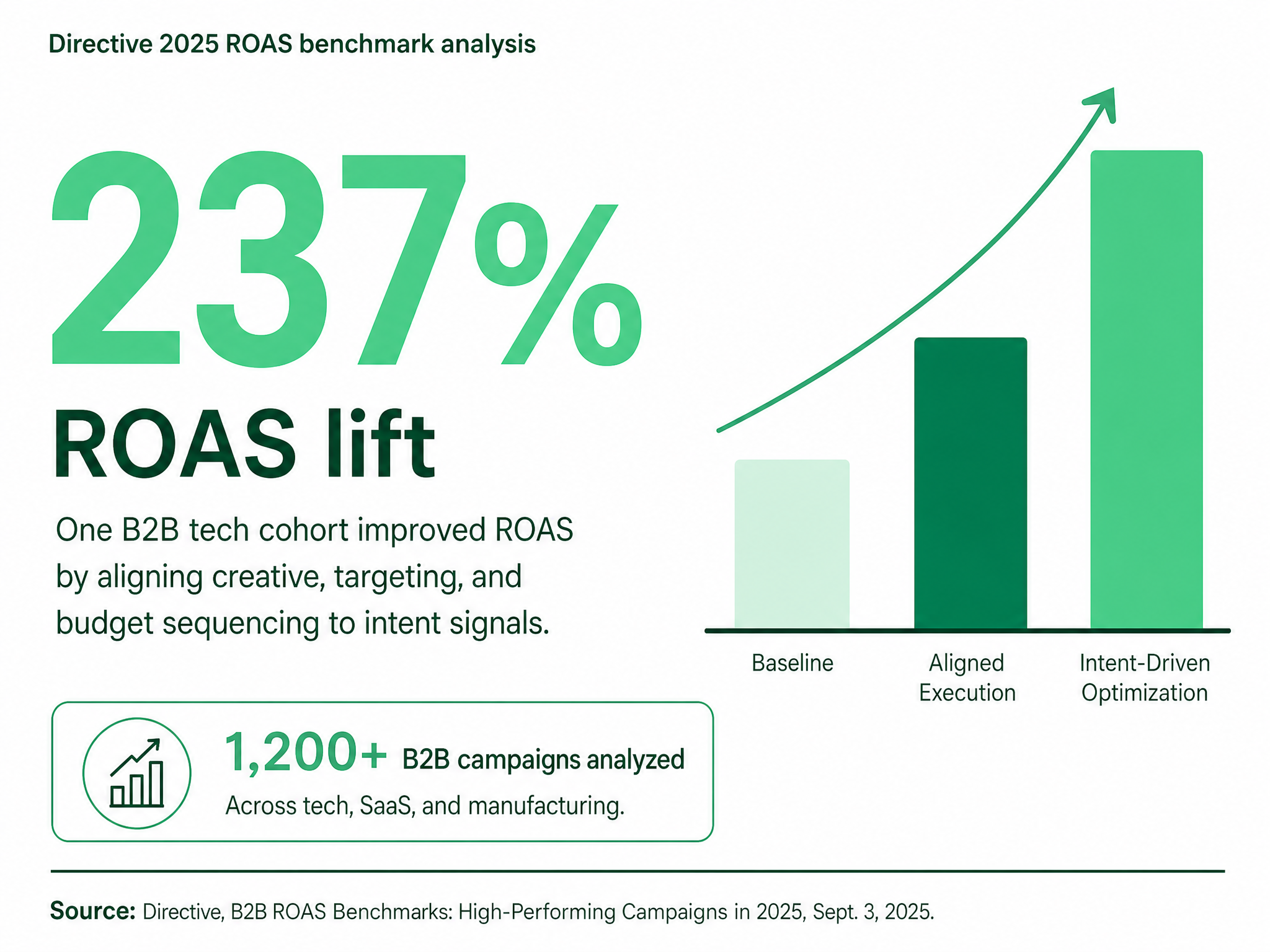
- This first-party analysis shows that paid performance can improve when teams connect strategy, targeting, creative, and budget decisions. Treat Google Ads ROI as an operating problem, not just a bidding problem.
5. Paid Online Channels Accounted for 69% of Digital Spend
- The same Gartner’s 2025 CMO Spend Survey found that paid online channels accounted for 69% of total digital spend in 2025. That share indicates where budget pressure is heading.
- Paid channels are still getting serious investment, but that also raises the bar for proof. Teams need clear rules for when campaigns earn more budget and when spending should pause.
6. Paid Search Was the Leading Digital Channel at 13.9% of Digital Spend
- Gartner’s 2025 CMO Spend Survey also found that paid search was the leading digital channel, increasing from 13.6% to 13.9% of total digital spend.
- That makes paid search a major budget line, not a side test. For B2B teams, the mistake is often measuring only by CPC or form fills. Paid search should be judged by lead quality, opportunity creation, CAC, and sales velocity.
7. More Than 75% of Marketers Plan to Maintain Search/Display Investment
- HubSpot State of Marketing Report (2026) found that over 75% of marketers plan to increase or maintain investment in search/display ads in 2026. HubSpot also reports that almost 27% currently use search/display ads as part of their marketing strategy.
- Competition is not going away. B2B teams should expect more pressure on keywords, audiences, and landing-page performance. The teams that win will usually have stronger qualification rules and better post-click experiences.
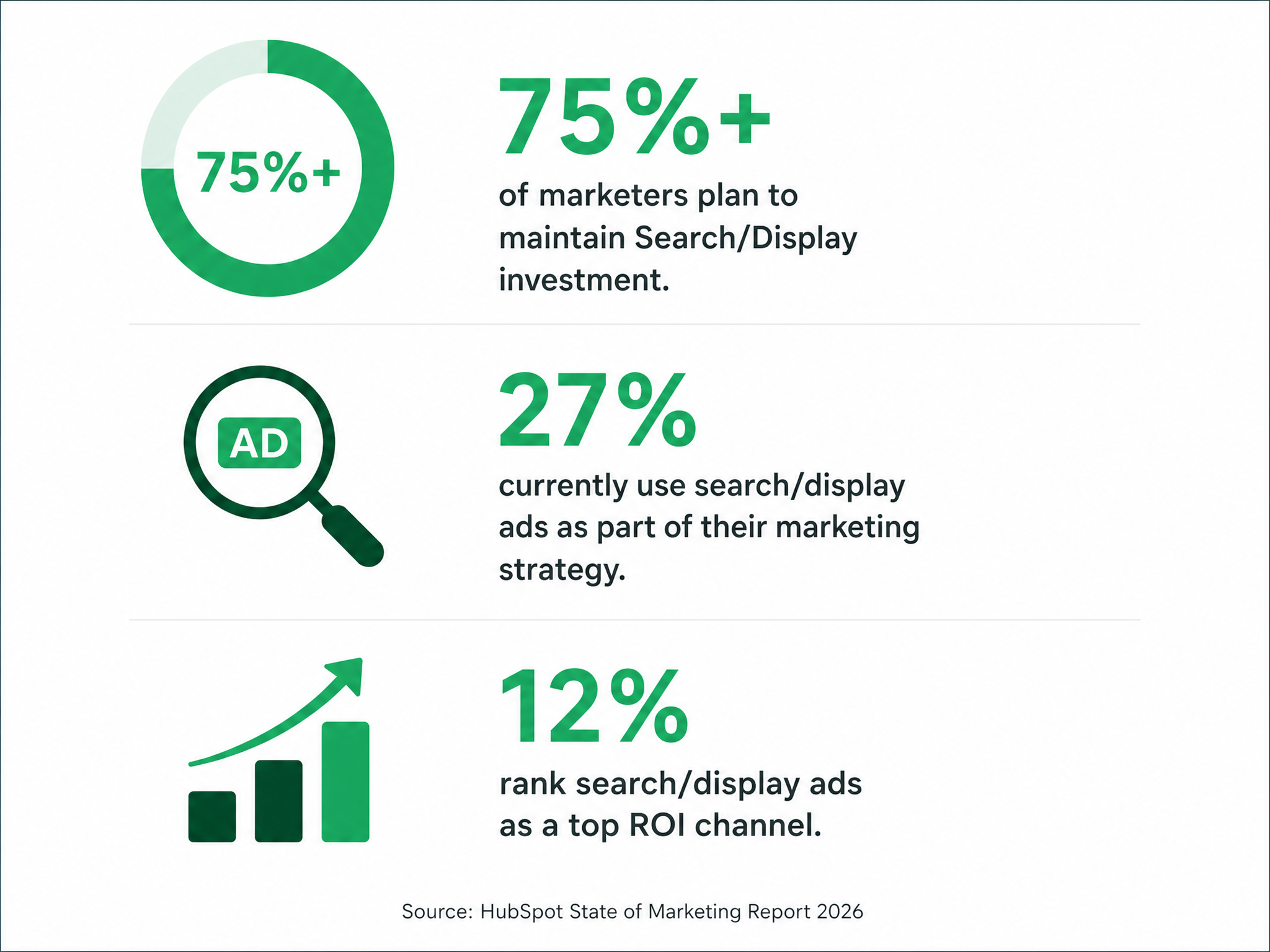
8. Search/Display Ads Rank as a Top ROI Channel for 12% of Marketers
- In the same report, HubSpot found that 12% of marketers name search and display ads among their highest ROI-driving channels. It also notes that marketers see search/display as a strong fit for segmentation and personalization.
- This is a useful reality check. Google Ads can work, but it is not automatically the best channel for every company. Strong results depend on offer fit, keyword intent, sales follow-up, and attribution.
9. Google Held 85.23% of the U.S. Search Engine Market Share in April 2026
- Statcounter shows Google held 85.23% of the U.S. search engine market share in April 2026. Bing followed at 9.76%.
- Takeaway: For B2B marketers, Google still deserves a central role in search capture. But that does not mean every dollar belongs there. Use Google to capture high-intent demand, then test other channels where buyers research, compare, and validate.
Do Google Ads Work for B2B Lead Generation? Performance and Buyer Behavior Stats
Google Ads can work for B2B lead generation, but dashboard metrics rarely tell the whole story.
CPCs can rise while the pipeline stays steady. CTR can decline as buyer research shifts toward AI summaries, review sites, and longer decision paths.
That is why performance needs to be judged against lead quality, sales acceptance, pipeline influence, and revenue.
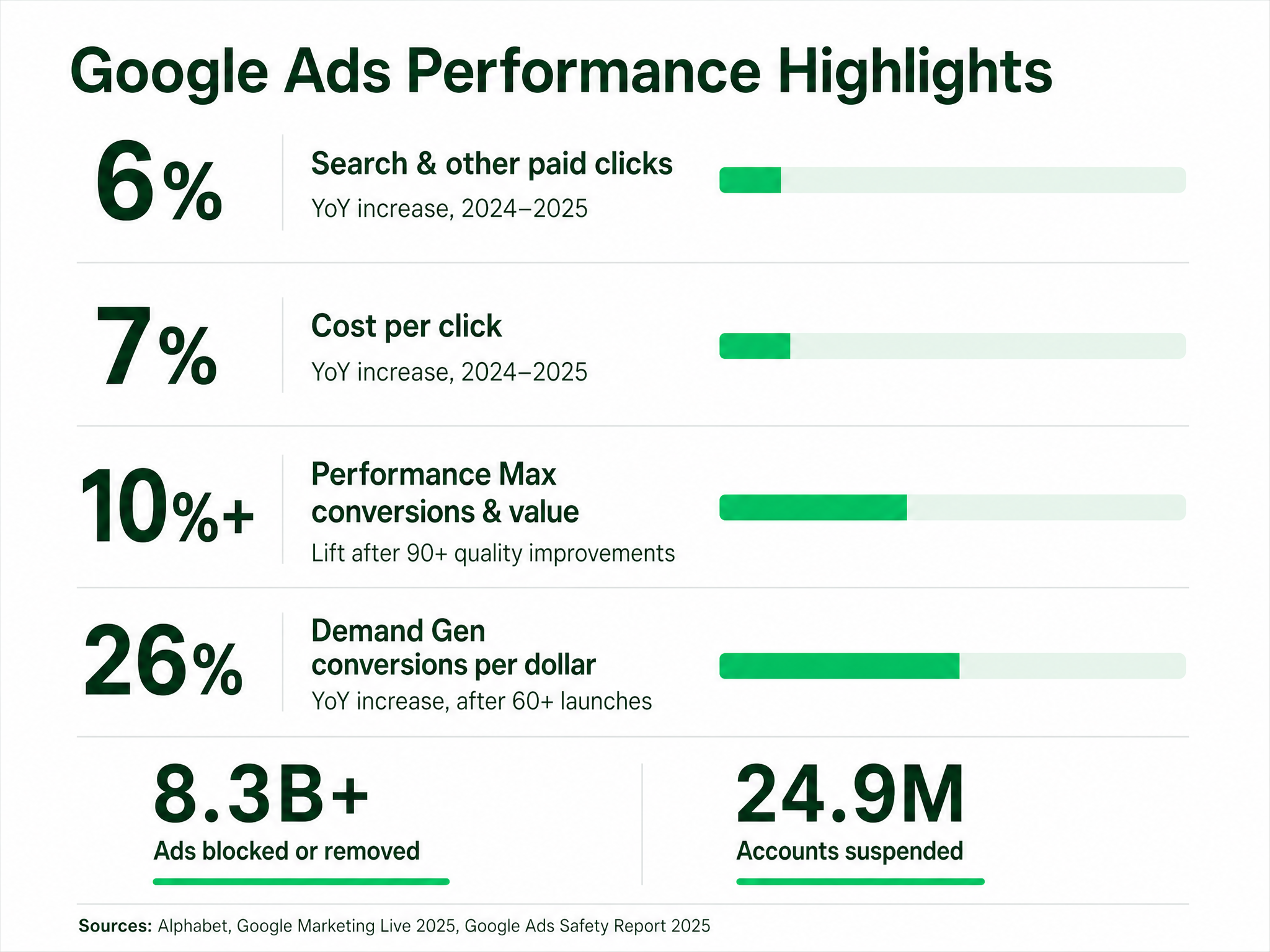
Google Search Paid Clicks Rose 6%, While CPC Rose 7% in 2025
- Alphabet reported that Google Search & other paid clicks increased 6% from 2024 to 2025. Cost per click increased 7% during the same period. Alphabet also notes that CPC changes can be affected by advertiser competition, product changes, device mix, geography, and other factors.
- Takeaway: Rising CPCs do not automatically mean Google Ads is failing. They mean teams need tighter targeting, better conversion paths, and revenue-connected measurement.
Performance Max Quality Improvements Increased Conversions by More Than 10%
- Google launched 90+ quality improvements to Performance Max campaigns, increasing conversions and conversion value by more than 10% for advertisers. Google also added more reporting controls, including channel-level performance and search term visibility.
- Takeaway: Automation can improve performance, but B2B teams still need visibility. Use Performance Max only when conversion goals, exclusions, creative, and CRM feedback are clean.
Demand Gen Saw a 26% Increase in Conversions per Dollar
- At Google Marketing Live 2025, Demand Gen reported a 26% year-over-year increase in conversions per dollar spent across goals, including purchases and leads. The lift came from 60+ launches, including AI-powered improvements to ramp time, bidding, and other updates.
- Takeaway: Demand Gen can support lead generation beyond search, but it needs strong creative, audience signals, and measurement tied to pipeline quality.
Google Blocked or Removed More Than 8.3B Ads in 2025
- Google’s 2025 Ads Safety Report stated that it blocked or removed 8.3B+ ads and suspended 24.9M accounts. Google also says its systems caught more than 99% of policy-violating ads before they served.
- Takeaway: Ad quality and trust are part of performance. B2B teams should keep claims accurate, landing pages transparent, and account setup compliant.
B2B Buyers Use an Average of 10 Interaction Channels
- McKinsey’s 2024 B2B Pulse found that B2B customers use an average of 10 interaction channels in their buying journey. It also found that buyer preferences split roughly in thirds across in-person, remote human, and digital self-service interactions.
- Takeaway: Google Ads may influence the pipeline even when it does not get full credit. Use multi-touch reporting, CRM stages, and an assisted pipeline to evaluate impact.
AI Overviews Triggered on 15.69% of Tracked Queries in November 2025
- Semrush analyzed 10M+ keywords and found that Google AI Overviews appeared on 15.69% of tracked queries in November 2025. The share peaked at 24.61% in July 2025, then settled lower later in the year. Semrush also found that AI Overviews expanded beyond informational searches, with commercial, transactional, and navigational queries all growing since October 2024.
- Takeaway: Lower CTR does not always mean lower buyer interest. AI Overviews are changing where buyers get answers, so B2B teams need ads, landing pages, and organic content that makes proof easier to validate, or content designed to make proof easy to validate.
19% of Buyers Using AI Applications Feel Less Confident Due to Inaccurate Information
- Forrester’s 2026 B2B predictions found that 19% of buyers using generative AI and conversational search tools feel less confident in their purchase decisions because of inaccurate or unreliable information.
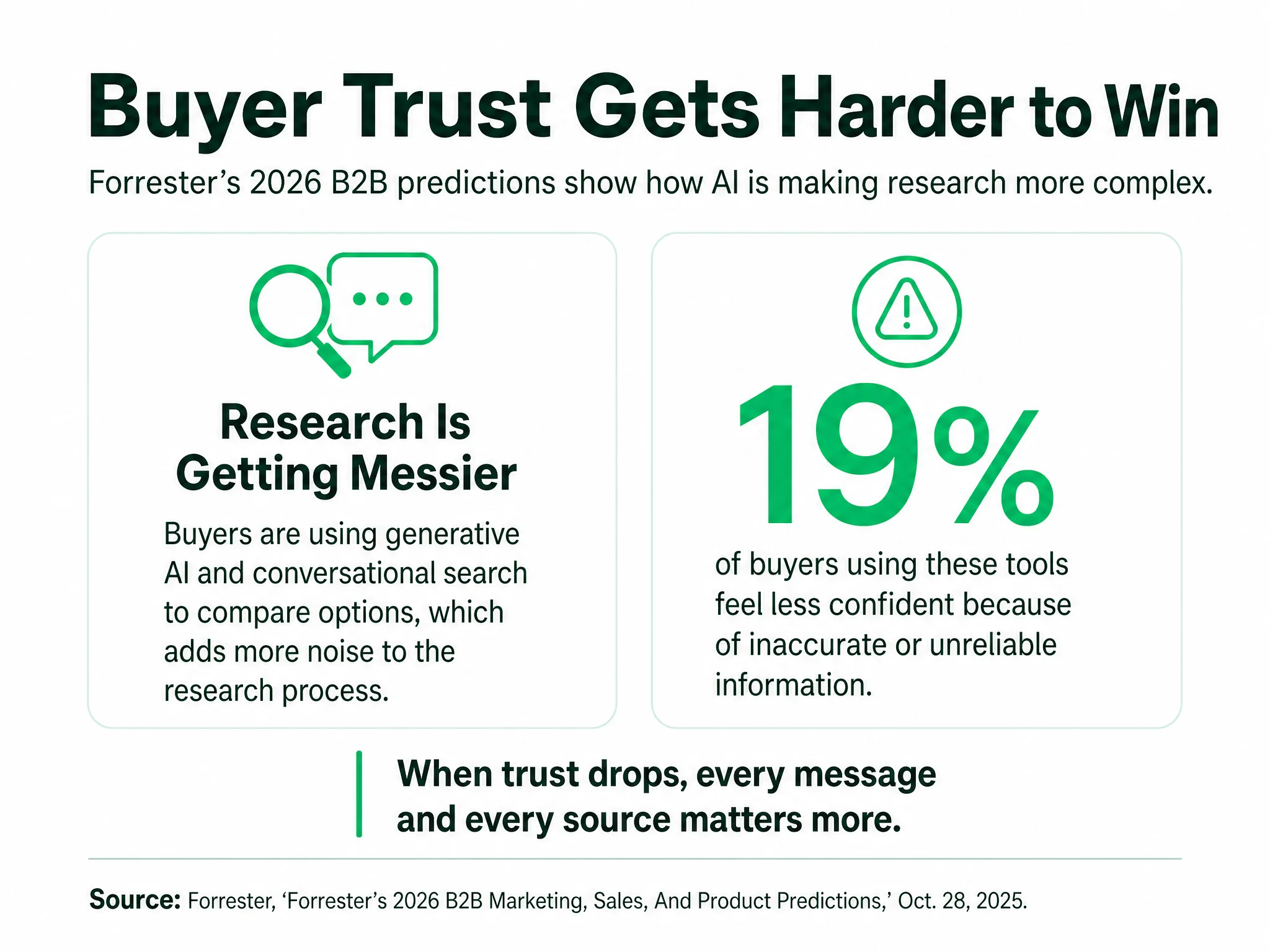
- Takeaway: AI search is creating faster research paths, but not always more confidence. B2B teams should make claims clear, sourced, and consistent across ads, landing pages, sales assets, and comparison content.
Make Google Ads work for B2B with Directive
If your Google Ads program is getting clicks but not enough qualified pipeline, the next step is a harder look at measurement.
Review which campaigns drive sales-accepted leads, which landing pages convert the right buyers, and where paid intent drops before revenue.
A pipeline-focused plan should connect keywords, offers, CRM data, landing pages, and sales feedback. That is how you move past surface-level performance and see where Google Ads can actually grow.
Explore how a b2b google ads agency can help you build a paid search plan tied to the pipeline, not just clicks.
Do Google Ads Work FAQs
Do Google Ads Work for B2B?
Yes, Google Ads can work for B2B when campaigns target real buying intent. Lead generation works best when your offer, landing page, and qualification process match the searcher’s stage.
How Much Should a B2B Company Spend on Google Ads?
Start with your sales-accepted lead goal, then work backward. Divide that goal by your expected lead-to-SAL rate and landing page conversion rate, then multiply the required clicks by your expected CPC.
For example, if you need 20 sales-accepted leads, expect a 50% lead-to-SAL rate, a 5% landing page conversion rate, and a $10 CPC, you would need about 800 clicks and an $8,000 test budget. Of course, this is just an example, and every campaign is different.
For more planning guidance, use these B2B Google Ads best practices to pressure-test campaign setup.
How Long Does It Take for Google Ads to Work?
Google Ads usually needs enough time and conversion data to exit the learning period and stabilize. Frequent changes to budgets, bids, targeting, or conversion goals can reset learning and delay useful performance signals.
Why Are Google Ads Leads Low Quality in B2B?
Low-quality B2B leads usually come from broad-match drift, weak negative keyword lists, vague offers, or landing pages that do not qualify for intent. Poor CRM feedback can worsen the problem because campaigns keep optimizing for form fills rather than sales-ready opportunities.
What Is Google AdWords?
Google AdWords is the former name for Google Ads. The platform was renamed in 2018, but many marketers still use the old term when searching for what Google AdWords is.